

27 So Far This Month and Keep Counting: October Marks Highest Number of Strait of Hormuz Attacks
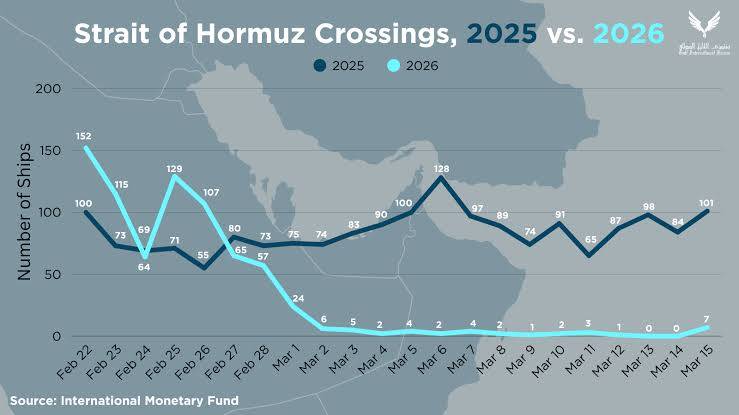

NEW YORK — October has had the highest number of ship attacks since the war between Iran and the U.S. began in late February.
There have been 27 attacks on commercial ships so far in October, according to the International Maritime Organization. There were 22 in March, as well as attacks on an offshore rig and two tugs, according to a list of attacks compiled by USNI News.
Despite the number of attacks, ships are continuing to sail through the strait. There were 104 non-Iranian-linked vessels that sailed through between Oct. 5-11, during which there were 12 attacks, according to data from London-based maritime intelligence firm Lloyd’s List. Of those, six occurred on Oct. 11, according to the IMO.
Transits did fall, going from 126 the week prior. However, transits between Oct. 5-11 were still 31 percent higher than August’s weekly average, according to Lloyd’s List.
While Iran is at fault for the majority of attacks, the U.S. has disabled a number of ships as part of its two-part blockade.
Iran is not going after specific ships, Noam Raydan, a senior fellow at The Washington Institute for Near East Policy, told an audience at Lloyd’s List Outlook Forum on Wednesday in New York. But Iran does not have to hit every ship or a specific company to keep the risk high, Raydan said.
“The aim is to hit as much as they can and make sure that they keep the southern route appear very unsafe and keep the risks very high,” Raydan said.
To achieve that goal, Iran can hit one or two ships, hail another one and make them turn around or keep another in the Persian Gulf. That all keeps the risks high for vessels, she said.

Raydan said she considers October’s number of attacks as evidence of what Iran can still do eight months into the war.
“And I believe they are conserving some of their cards or energy for a future conflict in the region,” she said.
Iran doesn’t need a nuclear weapon to have leverage, Joshua Tallis, a naval analyst with CNA, said during the forum. Instead, Iran can use the Strait of Hormuz as a negotiating tool.
The strait gives Iran a lever to pull with smaller moral and social costs than a nuclear weapon, and that was something the U.S. and Iran learned as a result of the war, he said.
“There’s no way of putting that cat back in the bag,” Tallis said.
Iran is fighting an economic war with the U.S. by attacking ships in the Persian Gulf and Strait of Hormuz, which drives up the prices of diesel and other refined oil products like gasoline. Iran knows that the US is facing a midterm and the Middle East country wants to keep those prices up in order to ship voters against the Trump administration, Tallis said.
“What Iran is trying to do is shape market behavior, to drive costs up, to put pressure on – predominantly – the United States because the U.S. is going to be more cost sensitive, particularly in the run to earn election, where it turns out Midwestern voters care a lot about the price of diesel,” he said.
There are no alternative routes from the Strait of Hormuz in terms of moving the same amount of oil, Tallis said. While Saudi Arabia did shift to a pipeline that uses the Red Sea as a port, Saudi Arabia had to stop using the route due to Houthi attacks.
The pipelines are going to be just as vulnerable as ships, Tallis said, noting that the use of cheap one-way attack drones pose a problem for land structures as much as they do for vessels on the water.
“At the end of the day, I think Iran has ratcheted the pressure up so high that it’s actually shifted the entire market incentive for commercial operators. They are now willing to take risks,” Tallis said. “The question is how much more do they need to strike?”
The U.S. reinstated its blockade on ships traveling to and from Iranian ports in July, using warships to disable tankers that violate it. The Navy has also used air defense over the Strait of Hormuz to protect commercial ships from being targeted by Iranian projectiles.

To support U.S. operations against Iran, the Navy has maintained a two-carrier presence in the Arabian Sea for six months, according to the USNI News Fleet and Marine Tracker. Additionally, an Amphibious Ready Group embarked with a Marine Expeditionary Unit has been on station in the Middle East since early March, and more than a dozen independent deployers have surged to the region.

The U.S. can continue to hold its blockade indefinitely, Tallis told the audience. For the U.S. it is not the immediate cost that they need to be considering, but rather the long-term effect of using so many ships in the Middle East.
Every ship that has multiple extensions will require more maintenance when it returns, affecting maintenance cycles and when the ship might be ready to sail again. The U.S. is also pulling ships from the western Pacific to meet the needs in the Middle East, which affects potential future conflicts, Tallis said.


- Previous India is getting nervous and jealous – Maldives entering Pak orbit: Muizzu signs defence deals, calls for Saarc revival
- Next South China Sea flash and clash point: Chinese Navy Shadows USS Charleston Near Contested Sabina Shoal
You may also like...






Random news












About us
Our Newly established Center for study of Asian Affairs has
branches in Indonesia, Malaysia and Singapore, as well as freelances in some other countries.
For inquires, please contact: newsofasia.info@yahoo.com Mr.Mohd Zarif - Secretary of the Center and administer of the web-site www.newsofasia.net
Polls
 Loading ...