

Singapoor’s view: “Push and pull for S-E Asia as China counters Malaysia’s US trade deal with own pact”
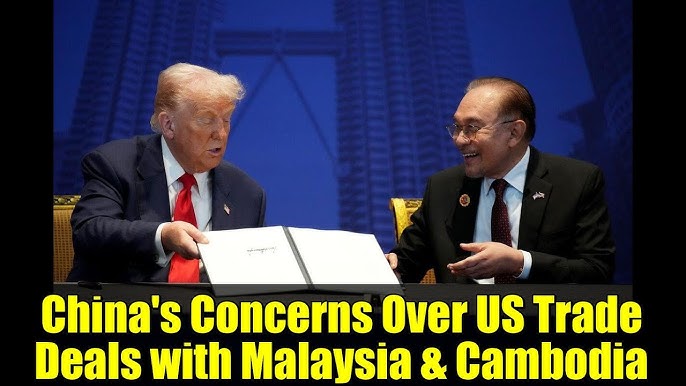
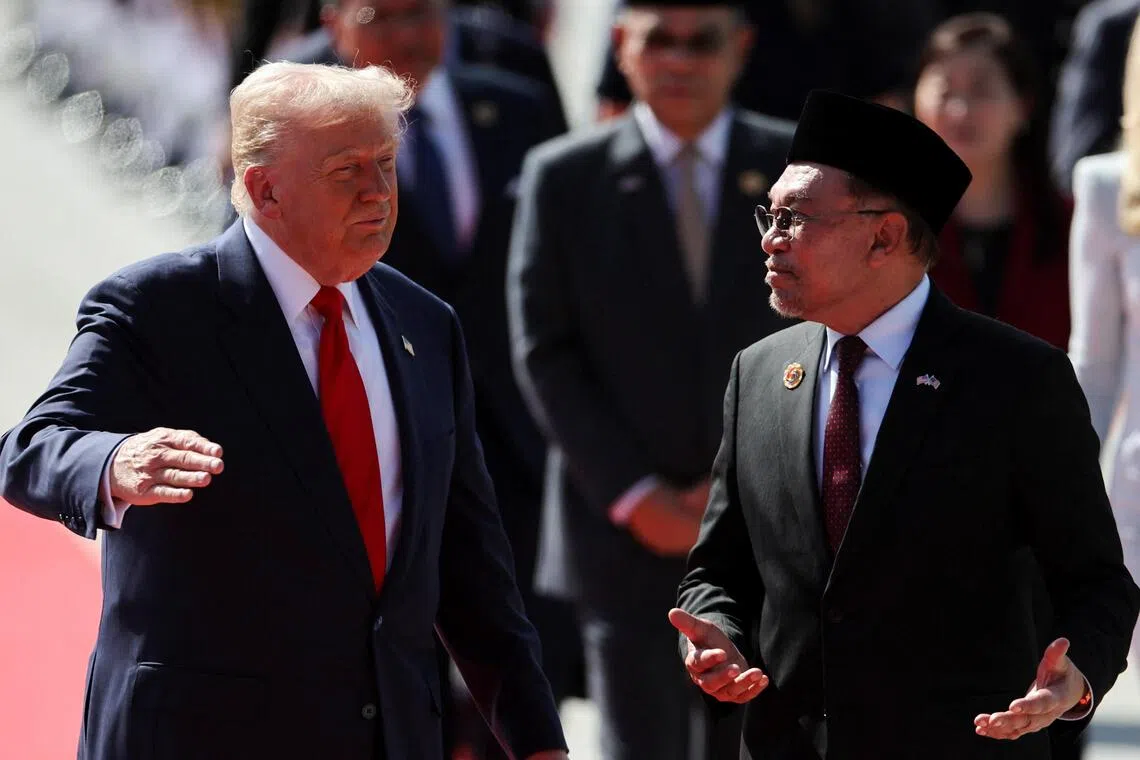
US President Donald Trump talking to Malaysian Prime Minister Anwar Ibrahim as he arrived at Kuala Lumpur International Airport on Oct 26 for the ASEAN summit.
PHIOTO: REUTERS
- China proposed a trade MOU with Malaysia after expressing concerns about Malaysia’s trade agreement with the US, fearing preferential treatment.
- Malaysia and Cambodia are pressured by both the US and China, particularly regarding clauses aligning them with US trade restrictions on sensitive technologies.
- Indonesia resists US demands in their trade deal, specifically regarding the use of Chinese shipping carriers due to increased costs.
KUALA LUMPUR – Malaysia is seeking to pacify China by exploring a new memorandum of understanding (MOU) that the latter proposed in the wake of a controversial trade treaty Malaysia signed in October with the United States.
Just days after Beijing raised “grave concerns” over Kuala Lumpur’s agreement with Washington, Malaysia’s Investment, Trade and Industry Minister Tengku Zafrul Aziz said on Dec 2 that the proposed deal with China would cover “strategic sectors” between the two trading partners.
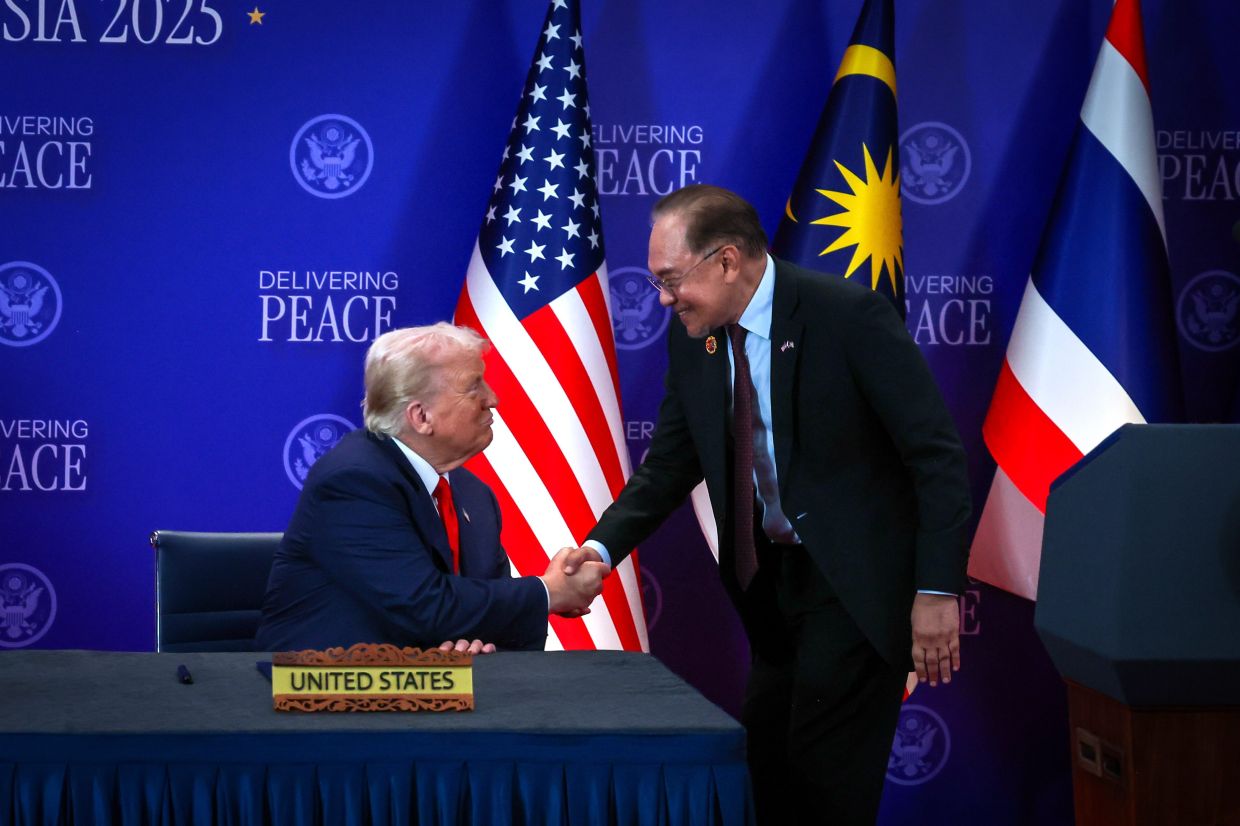
But the conundrum lies in how this could be reconciled with the demands of the earlier deal with Washington, signed during President Donald Trump’s visit to Malaysia, which requires the South-east Asian nation to align with the US on sensitive national security.
How Malaysia navigates this will be closely watched by regional neighbours, with China applying similar pressure on Cambodia. Meanwhile, Indonesia continues to resist US demands that could significantly increase shipping costs, and Vietnam and Thailand weigh their options after signing their own deals with the US.
Beijing made public on Nov 28 that it had expressed unease about the US-Malaysia Agreement on Reciprocal Trade (ART) during a Nov 25 bilateral meeting, even as Datuk Seri Zafrul cast ongoing discussions as “a statement that they want to work closer with us, and they want it to be more tangible”.
He told reporters during a press conference on his final day as minister that by proposing the MOU, “they are saying that they want to strengthen the collaboration on trade and investment with Malaysia”.
Mr Zafrul, who ended his three-year tenure as senator, stressed that discussions are at a preliminary stage. He said the MOU’s “parameters are to look at how Malaysia and China can improve on bringing investments to both countries – Malaysia companies to China, and China companies to Malaysia – and also strategic sectors that they feel Malaysia can support Chinese companies (to) play a role here in Malaysia and, of course, ASEAN”.

Singapore
ST Explains: Cyclone Senyar was rare for S-E Asia – could a storm like it ever hit Singapore?

Singapore
$3b money laundering case: 8 companies in Singapore blacklisted over their links to 2 fugitives

Singapore
Sale of bungalow, death of widow close chapter on cheating case involving ex-tour guide Yang Yin

Singapore
Worker dislodged 62kg steel bar that fell and killed colleague in 2024 Tuas accident: Coroner

Life
First look at Chick-fil-A Singapore’s Bugis+ outlet and full menu

Singapore
MOM to scrap Performing Artiste Work Permit scheme due to widespread abuse by syndicates

Asia
People versus power? Hong Kong’s fire fallout risks reopening societal divide

Asia
India investigates Air India after plane flown repeatedly without safety certificate
In the current context, “strategic sectors” is usually code for tech supply chains, including for semiconductors and rare earths – critical minerals that are crucial in advanced technology products
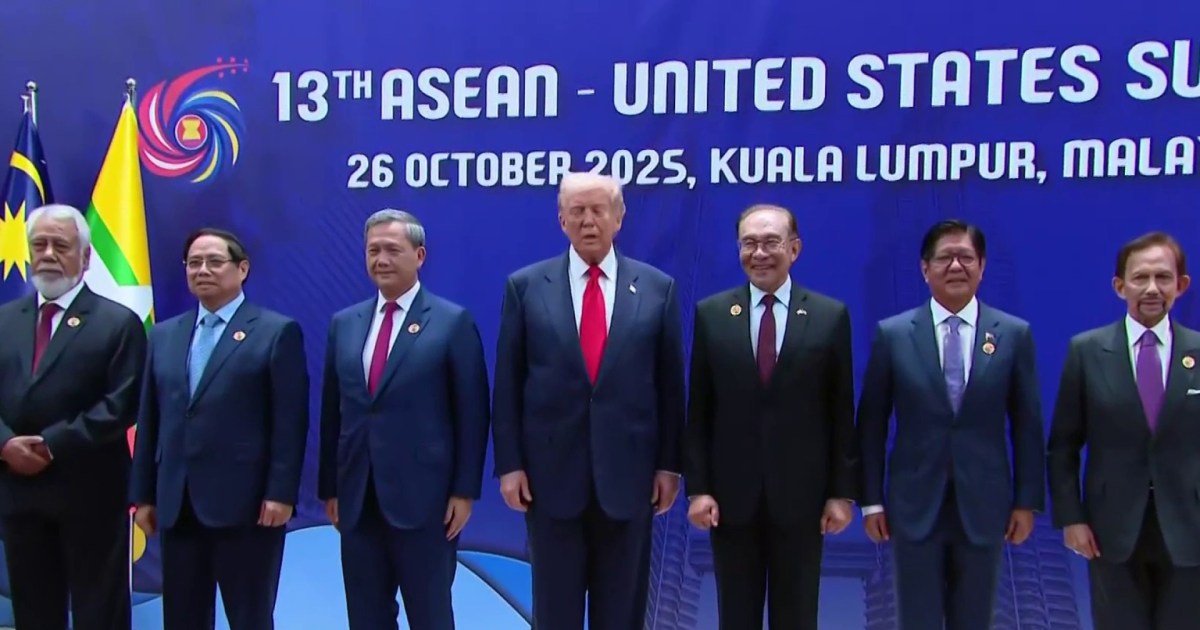
ranging from smartphones to wind turbines to electric vehicles.The suggestion for a trade MOU first surfaced during an Oct 27 bilateral meeting on the sidelines of the ASEAN summit in Kuala Lumpur. It came a day after Mr Trump
signed off on Washington’s ARTs with both Malaysia and Cambodia. The meeting between Chinese Premier Li Qiang and Malaysian Prime Minister Anwar Ibrahim, with Mr Zafrul and Chinese Commerce Minister Wang Wentao in attendance, discussed “concerns they have on ART because they don’t want to be in a position where we give preferential treatment to the US”, said Mr Zafrul.
“So we gave our explanation during the meeting in KL, and we also agreed to meet again in Beijing. We sent our team to Beijing last week, explaining the wording, the implications of ART for China, and they are satisfied,” he added.

Malaysia’s Investment, Trade and Industry Minister Tengku Zafrul Aziz said discussions with China on the MOU are at a preliminary stage.
PHOTO: TENGKU ZAFRUL AZIZ/FACEBOOK
Caught between Beijing and Washington
Malaysia is already part of several free trade agreements (FTAs) with China, such as the Regional Comprehensive Economic Partnership and the ASEAN-China FTA, so the form of any bilateral deal they make is still in question.
China’s rebuke following the US-Malaysia ART, calling on Malaysia to “fully consider and properly handle this matter in the light of its long-term national interests”, comes on the heels of a similar meeting it had with Cambodian officials on Nov 18. Chinese trade envoy Li Chenggang had also urged Phnom Penh to ensure “any agreement should not affect global trade development and regional cooperation, and must not harm China’s interests”.

Dr Deborah Elms, head of trade policy at the Hinrich Foundation, said China’s priority was to obtain clarification from Malaysia and Cambodia over their interpretation and intentions on the key clauses.
Depending on the level of concern, China is also likely to have pre-emptively engaged other countries in the region, such as Indonesia, Thailand and Vietnam, on their negotiations with the US.
“If you’re Malaysia or Cambodia, you’re between a rock and a hard place,” Dr Elms said.
“You’ve got pressure on both sides from your two most important trading partners… and I think that probably Malaysia and Cambodia would say we had to reach an accommodation with the United States before the US pressure got worse.”
Central to China’s concerns on Malaysia’s and Cambodia’s ARTs are clauses that effectively require them to align with Washington on sensitive national security issues. The issue has already sparked criticism locally, with critics accusing the Anwar administration of selling out Kuala Lumpur’s sovereignty.
Under the deals, both countries are expected to abide by US trade restrictions and controls on sensitive technologies, and commit to preventing their companies from helping other nations circumvent those measures.
China is concerned about any deal that jeopardises market access for its exports, and access to the foreign technologies it still depends on for its chipmaking and artificial intelligence development, said Ms Guo Shan, a partner with consultancy Hutong Research in Shanghai.
And more broadly, there are concerns that other South-east Asian countries might make similar moves in negotiating trade agreements with the US.

“An MOU could help clarify the treatment for politically sensitive sectors, while identifying the trade and investment opportunities that the two sides could still work on together,” she added.
In the first 10 months of 2025, Chinese exports to Malaysia were up 3.6 per cent from the same period the previous year, according to Chinese Customs data. Shipments to South-east Asia rose 14.3 per cent for the same period, while exports to the US plunged 17.8 per cent.
Malaysia’s dilemma underscores the difficulty that members of ASEAN – China’s top trading partner – face in balancing the demands between the world’s two largest economies. While the Trump administration threatens tariffs to force concessionary trade deals, Beijing has issued repeated warnings against undermining Chinese interests.

Although Vietnam and Thailand also signed similar deals adopting frameworks leading to ARTs, Indonesia is still in the midst of finalising the details of a deal reached in July to reduce tariffs on exports to the US to 19 per cent from 32 per cent.
Among the most contentious issues being discussed was the US’ demand that Indonesia avoid using Chinese shipping carriers when transporting merchandise to the US market. If accepted, this condition would significantly increase shipping costs for Indonesian exporters by up to 30 per cent.
“This is something that is hard to swallow on our part,” said an Indonesian official familiar with the negotiations, speaking on condition of anonymity as he was not authorised to speak to the media on the matter.
Jakarta-based think-tank Institute for Essential Services Reform’s executive director Fabby Tumiwa told The Straits Times that Indonesia’s trade deal with the US is not as geopolitically important for China as those made by Malaysia and Cambodia.
“Cambodia is believed to have a close relationship with China. Malaysia has other interests related to access to semiconductors and raw materials, because Malaysia produces them for export to the US.”
Professor Xu Liping, director of the Centre for South-east Asian Studies at the Chinese Academy of Social Sciences, said “Washington is using administrative, not market, levers to influence governments here”, although “experience shows these methods may deliver short-term gains but cannot last; the enforcement and business costs quickly become prohibitive”.
“That’s why, despite the ‘poison pill’, Indonesia has already said no. I’m confident China can maintain its trade ties with countries like Malaysia and Cambodia,” he added.
Malaysia inked the deal with the US on Oct 26 to lock in a 19 per cent tariff rate that was agreed back in August.

The deal included several concessions made by the Anwar administration, including promising not to curb the supply of critical minerals to the US, a key plank of ongoing trade negotiations between Washington and Beijing centring on curbs of advanced technology supply chains.
Despite the Chinese registering their interest in investing in Malaysia’s rare earth sector as far back as in 2023, Mr Zafrul said “we’re still waiting”.
“I was made to understand they are talking to one of the government-linked investment companies. We welcome China, US – Australia is already here – to come and develop the midstream and downstream industry for rare earth elements, but we have yet to approve any licences from China or from other countries apart from (Australia’s) Lynas, because they have no submission yet,” he said.
Sources have previously said sovereign wealth fund Khazanah has been in talks
with Chinese companies to establish a rare earth refinery in Malaysia, but a sticking point is Beijing’s unwillingness to share its processing technology, insisting that any such facility operate as a “black box”.
Malaysia was China’s second-largest source of rare earth imports in 2024 after Myanmar, according to calculations of Chinese Customs figures by business intelligence website China Briefing.
-
Additional reporting by Philip Wen, Wahyudi Soeriaatmadja, Yew Lun Tian and Joyce Lim ZK

- Previous Tun Dr. Mahathir lodges police report against Malaysia PM Anwar over US trade deal
- Next Türkiye warns Kyiv’s Black Sea attacks threaten navigation, widen conflict
You may also like...




Random news









About us
Our Newly established Center for study of Asian Affairs has
branches in Indonesia, Malaysia and Singapore, as well as freelances in some other countries.
For inquires, please contact: newsofasia.info@yahoo.com Mr.Mohd Zarif - Secretary of the Center and administer of the web-site www.newsofasia.net
Polls
 Loading ...