

Dangerous act that could lead to military conflict: Japan counters Chinese radar lock-on claims
December 8, 2025 at 18:50 JST
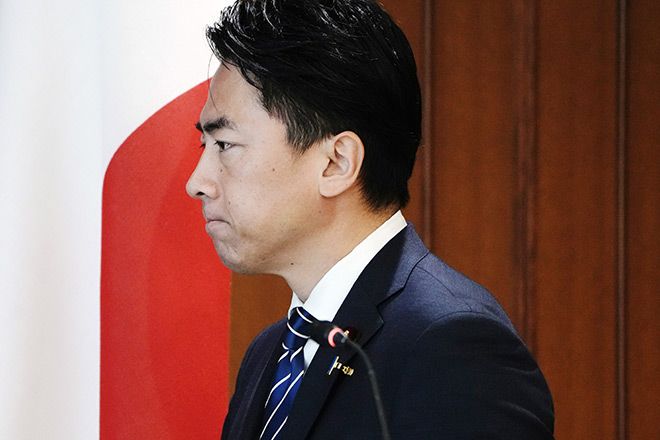 Defense Minister Shinjiro Koizumi at a news conference on Dec. 7 (Tetsuro Takehana)
Japan is pushing back against Chinese accusations and sharpening its messaging while stressing restraint as it continues to rail against a radar lock-on provocation targeting a Japanese fighter jet as a dangerous act.
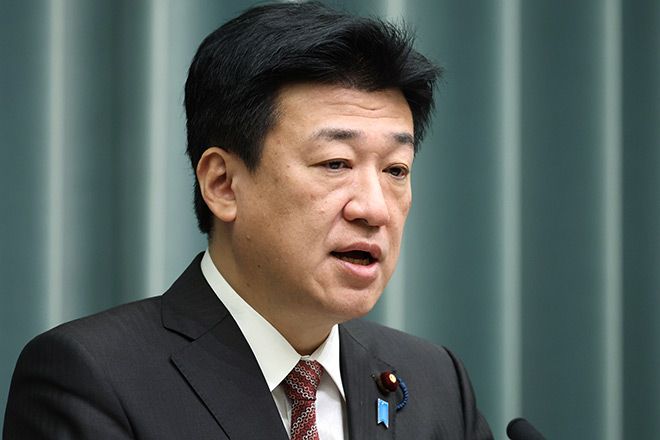
Chief Cabinet Secretary Minoru Kihara on Dec. 8 dismissed Beijing’s assertion that Japanese Self-Defense Force aircraft endangered flight safety by approaching Chinese forces.
“The claim that SDF aircraft seriously obstructed safe flight is unfounded,” Kihara said at a news conference.
China’s People’s Liberation Army Navy issued a statement on Dec. 7 saying that the SDF aircraft “repeatedly approached and disrupted the training zones of the Chinese aircraft carrier task group, seriously affecting the normal operations and posing a serious threat to the flight safety.”
It asserted, “Japan’s related hypes are completely inconsistent with the facts. We sternly urge the Japanese side to immediately cease its slanderous and defamatory acts against China and strictly discipline its front-line operation.”
Kihara explained at the news conference that he had received reports that the SDF aircraft “maintained a safe distance while performing airspace defense duties.”
He criticized China, saying, “Radar lock-on is a dangerous act that exceeds the scope necessary for the safe flight of aircraft.”
HEIGHTENED POLITICAL FRICTION
The incident occurred as Japan-China confrontation was intensifying over Prime Minister Sanae Takaichi’s remarks concerning a Taiwan contingency.
Defense Minister Shinjiro Koizumi held an emergency news conference shortly after 2 a.m. on Dec. 7 where he disclosed that a Chinese J-15 fighter intermittently locked its radar on an Air Self-Defense Force F-15 fighter that had scrambled in response to a potential airspace violation.
The incident occurred the afternoon of Dec. 6 over international waters southeast of Okinawa Prefecture’s main island.

Koizumi condemned the act as “dangerous and beyond what is necessary for safe flight.”
The ministry said there was no damage to the SDF aircraft or personnel.
However, this marks the first public disclosure of such an incident involving Chinese aircraft and the SDF.
Later that day, Takaichi also said the event was “extremely regrettable,” adding that the Japanese government would respond “calmly yet resolutely.”
The Japanese government already lodged a strong protest with the Chinese side in the early hours of Dec. 7 through both diplomatic and defense channels and made a strict request to prevent a recurrence.
“We will closely monitor the movements of the Chinese military in the seas and airspace around our country, and we will make every effort to conduct vigilance and surveillance activities in the surrounding maritime and airspace,” Takaichi said.
DEFENSE CIRCLES ON EDGE
Although military tensions between Japan and China had been rising around Japan for some time, the incident—one that could lead to an accidental clash—has sent shock waves through the Defense Ministry and the SDF.
A senior SDF official said, “It is a dangerous act that could lead to military conflict if one step is taken in the wrong direction. For the pilot, it must have been terrifying, like having a finger on the trigger of a gun pointed at them.”
If fighter jets had locked their radars onto each other, it would have constituted such a strong act of hostility that “the U.S. military might have retaliated,” the official said.
According to this official, fighter radars have two modes that are used differently: a search mode, which widely emits radio waves to locate the other aircraft; and a fire-control mode, which concentrates radio waves to designate an attack target and guide weapons.
Another SDF official said that the search mode is sometimes used to ascertain the position and distance of the other aircraft, but often only briefly.
Since the fire-control mode was likely used in the latest incident and the targeting continued intermittently over a long period, the ministry judged it a “dangerous act.”

A ministry official said, “We cannot but consider that it was done with intent.”
HOTLINE FAILS TO HELP
This incident is not the first such provocation in the past year and a half. In August 2024, a Chinese military aircraft violated Japanese airspace for the first time off Nagasaki Prefecture.
This was followed by a Chinese Coast Guard helicopter violating airspace around the Senkaku Islands in Okinawa Prefecture in May.
Meanwhile, since last September, Maritime Self-Defense Force destroyers have been transiting the Taiwan Strait, and Japan has also conducted training in seas and airspace near Taiwan where it had not conducted maneuvers before.
All this was preceded by the Japanese and Chinese governments establishing a dedicated hotline between defense authorities in March 2023 to avoid accidental clashes between the SDF and the Chinese military.
However, the hotline has not functioned in practice.

A ministry official pointed out that it was not utilized in the latest incident.
“Originally, we would want to use the hotline in such situations, but it is difficult under these circumstances. With intent unconfirmed, confrontation deepens and it becomes increasingly dangerous,” the official said.
BATTLE FOR GLOBAL NARRATIVE
China had retaliated against Takaichi’s remarks about a Taiwan contingency with economic coercive measures, but this time it may have moved to a military provocation.
Another senior Defense Ministry official said, “It was originally important for both Japan and China to stop the escalation, but the risk of accidental conflict is now increasing.”
The confrontation over Takaichi’s remarks is taking on the aspect of an information battle, with both sides appealing the legitimacy of their positions to the international community.

For example, when in January 2013 a Chinese warship directed a fire-control radar used for shooting at an MSDF destroyer, the Japanese government disclosed the incident six days later.
This time, however, Koizumi spoke with reporters less than 10 hours after the initial radar event.
A Japanese government official said, “It is necessary to lower the international community’s evaluation of China and raise the cost of (provocation) on the other side.”
By promptly clarifying China’s dangerous act of locking on its radar, Japan aims to broaden international support for its position, the official said.
‘CALMLY YET RESOLUTELY’
Meanwhile, according to the officials involved, Takaichi and other senior administration members began to collectively emphasize the key phrase “calmly yet resolutely” concerning how Japan should respond to the incident.
The Japanese officials say this partly reflects a genuine desire to avoid any further increase in military tensions with the expectation for a prolonged confrontation between Japan and China.
A senior administration official said, “Japan must never overreact to this issue,” indicating a desire to calm the situation.
Although military tensions between the two countries had been rising for some time, there is a view within the administration that the latest incident was influenced by the deterioration of Japan–China relations triggered by Takaichi’s remarks.
A Japanese government official said, “Under China’s policy of dealing strictly with Japan, each institution is making judgments and acting.”
Another government official said, “As Japan–China relations worsen, there is a view on the Chinese side that they must take a strong stance against Japan.”
However, within the Takaichi administration there is also a view that the latest incident occurred amid the push-and-pull as SDF aircraft responded with an emergency scramble to the presence of Chinese military aircraft.
Another government official said, “It is not a case in which radar was suddenly directed at an SDF aircraft that was flying normally,” and emphasized the need for a calm response.
(This article was compiled from reports written by Nobuhiko Tajima, Mizuki Sato, Daisuke Yajima, Ryo Kiyomiya, Yuta Ogi and others.)

- Previous Ukrainian bombing of Kazakh oil terminal in Black Sea – shooting its own foot by clown-run Kiev administration: aftermath and implication
- Next Were Chinese nationalist were beaten in Elections!? Asahi Shimbun – VOX POPULI: Hong Kong’s ‘heart’ rejects latest ‘patriots only’ election
You may also like...





Random news








About us
Our Newly established Center for study of Asian Affairs has
branches in Indonesia, Malaysia and Singapore, as well as freelances in some other countries.
For inquires, please contact: newsofasia.info@yahoo.com Mr.Mohd Zarif - Secretary of the Center and administer of the web-site www.newsofasia.net
Polls
 Loading ...