

Takaichi and ‘wine-and-dine’ politics
By HAYATO JINNO/ Staff Writer
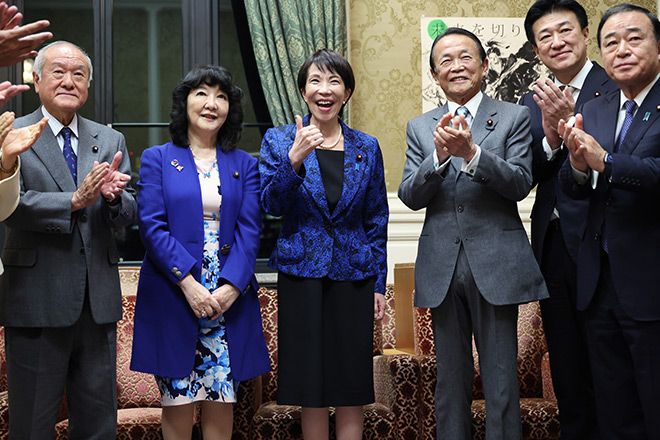 Prime Minister Sanae Takaichi visits the Liberal Democratic Party’s waiting room in the Diet to offer greetings after the supplementary budget bill passed the Lower House on Dec. 11. (Takeshi Iwashita)
Two months into her tenure, Prime Minister Sanae Takaichi is facing rising unease within her party over her reluctance to partake in traditional male-dominated “wine-and-dine” politics, despite maintaining high approval ratings.
The position of prime minister, often described as “lonely” due to its crushing responsibilities, nevertheless requires exposure to diverse opinions.
How Takaichi gathers information and communicates with those around her will likely be a key factor in the future management of her administration.
PENCHANT FOR SOLITUDE
“Information has a hard time getting into the prime minister’s office,” a senior official of the ruling Liberal Democratic Party was told by a Diet member who had previously worked in the office.
The official took it to mean that while there is an impression that all information collects at the center, surprisingly little gets through, and therefore it is necessary to consciously interact with the outside.
However, a close aide to Takaichi said the prime minister “likes to shut herself away and study alone.”
Takaichi has been described as not being adept at building camaraderie through events such as dinner meetings.

Even after becoming prime minister, she often retreats straight to her residence to read through documents.
PARTY MEMBERS FEEL UNHEARD
“Is the atmosphere within the LDP getting through to the prime minister?” a veteran LDP Diet member asked.
The lawmaker said the trigger for this anxiety was the move to reduce the number of Lower House seats, which was included in the coalition agreement between the LDP and Nippon Ishin (Japan Innovation Party).
At the time, Takaichi showed a proactive stance and submitted a bill to the recent extraordinary Diet session as the ruling party, but complaints erupted from within the LDP, such as decrying it as “too hasty.”
In the background was the fact that Komeito, which had left the coalition government with the LDP to become an opposition party, was strongly opposed to the bill.
Anxiety had been spreading within the LDP about completely losing the cooperation of Komeito supporters in future elections, which they had been counting on.
According to several sources close to the prime minister and senior officials in her office, Takaichi repeatedly exchanges phone calls and emails with LDP Diet members.
However, her unread emails can reportedly pile up to 1,000.
A senior LDP official grumbled, “There are times when I can’t get in touch with her.”
Citing the “Ishiba-oroshi”—the movement that forced former Prime Minister Shigeru Ishiba to resign—a close aide to Takaichi warned of the dangers of internal party dissatisfaction.
“The prime minister’s office must proactively gather information from within the party,” the aide said.
STARK CONTRAST WITH PREDECESSORS
Takaichi’s lack of “political networking through dining” during these past two months is conspicuous even when compared to past prime ministers.
An analysis of The Asahi Shimbun’s “Prime Minister’s Schedule” reveals that, excluding official meetings and diplomacy-related events, Takaichi has had only two dinner meetings outside the prime minister’s office: one with the LDP executive board and a social gathering with her LDP presidential election campaign members.
At the meeting with the LDP executive board, Vice President Taro Aso reportedly advised Takaichi, “You should invite the Diet Affairs Committee members and others for a meal.”
In the first two months after taking office, former Prime Minister Shinzo Abe had 27 dinner meetings with business leaders and party executives, while former Prime Minister Yoshihide Suga had 55.
Former Prime Ministers Fumio Kishida and Ishiba, who both faced a Lower House election immediately after taking office, also attended more than 10 dinner meetings each.
A senior LDP heavyweight close to Takaichi expressed concern, saying, “She should also dine with the business community to hear their unfiltered voices. Relationships don’t deepen just by giving speeches at conferences.”

IMPLICATIONS FOR DIPLOMACY
Takaichi has also skipped dinners attended by national leaders at the Asia-Pacific Economic Cooperation (APEC) summit in October and the Group of 20 (G20) summit in November.
Journalist Megumi Nishikawa, author of “Wine and Diplomacy,” which deciphers international politics through leaders’ meals, said, “The culture of politicians’ nighttime dinner meetings is typical of a male-dominated society, and it is time for a change.”
He added that if Takaichi is not adept at dinner meetings, there is the option of focusing on alternative methods, such as creating a team of close aides to gather opinions.
On the other hand, he said, “Meals in foreign affairs are extremely meaningful for building personal relationships. I would like her to place importance on them to demonstrate Japan’s presence.”

- Previous Japan plans 30 trln. yen ($189bn) new bond issuance
- Next 27 cities – the pillars of Soviet-era industrialization to heavy to revive: Kazakhstan’s Rust Belt On a Path of Decline
You may also like...





Random news












About us
Our Newly established Center for study of Asian Affairs has
branches in Indonesia, Malaysia and Singapore, as well as freelances in some other countries.
For inquires, please contact: newsofasia.info@yahoo.com Mr.Mohd Zarif - Secretary of the Center and administer of the web-site www.newsofasia.net
Polls
 Loading ...