

Takaichi’s LDP wins in a major way: 310 of 461 seats supermajority in Lower House elections
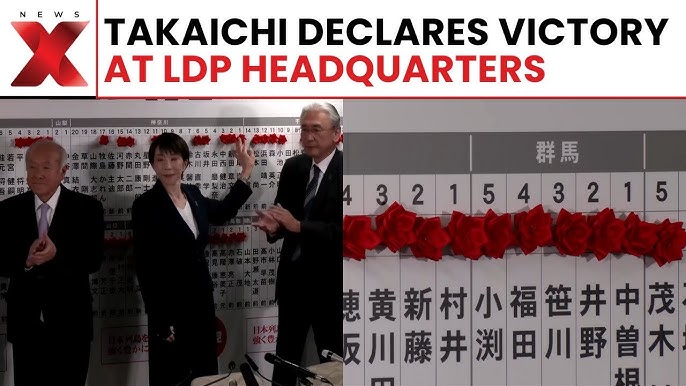
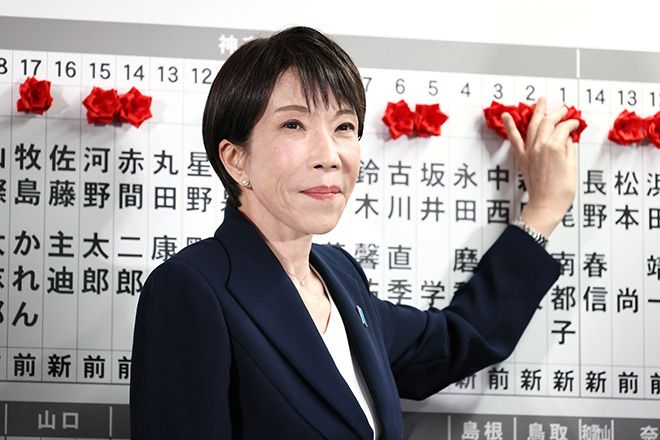 Prime Minister Sanae Takaichi places flowers on the names of winning candidates in the Lower House election on Feb. 8 at the Liberal Democratic Party headquarters in Tokyo’s Nagatacho district. (Hikaru Uchida)
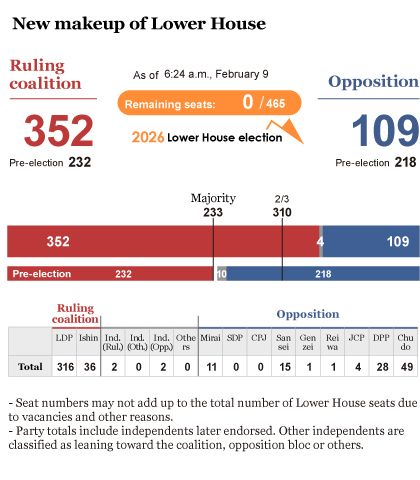
Voters overwhelmingly gave a mandate to Prime Minister Sanae Takaichi on Feb. 8, sending her Liberal Democratic Party to its most resounding Lower House election victory since its founding in 1955.
The LDP is certain to secure more than the party record of 300 seats won in the 1986 Lower House election under the Yasuhiro Nakasone administration.
In fact, the LDP gained a crucial supermajority exceeding two-thirds, or 310 seats, in the 465-seat Diet chamber. This marks the first time since World War II that a single party has won more than two-thirds of the seats in the Lower House.
This will allow the party to secure the chair positions and a majority of members on all Lower House standing committees.
It also means that even if a bill is passed in the Lower House but rejected by the Upper House, the LDP can have it ultimately passed again in the Lower House.
The supermajority could also push talks on Takaichi’s plan to revise pacifist Article 9 of the Constitution.
The LDP suffered a major defeat in the previous Lower House election in 2024, losing the outright majority it had held since its return to power in 2012.
Before this election, the LDP held 198 seats while its coalition partner, Nippon Ishin (Japan Innovation Party), had 34 for a total of 232 seats.

Takaichi dissolved the Lower House and called the election last month while her support ratings were high. Although some pundits said her move was a gamble, it clearly paid off for the prime minister in securing a stable governing foundation.
The election has also left the opposition in shambles, particularly the main opposition Centrist Reform Alliance (Chudo), which suffered a humiliating defeat.
The Lower House will now feature a “one strong, many weak” Diet, where the LDP holds overwhelming dominance, reminiscent of the second Abe administration.
TAKAICHI STRENGTHENS POWER
“We have advocated policies facing significant opposition, including a major shift in economic and fiscal policy, strengthening our security policy, and enhancing intelligence capabilities,” Takaichi said at the LDP headquarters in Tokyo’s Nagatacho district when the results were coming in. “If we receive the people’s trust, we must work diligently on these matters.”
The power balance within the ruling coalition could also shift, with Nippon Ishin’s power diminishing with the LDP’s gains.
In an interview with TV Tokyo, Takaichi was asked whether she would continue the coalition government with Ishin.
“My desire for them to share responsibility within the Cabinet remains unchanged,” she said.
The prime minister also said there was no need for a major Cabinet reshuffle.
Before the election, Takaichi had been exploring the possibility of expanding the coalition to include the Democratic Party for the People (DPP).
However, the LDP now does not need DPP votes in the Lower House to pass legislation.
Still, Takaichi indicated she plans to call on other parties to join the coalition, given the LDP’s minority status in the Upper House.
Regarding the rise in long-term interest rates and the weakening of the yen since she became prime minister, Takaichi said, “It is extremely important that the ‘responsible’ part of my ‘responsible proactive fiscal policy’ is correctly understood.”
She added, “While valuing fiscal sustainability, we will maintain flexibility and firmly carry out necessary investments.”
Takaichi’s leadership is bound to grow substantially stronger, creating a political landscape that could be called “Takaichi’s one-stronghold rule.”
She is expected to be re-elected as prime minister at the extraordinary Diet session scheduled to convene on Feb. 18.
In an interview with TV Tokyo on the night of Feb. 8, LDP Secretary-General Shunichi Suzuki said the election results are a sign of the “public’s expectations for Prime Minister Takaichi.”
“I am convinced that we have been given a stronger political foundation than before,” he said, indicating the administration will push ahead with her economic and defense-strengthening policies.
ISHIN REACTION
Nippon Ishin was struggling to maintain its pre-election strength of 34 seats.
Party leader Hirofumi Yoshimura said in an NHK interview, “Although we are coalition partners, we did not coordinate electoral districts with the LDP, making this an extremely difficult and tough election campaign.”
He added: “In Osaka, we are barely holding our ground. Nationally, the situation is very difficult.”
Regarding the framework of the coalition government, Yoshimura said if Takaichi approaches him about cooperation within the Cabinet, “I will take it seriously and consider it carefully.”
CHUDO REACTION
The main opposition Chudo aimed to act as a counterweight to the strongly conservative Takaichi administration and to create a political system where two major forces faced each other with a sense of tension.
But Chudo never gained momentum after it was formed through the merger of Lower House members from the Constitutional Democratic Party of Japan and Komeito on Jan. 22.
The CDP and Komeito together held 167 seats before the election was called, the second most after the LDP.
Chudo co-leader Yoshihiko Noda had indicated that the benchmark for success was to “exceed our current number of approximately 170 seats.”
Chudo is certain to have fallen well below that level, even to double digits.
Veteran politicians who held key positions in the CDP and its predecessor, the Democratic Party of Japan, were facing defeat in single-seat districts.
Yukio Edano, Katsuya Okada, Koichiro Genba, Harumi Yoshida, Sumio Mabuchi and Ichiro Ozawa were all set to lose to LDP candidates.
Jun Azumi, a Chudo co-secretary-general, is also certain to have lost his seat in Miyagi No. 4 electoral district.
He has submitted a resignation letter to Noda regarding the party post, sources said.
Noda and the other party co-leader, Tetsuo Saito, appeared together on an NHK program and hinted at the possibility of stepping down.
“I have made up my mind, but I want to hold thorough discussions with other executives and consider the future direction of the party before deciding how to proceed,” Noda said.
Saito also said he has made up his mind regarding his future plans but would not say what they were.
“We have formed a ‘centrist’ bloc. This is extremely important for Japanese politics, and we must now establish a new framework to keep the fire burning strongly and continue expanding it,” he said.
Chudo will hold an executive committee meeting on Feb. 9 to decide on its future course of action.
The party had emphasized such ideals as “diversity” and “inclusion” under the banner of “people first.” It also called for a permanent zero consumption tax rate on food.
For the election, the party tried to solidify organized votes from the CDP’s support group, Rengo (Japan Trade Union Confederation), and Komeito’s main support base, lay-Buddhist organization Soka Gakkai, while trying to appeal to unaffiliated voters.
However, the party’s strategy clearly did not pan out.
DPP VOWS COOPERATION
The DPP, which vowed to “increase take-home pay,” was also struggling to gain seats.
In an interview with TBS Radio, DPP leader Yuichiro Tamaki said of his party’s message: “I felt that it was getting through in the latter half of the election campaign.”
When asked how the DPP would face the ruling coalition as an opposition party, Tamaki said: “The same as before. We want to cooperate on policies that should be advanced on a policy-focused basis, and for issues that have not seen enough progress, such as politics and money scandals, we want to move forward by presenting our party’s arguments and counter-proposals.”
TEAM MIRAI ENTERS HOUSE
Team Mirai is certain to have secured its first seats in the Lower House.
Party leader Takahiro Anno was elected in last summer’s Upper House election, giving the party its only seat in the Diet.
The party went against the trend of political parties calling for consumption tax cuts, warning that such reductions could, in fact, further accelerate price hikes.
Team Mirai gained support by advocating a “child-rearing tax cut” to ease the income tax burden based on the number of children in a family. It also called for reducing social insurance premiums for the working generation.
“It is gratifying that we seem able to achieve our goal of five or more seats,” Anno said in an interview with NHK.
Regarding the party’s consistent opposition to a consumption tax cut, Anno said, “I spoke about it many times in street speeches, and quite a few people said, ‘That’s right.’ In a way, we became an option for those who believe a consumption tax cut is unnecessary.”
SANSEITO FALLS SHORT
Sanseito appears unlikely to reach its goal of 30 seats.
Party leader Sohei Kamiya told NHK in an interview, “The LDP’s momentum was strong, and we were unable to sufficiently increase our vote count.”
However, Sanseito was expected to exceed its pre-election seat count of two.
“We were able to put down deeper roots and expand our organization compared to 18 months ago,” Kamiya said.
JCP REACTION
Japanese Communist Party leader Tomoko Tamura said in an NHK interview that with the LDP’s landslide victory and Chudo’s crushing defeat, the JCP’s role is becoming even more important.
She said: “The largest opposition party was expected to confront increasingly right-wing politics. Instead, a new party emerged in a way that seemed absorbed by Komeito, ultimately benefiting the LDP.”

- Previous China strongly condemns the deadly explosion in Islamabad,
- Next After visit of British Starmer, Jimmy Lai, Hong Kong pro-democracy tycoon, jailed by China 20 years, labeling national security theat
You may also like...






Random news













About us
Our Newly established Center for study of Asian Affairs has
branches in Indonesia, Malaysia and Singapore, as well as freelances in some other countries.
For inquires, please contact: newsofasia.info@yahoo.com Mr.Mohd Zarif - Secretary of the Center and administer of the web-site www.newsofasia.net
Polls
 Loading ...