

Mihrimah Sultan Ottoman Mosque in Istanbul reflections
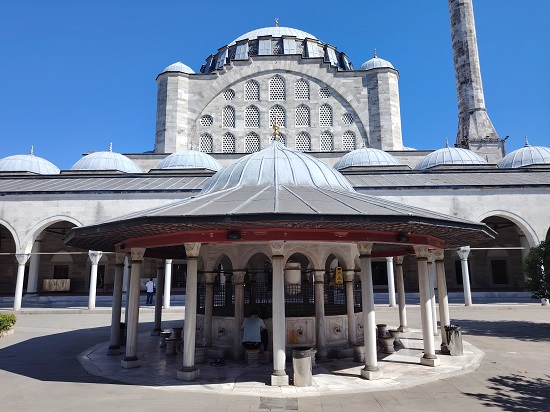

Dominating the waterfront of Istanbul’s Üsküdar with its commanding position by the ferry docks, the Mihrimah Sultan Mosque remains one of the most prominent architectural markers of Istanbul’s skyline, reflecting the early classical style of chief Ottoman architect Mimar Sinan.
Commissioned in the 1540s by Suleiman the Magnificent in the name of his daughter Mihrimah Sultan, the mosque has long been regarded as a defining symbol of Üsküdar, distinguished by its strategic coastal location and refined architectural composition.
Built concurrently with the Şehzade Mosque, the Mihrimah Sultan Mosque complex represents one of the first major architectural programs undertaken by Sinan after his appointment as chief imperial architect. The külliye was conceived as a comprehensive urban unit, incorporating a madrasa, primary school, soup kitchen, inn, water infrastructure, fountains, reservoirs and auxiliary service structures.
Also known as the “Iskele Mosque,” the building features a central dome supported by three semi-domes, a five-domed portico, and an additional congregation area that wraps around the structure. Due to the mosque’s narrow seaside plot, the traditional arcaded courtyard was not implemented. Instead, an enclosed outer congregation space with a wooden roof was designed to protect worshippers from strong coastal winds while accommodating large gatherings.

Within the same garden, a 16-cell madrasa was arranged along the wider sides of a porticoed courtyard. Restored in 1961, the building currently functions as a health center, while the former primary school has been repurposed as a children’s library.
The mosque’s proximity to the water has made it a lasting contributor to the Istanbul Bosporus silhouette. Historically, it was among the first monumental structures encountered by travelers arriving in Istanbul from Anatolia, reinforcing Üsküdar’s role as a key gateway to the city.
Mahmut Sami Kanbaş of Marmara University, Faculty of Theology, Department of Turkish-Islamic Art History, said that the mosque was deliberately designed to highlight Üsküdar’s skyline rather than dominate it through scale. He noted that the absence of a semi-dome on the Bosporus-facing side created a more open spatial relationship with the waterfront, underscoring Sinan’s sensitivity to topography and climate.

Kanbaş emphasized that Ottoman mosques were developed not only as places of worship but as multifunctional social centers supported by revenue-generating commercial units and surrounded by educational, charitable and service-oriented institutions.
During Ramadan, the Mihrimah Sultan Mosque historically played a central role in Üsküdar’s public life. Illuminated mahyas, soup kitchens and sebils transformed the area into a focal point of communal activity, with visual displays observable from across the Bosporus and from passing vessels, contributing to the city’s seasonal cultural identity.

- Previous Another Decade of Turmoil: Yunus’s actions totally illegal: Bangladesh President, now free, exposes dark plots
- Next Wazir Khan Mosque showcases Mughal architecture in Lahore
You may also like...






Random news





About us

Our Newly established Center for study of Asian Affairs has
branches in Indonesia, Malaysia and Singapore, as well as freelances in some other countries.
For inquires, please contact: newsofasia.info@yahoo.com Mr.Mohd Zarif - Secretary of the Center and administer of the web-site www.newsofasia.net
Polls
 Loading ...