

237 to 169: US House puts University on funding cut, if anti-Israeli activities go on
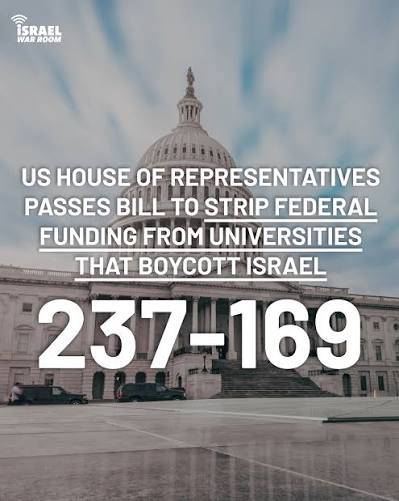
The House passed legislation Thursday that would put federal funding at risk for universities that participate in certain boycotts of Israel, despite warnings from critics that the measure could chill political expression and effectively extend anti-boycott protections to Israeli settlements in occupied territories.
The Protect Economic and Academic Freedom Act, introduced by Reps. Virginia Foxx (R-N.C.) and Josh Gottheimer (D-N.J.), would bar colleges that receive federal funds from engaging in what it defines as a “nonexpressive commercial boycott” of Israel, including “refusals to deal” or terminating business relationships in order to limit commercial ties without a “valid business reason.” The law would require these institutions to submit annual certification that they were giving students and faculty access to academic programs in Israel on the same terms as programs in other countries.
The legislation, which passed in a 237-169 vote, could put universities in a precarious position. “The goal here is to basically say every university not only cannot refuse cooperation with Israel but must actively seek every opportunity to cooperate with Israel,” Lara Friedman, the President of the Foundation for Middle East Peace, told RS ahead of the vote. “And if they’re not doing that, they’re pro-BDS and anti-Israel.”
In an earlier analysis of the bill, Friedman noted that the bill could open the door for legal action against a school, because politically minded individuals or groups could “search for and point to the absence of some relations with Israel to allege that a university lied in that certification.”
House Education and Workforce Committee Democrats urged members to vote against the measure late Wednesday evening, arguing that it threatens constitutionally protected speech and targets conduct that no American university has actually undertaken.
Thirty-three Democrats voted against the party line, while Reps. Thomas Massie (R-Ky.) and Warren Davidson (R-Ohio) were the only two Republicans to oppose the measure.
Among the Democratic “yea” votes was Rep. Jared Moskowitz of Florida, who was recently named ranking member of the subcommittee on the Middle East and North Africa — a move that angered progressives who see him as too pro-Israel.
“There is overwhelming Democratic opposition to undermining American rights and institutions to shield Israel from accountability,” Dylan Williams, VP of Government Affairs at Center for International Policy, told RS in an email. “A lawmaker put in a position of trust by the caucus on these issues can’t just ignore that without consequences.”
The legislation does not explicitly mention the Boycott, Divest, and Sanction (BDS) movement, an international grassroots effort to isolate Israel that draws inspiration from the global initiative to boycott South Africa’s Apartheid government. But statements from sponsors of the law and the committee debate make clear that BDS is the target. The legislation appears modeled, in part, after state-level anti-BDS laws that restrict government contracting or investment involving entities that boycott Israel; such laws have passed in 38 states since 2015.
Supporters of the bill in Congress frame the measure as a preventative response to the growth of the BDS movement on college campuses, which they say has contributed to rising antisemitism in American universities.
Democrats on the rules panel focused much of their opposition on the more basic objection that the legislation is aimed at conduct no American university has actually undertaken. “There has not been a single case of an American college or university administration adopting the BDS movement policies that are described in the bill. Not one,” Rep. Bobby Scott (D-Va.) said during the mark-up.
The minority party’s committee report similarly concluded that the bill was a “solution in search of a problem” and lamented that ensuring students are able to engage with their Israeli counterparts could have been a “building block for a bipartisan unanimous bill, but the Majority decided to include in the bill a section on the BDS movement.”
The committee report also raises First Amendment concerts over conditioning federal student-aid eligibility on universities’ boycott policies, saying that Congress cannot avoid the constitutional issue by labeling the conduct “nonexpressive” because the BDS movement is “clear and open about the ideas it hopes to express.” The wording of “nonexpressive boycotts” in the bill stems from a 2022 Eighth Circuit ruling upholding Arkansas’s anti-BDS law, which ruled that the act of boycotting is nonexpressive conduct, and therefore not protected by the First Amendment, and that only calling for a boycott remains protected speech. The Supreme Court has thus far refused to take up challenges to that ruling.
Friedman told RS that this distinction goes much further than the immediate fight over Israel, calling it part of an effort to “not just erode but, for all practical purposes, erase any First Amendment protection for the right to boycott.”
During the mark-up, Rep. Morgan Griffith (R-Va.) retorted that, if universities are not currently engaging in the conduct the bill would prohibit, opponents should have little reason to object.
“Let’s take my colleagues on the other side of the aisle and their argument, and that is the bill does nothing, and there’s nothing to see here,” Griffith said. “Then there’s no harm in passing it.”
Outside critics have focused more on the potential ramifications of the bill. The measure “seeks to chill free speech by penalizing universities for engaging in constitutionally protected political expression in support of Palestinian human rights,” according to a memo written by the lobbying group A New Policy when the bill was initially introduced last summer.
Some Democratic members made this case forcefully ahead of the vote. “No matter how much I may disagree with BDS, and find it strategically stupid and morally repugnant, I will always fight to protect Americans’ right to speech with which I disagree. It is the only way to ensure speech I do agree with is equally protected,” Rep. Jerry Nadler (D-N.Y.) said in a statement, calling the bill a “gross violation of the First Amendment.”

- Previous “Me too” movement gather steam in India: 10 JNU students accuse professor of sexual harassment
- Next China and Singapore hold joint naval exercises
You may also like...






Random news













About us

Our Newly established Center for study of Asian Affairs has
branches in Indonesia, Malaysia and Singapore, as well as freelances in some other countries.
For inquires, please contact: newsofasia.info@yahoo.com Mr.Mohd Zarif - Secretary of the Center and administer of the web-site www.newsofasia.net
Polls
 Loading ...