

Boost U.S. support for the self-governing island of Taiwan – Congress targets China with new restrictions in $901 bn. defense bill
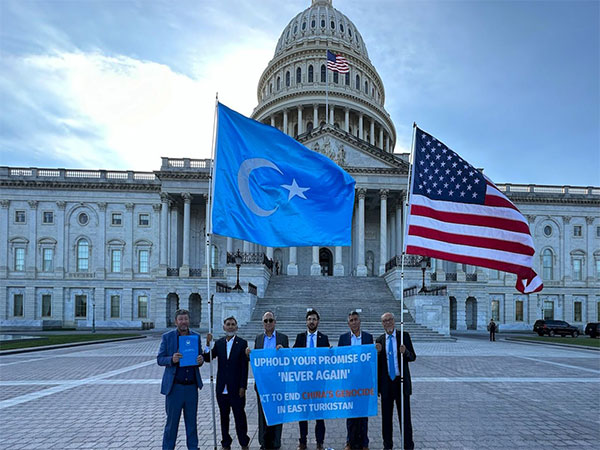
The Trump administration may have softened its language on China to maintain a fragile truce in their trade war, but Congress is charging ahead with more restrictions in a defense authorization bill that would deny Beijing investments in highly sensitive sectors and reduce U.S. reliance on Chinese biotechnology companies.

Included in the 3,000-page bill approved Wednesday by the House is a provision to scrutinize American investments in China that could help develop technologies to boost Chinese military power. The bill, which next heads to the Senate, also would prohibit government money to be used for equipment and services from blacklisted Chinese biotechnology companies.
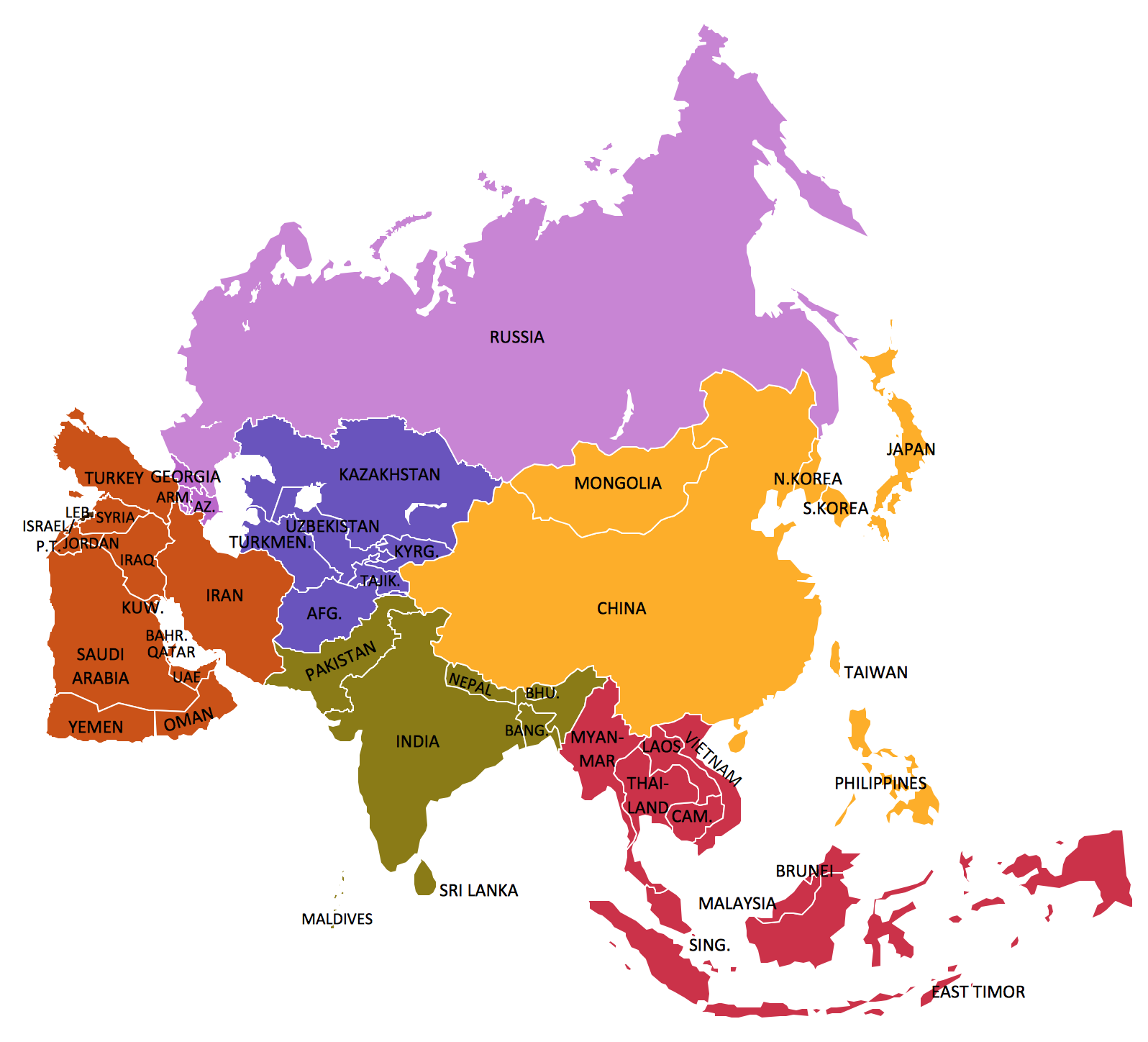
In addition, the National Defense Authorization Act would boost U.S. support for the self-governing island of Taiwan that Beijing claims as its own and says it will take by force if necessary.
“Taken together, these measures reflect a serious, strategic approach to countering the Chinese Communist Party,” said Rep. Raja Krishnamoorthi, the top Democrat on the House Select Committee on the Chinese Communist Party. He said the approach “stands in stark contrast to the White House’s recent actions.”
The compromise bill authorizing $900 billion for military programs was released two days after the White House unveiled its national security strategy. The Trump administration dropped Biden-era language that cast China as a strategic threat and said the U.S. “will rebalance America’s economic relationship with China,” an indication that President Donald Trump is more interested in a mutually advantageous economic relationship with Beijing than in long-term competition.
The White House this week also allowed Nvidia to sell an advanced type of computer chip to China, with those more hawkish toward Beijing concerned that would help boost the country’s artificial intelligence.
The China-related provisions in the traditionally bipartisan defense bill “make clear that, whatever the White House tone, Capitol Hill is locking in a hard-edged, long-term competition with Beijing,” said Craig Singleton, senior director of the China program at the Foundation for Defense of Democracies, a Washington-based think tank.
If passed, these provisions would “build a floor under U.S. competitiveness policy — on capital, biotech, and critical tech — that will be very hard for future presidents to unwind quietly,” he said.
The Chinese embassy in Washington on Wednesday denounced the bill.
“The bill has kept playing up the ‘China threat’ narrative, trumpeting for military support to Taiwan, abusing state power to go after Chinese economic development, limiting trade, economic and people-to-people exchanges between China and the U.S., undermining China’s sovereignty, security and development interests and disrupting efforts of the two sides in stabilizing bilateral relations,” said Liu Pengyu, the embassy spokesperson.
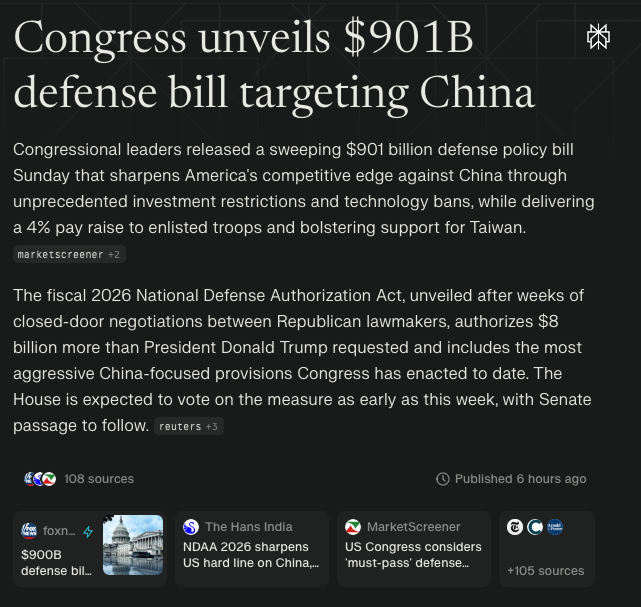
“China strongly deplores and firmly opposes this,” Liu said.
U.S. policymakers and lawmakers have been working for several years toward bipartisan legislation to curb investments in China when it comes to cutting-edge technologies such as quantum computing, aerospace, semiconductors and artificial intelligence. Those efforts flopped last year when Tesla CEO Elon Musk opposed a spending bill.
Musk has extensive business interests in China, including a Tesla gigafactory in the eastern city of Shanghai.
The provision made it into the must-pass defense policy bill, welcomed by Rep. John Moolenaar, a Michigan Republican who chairs the House Select Committee on the Chinese Communist Party.
“For too long, the hard-earned money of American retirees and investors has been used to build up China’s military and economy,” he said. “This legislation will help bring that to an end.”
Congress last year failed to pass the BIOSECURE Act, which cited national security in preventing federal money from benefiting a number of Chinese biotechnology companies. Critics said then that it was unfair to single out specific companies, warning that the measure would delay clinical trials and hinder development of new drugs, raise costs for medications and hurt innovation.
The provision in the NDAA no longer names companies but leaves it to the Office of Management and Budget to compile a list of “biotechnology companies of concern.” The bill also would expand Pentagon investments in biotechnology.
Moolenaar lauded the effort for taking “defensive action to secure American pharmaceutical supply chains and genetic information from malign Chinese companies.”
The defense bill also would authorize an increase in funding, to $1 billion from $300 million this year, for Taiwan-related security cooperation and direct the Pentagon to establish a joint drone and anti-drone program.
Another provision supports Taiwan’s bid to join the International Monetary Fund, which would provide the self-governing island with financial protection from China.
It comes amid mixed signals from Trump, who appears careful not to upset Beijing as he seeks to strike trade deals with Chinese President Xi Jinping. The Chinese leader has urged Trump to handle the Taiwan issue “with prudence,” as Beijing considers its claim over Taiwan a core interest.
In the new national security strategy, the White House says the U.S. does not support any unilateral change to the status quo in the Taiwan Strait and stresses that the U.S. should seek to deter and prevent a large-scale military conflict.
“But the American military cannot, and should not have to, do this alone,” the document says, urging Japan and South Korea to increase defense spending.

- Previous UAE beats Saudis in Yemen? Emirate-backed militias seize oil facility in central Yemen as Saudi Arabia evacuates troops from Aden
- Next Another Gulf of Tonkin accident – U.S. seizes alleged Iranian Revisionary Guard oil tanker off the coast of Venezuela
You may also like...




Random news












About us
Our Newly established Center for study of Asian Affairs has
branches in Indonesia, Malaysia and Singapore, as well as freelances in some other countries.
For inquires, please contact: newsofasia.info@yahoo.com Mr.Mohd Zarif - Secretary of the Center and administer of the web-site www.newsofasia.net
Polls
 Loading ...