

Government shifting away from inclusion of foreigners
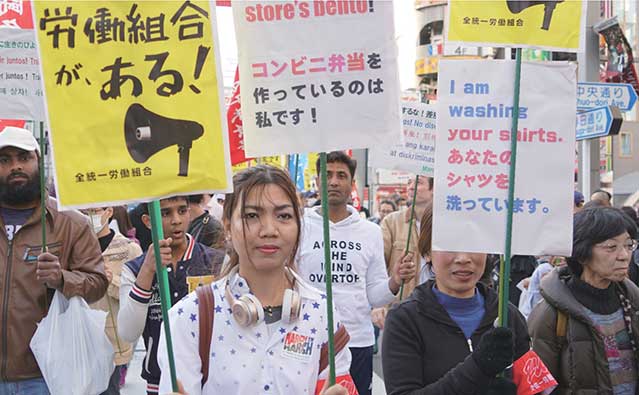
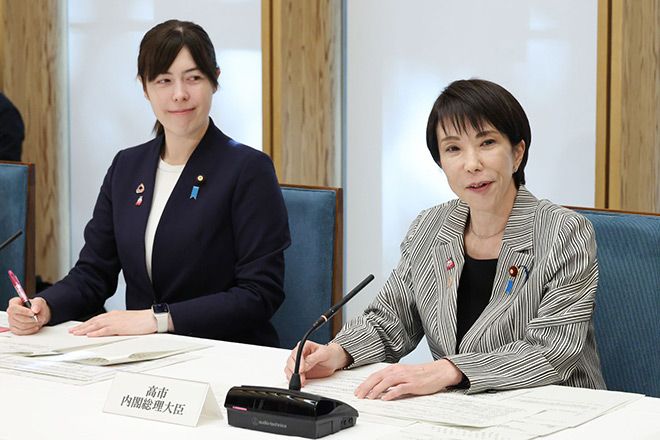 Prime Minister Sanae Takaichi, right, speaks at a November 2025 meeting of relevant Cabinet ministers discussing policy toward foreigners while Kimi Onoda, the minister dealing with policy toward foreign nationals, looks on. (Asahi Shimbun file photo)
Prime Minister Sanae Takaichi’s Cabinet is seemingly focusing on maintaining order over foreign nationals rather than accepting them as members of the community.
The Cabinet on Jan. 23 approved a comprehensive policy package toward foreigners that could make it tougher for them to receive public assistance.
Speaking at a news conference the same day, Kimi Onoda, the minister in charge of policy toward foreign nationals, said, “Based on the new perspective of placing order as the foundation for an inclusive society, we have established the parts to give the people safety and peace of mind and provided a comprehensive list of related measures.”
After the specified skilled worker visa was established in 2018, the government compiled comprehensive measures to deal with the increased entry of foreign workers.
The basic package has been revised annually. Under then Prime Minister Shigeru Ishiba, the last revision in June 2025 added wording about the fundamental thinking and said it was important for foreigners to understand Japan’s rules and systems and to act in a responsible manner.
But according to a Cabinet Secretariat source, Onoda was not convinced that policy measures should continue to place an emphasis on coexistence.
As a result, the fundamental thinking itself was totally rewritten.
One part deleted was the wording that pledged, “No foreigner would be left isolated, but all would be accepted as members of society.”
Wording that was added included “the need to deal with a situation that left the public holding feelings of concern and unfairness due to acts that violated rules and inappropriate use of various social systems.”
The new policy package included measures to more strictly deal with foreigners to provide peace of mind and a feeling of safety to the public.
A high-ranking Immigration Services Agency official said the new package of measures was 60 percent about maintaining order and 40 percent about coexistence.
A high-ranking official in the prime minister’s office said the measures were compiled on the same day that the Lower House was dissolved so they could be cited during the election as evidence the government was dealing with foreigners.
While Onoda may have led the way in vastly changing the measures, she had the full backing of Takaichi who wanted to deal with the concerns and dissatisfaction held by the public.
A government source said Onoda used the internet to glean points considered to be problematic by the public.
That led to measures such as considering a review of eligibility for public assistance.
The government position has been that foreign nationals are not eligible under the Public Assistance Law. But in 1954, the former welfare ministry issued a notice that allowed for providing public assistance from a humanitarian standpoint.
Currently, foreign nationals eligible for public assistance are special permanent residents, such as ethnic Koreans, as well as long-term residents granted refugee status and permanent residents.
But any attempt to deal with inappropriate receipt of public assistance will take time because the government does not have detailed data about foreigners receiving such assistance.
A source said it might take up to a year to determine the nationality and visa status of such recipients.
One source said a sample study was needed to grasp the situation.
According to several government sources, one possible case for review would be foreigners applying for refugee status who receive public assistance along with money coming from a separate support program.
Others in government have raised concerns about permanent residents receiving public assistance because normally one condition for granting that residence status is that it does not lead to an additional public burden.
Another option that might be considered is raising the income level at which permanent resident status is granted.
According to the welfare ministry, there were about 2.021 million people receiving public assistance in fiscal 2023.
Of that figure, there were about 66,000 foreigners heading households who received public assistance, or about 3 percent of the total.
There are no statistics about receiving public assistance based on the residence status of the individual. The government plans to begin using the My Number identification card system from June 2027 to more accurately grasp that data.
(This article was written by Yuki Nikaido, Haruka Suzuki and Ayami Ko.)

- Previous Malaysia remains open to foreign investment bringing global connectivity
- Next Japan two railway lines collapsed: Failure to press button caused outage on train lines in Tokyo
You may also like...




Random news













About us
Our Newly established Center for study of Asian Affairs has
branches in Indonesia, Malaysia and Singapore, as well as freelances in some other countries.
For inquires, please contact: newsofasia.info@yahoo.com Mr.Mohd Zarif - Secretary of the Center and administer of the web-site www.newsofasia.net
Polls
 Loading ...