

Honey-trapped by ISI Nishant Agarwal, blamed for selling Indian BrahMos missile secrets, in Bombay High Court gets new jail term

Agarwal had been accused of leaking sensitive missile-related information to Pakistani intelligence agencies and was sentenced to life imprisonment by a Nagpur court in 2024.
By Ankita Deshkar

Since Agarwal has already spent over six years in custody without bail, his three-year sentence for the lesser charge stands fully served. (File Photo)
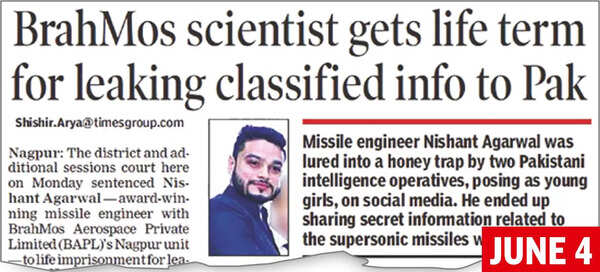
The Nagpur Bench of the Bombay High Court has set aside the life sentence awarded to former BrahMos Aerospace senior scientist Nishant Agarwal, clearing him of major espionage charges and paving the way for his release.
Agarwal had been accused of leaking sensitive missile-related information to Pakistani intelligence agencies and was sentenced to life imprisonment by a Nagpur court in 2024.
A division bench of Justices Anil Kilor and Pravin Patil struck down the conviction under Section 66(f) of the Information Technology Act (cyber terrorism) and key provisions of the Official Secrets Act (OSA). The court ruled that although Agarwal committed procedural violations, the prosecution failed to establish that any sensitive data was actually transmitted to Pakistan or its operatives.
However, the court upheld his conviction under Section 5(1)(d) of the OSA for unauthorised possession of classified documents on a personal device. Agarwal was sentenced to three years’ imprisonment for this offence. Since he has been in custody since October 2018 – more than six years – he has already served the sentence.
The prosecution had alleged that Agarwal was honey-trapped by Pakistani operatives using fake Facebook profiles of women and that malware on his laptop had siphoned off sensitive BrahMos data to foreign servers. But the High Court found no technical evidence to support these claims, Government Pleader Adv Sanjay Doifode told The Indian Express.
“In the judgment delivered today, the High Court convicted him (Nishant Agarwal) for three years under Section 5(1)(d) of the Official Secrets Act regarding the possession of secret information. However, he has been acquitted of the charge under Section 66(f) of the IT Act, for which he had been sentenced to 14 years,” Adv Doifode said.
“Regarding Section 5, it was established that he transferred 19 files containing secret BrahMos information from his official laptop to his personal device, another laptop. Section 66(f) was applied on the premise that this data was transferred to, used by, or obtained by a third party. However, it could not be proven that this secret information was actually transferred elsewhere,” he added.

“We alleged that he either transferred the data to them, or they extracted it from his device, because the malware or the software he was using was active and capable of sharing all data to a cloud-based server. Therefore, our stance was that the data had gone elsewhere,” Adv Doifode said.
With the High Court holding that the prosecution failed to prove intent or action amounting to aiding an enemy state, the 14-year rigorous imprisonment imposed under the IT Act was set aside. Since Agarwal has already spent over six years in custody without bail, his three-year sentence for the lesser charge stands fully served.
A Nagpur court had, in 2024, sentenced the ex-BrahMos Aerospace engineer to life imprisonment on charges of spying for Pakistan’s ISI. Agarwal was arrested in 2018 for allegedly leaking information on the BrahMos missile system to Pakistani intelligence operatives.
Agarwal, a senior system engineer at BrahMos Aerospace, a joint venture between DRDO and Russia’s Military Industrial Consortium (NPO Mashinostroyenia), worked on India’s supersonic cruise missile capable of being launched from land, air, sea and underwater.

He was granted bail by the Nagpur bench of the Bombay High Court in April 2023. His arrest in 2018 created ripples as it marked the first espionage case to hit BrahMos Aerospace. Investigators had found he was in touch with suspected Pakistani intelligence operatives through two Facebook profiles – allegedly “Neha Sharma” and “Pooja Ranjan” – which were traced to Islamabad.
Agarwal, an NIT Kurukshetra graduate and recipient of DRDO’s Young Scientist Award, was regarded as a bright engineer, making the allegations particularly shocking for his colleagues.

- Previous New Delhi says Pakistan has rebuilt and reactivated 72 terror launchpads along Jammu frontier since Op Sindoor
- Next Trump Administration tries to go after Chinese CCP-linked firms with stakes in US solar companies and wanting federal money from qualifying for Inflation Reduction Act incentive
You may also like...






Random news









About us
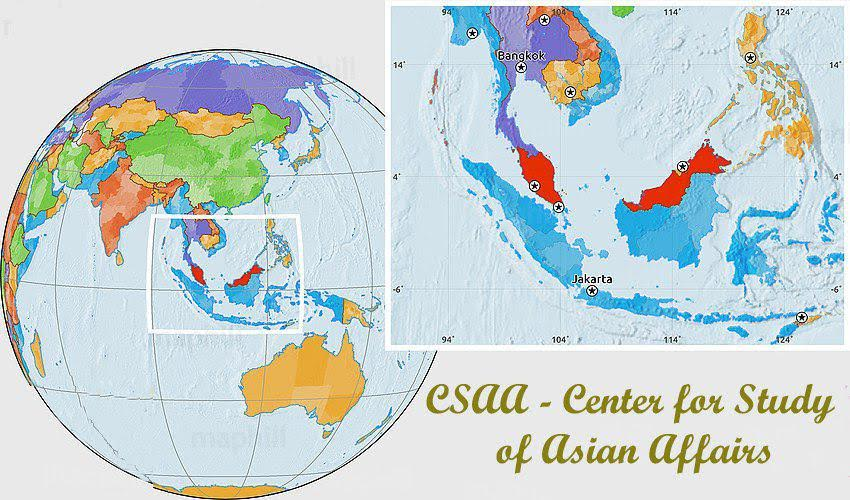
Our Newly established Center for study of Asian Affairs has
branches in Indonesia, Malaysia and Singapore, as well as freelances in some other countries.
For inquires, please contact: newsofasia.info@yahoo.com Mr.Mohd Zarif - Secretary of the Center and administer of the web-site www.newsofasia.net
Polls
 Loading ...