

India Today’s Assessment Opinion: If Netanyahu goes, will Israel’s wars and woes end?
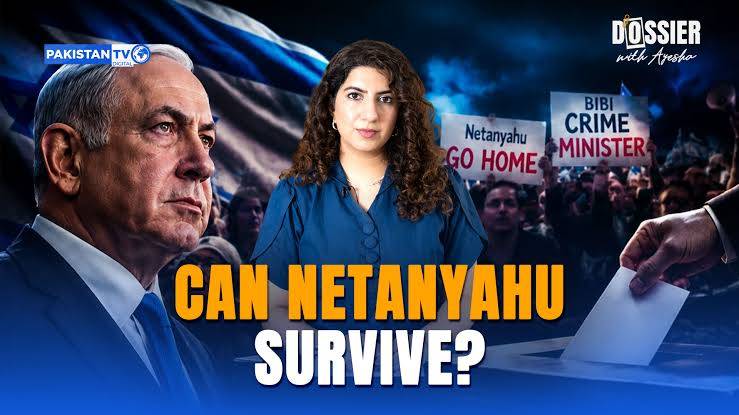
Israel votes on October 27. Pre-election polls suggest PM Benjamin Netanyahu is struggling. If he loses, will Israel’s security doctrine change? Would a new prime minister change Israel’s approach to Iran, Gaza, Lebanon and Palestinian statehood?
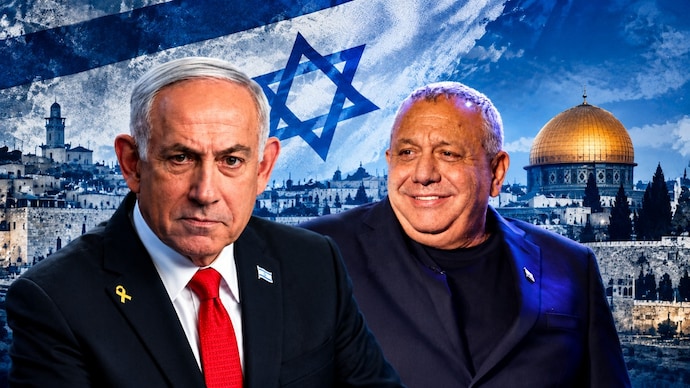
For many Indians, Benjamin Netanyahu has been the face of Israel’s growing friendship with India — from defence cooperation to the much-publicised camaraderie with Prime Minister Narendra Modi. He has been the face of Israel’s military might, its ties with the White House and, also, its controversial wars and policies towards Palestinians. But Israel’s October 27 election could end his long dominance over the country’s politics.
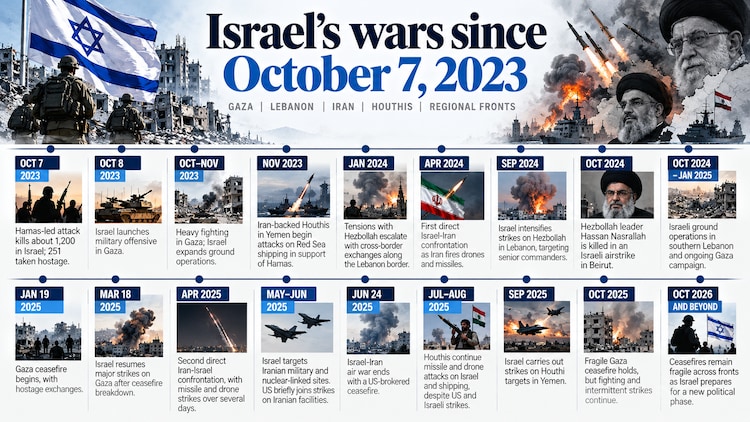
The question matters because Israel has spent the last three years, especially after the October 7, 2023, massacre by Hamas, fighting on multiple fronts. Because of the destruction and humanitarian crisis in Gaza, tensions with Iran and Hezbollah, it has received international criticism. The Jewish nation has also faced enormous security and diplomatic challenges. In all likelihood, a new government, particularly one without Netanyahu’s far-right allies, could change how Israel negotiates, conducts military operations, and deals with Palestinians.
So, what might actually change if Netanyahu loses? Recent statements by his challengers and assessments by Israeli and international experts help us understand that.
NETANYAHU’S BIGGEST CHALLENGER IS NO PEACE DOVE
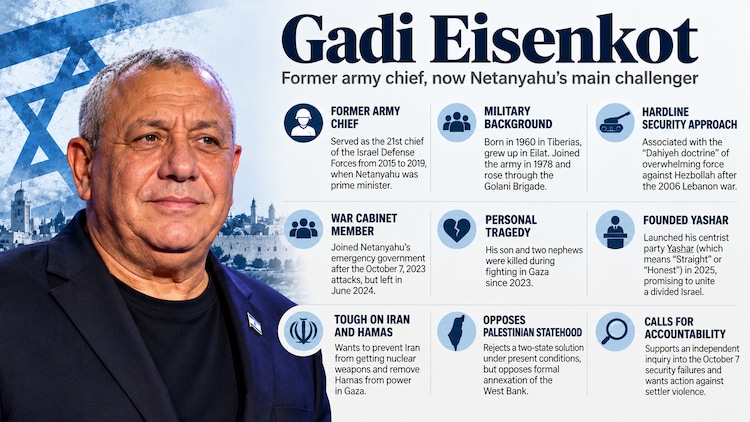
Gadi Eisenkot, the former chief of the Israel Defense Forces (IDF), has emerged as Netanyahu’s strongest challenger ahead of the October 27 election. Experts believe he’s offering Israelis a change in leadership without promising to abandon the country’s military-first security policies.
Eisenkot headed the IDF from 2015 to 2019, during Netanyahu’s tenure as prime minister. After the October 7 Hamas attack, he joined Netanyahu’s war cabinet but left in June 2024, accusing the prime minister of failing to achieve the government’s objectives.
The conflict is personal for Eisenkot, too. His son and two nephews have been killed fighting in Gaza since 2023.
But Eisenkot is not a pacifist. During Israel’s 2006 against Hezbollah in Lebanon, he was associated with the “Dahiyeh doctrine”, which advocates overwhelming military force in response to attacks by armed groups.
The immediate question is whether Eisenkot would be tougher or softer than Netanyahu. The bigger and more consequential one is whether he would pursue the same military objectives through different methods. Would those methods mean fewer wars or even deadlier attacks?
IRAN WAR COULD OUTLAST NETANYAHU, TRUMP: EXPERTS
Israel’s confrontation with Iran has become central to its national security doctrine, particularly since it added another front by initiating joint military operations along with the Americans against Tehran in February 2026.
Netanyahu has increasingly presented the overthrow of Iran’s ruling establishment as an Israeli objective. “There is only one way to remove this threat once and for all: overthrow the regime in Iran,” Netanyahu said at a military graduation ceremony in October.
Jared Szuba, a defence and security correspondent with Al-Monitor, highlighted an important point in a post on X. “With the exception of former IDF chief Gadi Eisenkot, all of Benjamin Netanyahu’s challengers to be Israel’s next prime minister say the war against Iran must resume. Only Netanyahu claims he has Trump’s support to do so.”
This suggests that Eisenkot does not want the war against Iran to be immediately resumed. But he has not ruled out future military action.
Michael Young of the Carnegie Middle East Center told Reuters that Israel’s security establishment and political class broadly shared the same strategic outlook on Iran. He also questioned if sustained military pressure could change Tehran’s calculations fundamentally. “This is a quagmire,” Young said. “The Iranians can outlast Trump.”
So, according to Young’s assessment, Israel might get a new prime minister, but its long-running conflict with Iran is unlikely to end.
WILL GAZA SEE PEACE WITHOUT NETANYAHU?
The war in Gaza began after Hamas terrorists attacked southern Israel on October 7, 2023, killing around 1,200 people and taking 251 hostages. Israel’s subsequent military campaign devastated the Palestinian territory and killed tens of thousands of people.
An American-brokered ceasefire in October 2025 brought an end to major combat and secured the release of the remaining hostages. However, Hamas’s disarmament, Israeli withdrawal and Gaza’s future governance are still unresolved. Netanyahu and Eisenkot agree that Hamas must not retain its military capabilities or govern Gaza.
In an interview, Eisenkot criticised Netanyahu for failing to achieve that objective. “This is where we need to see how it gets done, how Hamas’ military wing is destroyed or dismantled. It must end with that,” he told Israel’s Channel 7.
Eisenkot has promised to end Hamas rule within 18 months of taking office.
In an October 22 analysis, the European Council on Foreign Relations (ECFR) said a government without Netanyahu might be more willing to compromise on disarming Hamas, which would help the Gaza ceasefire move forward. But lasting peace would still depend on Israel withdrawing its troops, deciding who runs Gaza and rebuilding the war-ravaged territory.
LEBANON AND HEZBOLLAH COULD REMAIN TARGETS
Israel’s confrontation with Hezbollah in Lebanon predates the current war. But the fighting that followed October 7 transformed its military posture along the northern border.
The IDF said that Israel has pursued a strategy of maintaining security zones beyond its borders in Lebanon to prevent armed groups like Hezbollah from threatening Israeli communities. And, that strategy has support beyond Netanyahu’s current government.
Peter Wijninga, a defence expert at The Hague Centre for Strategic Studies (HCSS), said in an assessment shared by the institution on X on that little would change in the Middle East if Eisenkot defeated Netanyahu.
“The attitude toward Iran and Israel’s enemies, Hezbollah, Hamas and the Houthis, will be maintained,” he said.
Eisenkot’s own military history reinforces Wijninga’s assessment. Eisenkot commanded Israeli forces during the 2006 Lebanon war and has long advocated overwhelming military responses to threats from Hezbollah. So, an opposition government might pursue negotiations more actively or alter the intensity of military operations. But there is little evidence that Eisenkot would abandon Israel’s forward-defence strategy or accept Hezbollah rebuilding its military strength near the northern border.
There could be a change in military tactics. But an end to confrontation is unlikely, it seems.
PALESTINIAN STATEHOOD FACES BIGGER OBSTACLE
For Palestinians and their supporters hoping that Netanyahu’s defeat could revive efforts towards a two-state solution, Eisenkot’s position offers little encouragement. Netanyahu opposes an independent Palestinian state. So does Eisenkot.
In an interview with Israel’s Channel 7, Eisenkot said, “Two states for two people is a mistake.”
He also insisted that Israel should have overriding security responsibility across the territory between the Jordan River and the Mediterranean Sea (east to west).
“My position is that between the Jordan River and the [Mediterranean] Sea, Israel must have overriding security responsibility. There must not be any foreign army between the Mediterranean and the Jordan if we wish to live,” he said.
However, Eisenkot differs from Netanyahu’s far-right coalition partners over Jewish settlements in the West Bank. He has opposed unauthorised outposts, has criticised settler violence against Palestinians and objects to construction in the controversial E1 area of the occupied West Bank.
The Netanyahu government’s E1 project has drawn international opposition and condemnation because it could divide the West Bank, scatter it in patches, and make a contiguous Palestinian state harder to establish.
Ghassan al-Khatib, a Palestinian political analyst, told Reuters that the fundamental Israeli position on Palestine is unlikely to change. “The substance of the policy remains the same: No to a Palestinian state and yes to further settlement expansion. On this, they are all in agreement,” he said.
An opposition government might curb some settlement activity and violence, but wouldn’t be accepting Palestinian sovereignty.
SO, WHAT COULD ACTUALLY CHANGE AFTER NETANYAHU?
While Israel’s security policies would continue even if Netanyahu goes out of power, his departure could produce significant changes in domestic politics, relations with Western governments and the influence of the far right.
In their analysis for the Peace Research Institute Frankfurt (PRIF), researchers Ilai Yaron Levy and Claudia Baumgart-Ochse identified accountability for the October 7 security failures, judicial independence and military-service exemptions for ultra-Orthodox Jews as major electoral issues.
Eisenkot has called for an enquiry into the October 7 Hamas attacks and has opposed the influence of Netanyahu’s far-right allies, including Itamar Ben-Gvir and Bezalel Smotrich.
The October 22 analysis by the European Council on Foreign Relations (ECFR) also suggested that an opposition government could improve relations with European and Arab governments, curb settler violence and pursue limited regional security agreements.
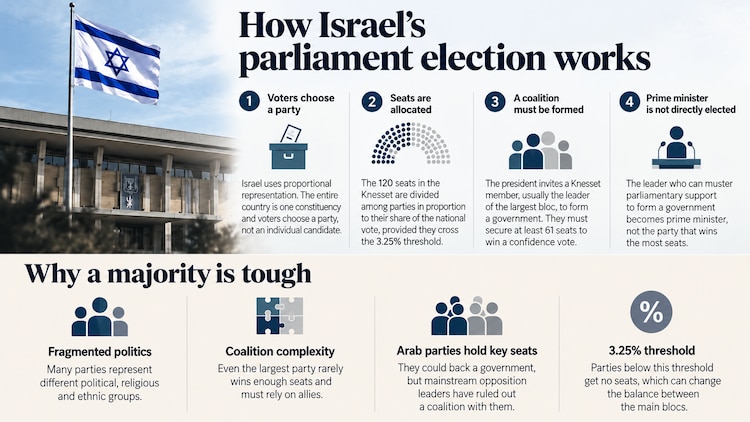
But the electoral arithmetic for power in the Knesset is complicated. Recent polls have placed Eisenkot’s Yashar ahead of Netanyahu’s Likud. However, neither political bloc is assured of the 61 seats required for a majority in the 120-member legislature.
Eisenkot has ruled out forming a coalition with Arab-led parties. This can make his path to government difficult. And, a political deadlock could even leave Netanyahu serving as caretaker prime minister.
There is another challenge for Israel’s next prime minister. Gulf countries want an end to Israel’s military campaigns and its hardline policies towards Palestinians, but they also see Iran as a major regional threat. Against Iran, Israel is on their side.
So, Israel’s October 27 election could bring a new prime minister after three years of devastating wars. But the change might not bring peace. The October 7 Hamas attacks changed how Israelis view their security. Much of the political establishment now supports a tough military approach towards Iran, Hamas and Hezbollah. Experts say Eisenkot would be willing to negotiate and improve ties with other countries. He might also rein in the far right. But his main security goals are not very different from Netanyahu’s. The wars and policies that have defined Netanyahu’s years in office could well outlast him, only if he loses.

- Previous China’s Communist Party’s plenum discussed anti-corruption, discipline and continuation of purge of ranks issues
- Next With 13 years of learning and no engineering degree an Uttarakhand man builds flying car
You may also like...



Random news






About us
Our Newly established Center for study of Asian Affairs has
branches in Indonesia, Malaysia and Singapore, as well as freelances in some other countries.
For inquires, please contact: newsofasia.info@yahoo.com Mr.Mohd Zarif - Secretary of the Center and administer of the web-site www.newsofasia.net
Polls
 Loading ...