

Indian city of Surat is becoming India’s new spending hub
Forget Mumbai, Bengaluru.
With a population nearly the size of a Big Six city (Mumbai, Bengaluru, Delhi, Chennai, Hyderabad and Kolkata) and a large concentration of young people, Surat has emerged as India’s largest consumption market outside the six megacities.
India’s consumption story has been told through the lens of its biggest metros; Mumbai, Bengaluru, Delhi, Chennai, Hyderabad and Kolkata, for years. But a new consumption map is emerging, and Surat is at the centre of it.
Surat may rank seventh among India’s top consumption markets, but it is the biggest market outside the country’s six megacities. That makes the Gujarat city an important marker of how India’s spending is spreading beyond its traditional metropolitan centres.
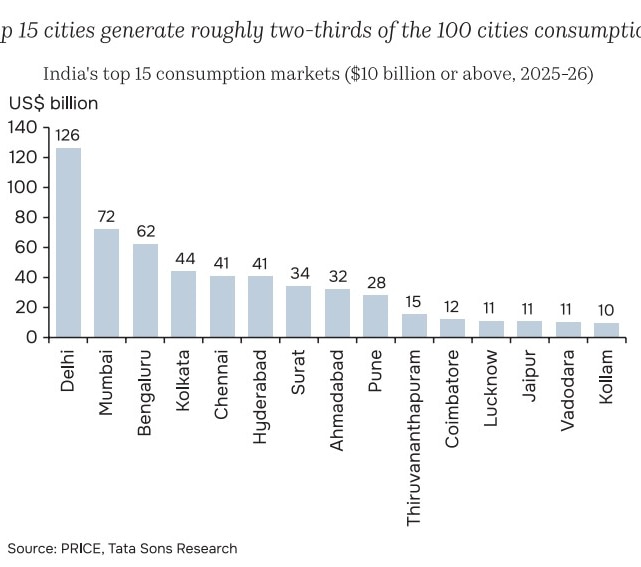
The top 15 cities, each with consumption markets of at least $10 billion, together account for roughly two-thirds of consumption across the 100 cities studied.
This does not mean Mumbai or Bengaluru are being overtaken in absolute consumption. The Big Six still account for 46% of the $844 billion annual consumption across the 100 cities. But Surat shows that India’s biggest consumption opportunities are no longer confined to the traditional metros.
Surat is not alone in standing out on consumption. Chandigarh and Thiruvananthapuram have the highest average household consumption in India, backed by high savings and low debt.
Surat’s rise is part of a wider shift in India’s urban economy. The top 100 cities house less than one-fifth of the country’s population but account for nearly one-third of national consumption, worth Rs 74.5 lakh crore or $844 billion. Household expenditure in these cities has been growing at 10.4% annually, compared with 8.5% for India as a whole.
Within this universe, Surat stands out because it combines a large population with unusually strong household spending.
The city is classified as a “Boomtown” — one of 19 fast-growing cities that also includes Pune, Ahmedabad, Lucknow, Coimbatore, Jaipur, Indore and Vadodara. These cities are becoming the next major pool of consumer markets because they combine sizeable populations with high spending per household.
In fact, the report says Surat, along with Chandigarh, Thiruvananthapuram and Vadodara, has higher per-household spending than the Big Six.
SURAT HAS THE INCOME TO SPEND BIG
A large consumer market needs more than people. It needs households with rising incomes and enough financial headroom to spend.
That is where Surat’s story gets particularly interesting.
The report says Surat’s pools of middle- and high-income households are not only among the largest in India but also among the fastest growing. It attributes this to the city’s textile-led entrepreneurship, diamond trade and the upward mobility of its migrant population.
Surat’s average household income is also higher than those in Hyderabad, Chennai and Kolkata. Bengaluru and Chandigarh have the country’s highest average household income at around Rs 28 lakh, while cities such as Pune, Thiruvananthapuram and Surat sit ahead of three of the Big Six on this measure.
This is happening as India’s urban middle class expands rapidly. Across the top 100 cities, the share of middle-income households, those earning Rs 6 lakh to Rs 36 lakh annually, has nearly doubled to 53% from 29% over the past decade. By 2030-31, they are expected to account for 60% of households.
The high-income segment is expanding even faster. Households earning more than Rs 36 lakh a year have risen to 12% from 3% over the past decade and are projected to account for nearly one-fifth of households by 2030-31.
Surat is therefore benefiting from exactly the income shift that is reshaping India’s urban consumption.
As incomes rise, what households spend on also changes.
Across India’s top 100 cities, food now accounts for 31% of household spending, down from around 38% a decade ago. At the same time, the typical urban household allocates roughly two-thirds of its expenditure to services, with housing, transport and education becoming increasingly important parts of the household budget.
The Boomtowns, including Surat, spent a combined Rs 20.1 lakh crore in 2025-26. Average household expenditure stood at Rs 12.2 lakh and has grown at 10.5% annually over the past decade. Food accounts for 31.1% of spending, housing and utilities 25.8%, transport 19.2% and education 6.8%.
Housing alone is a major consumption engine. Boomtown households spend nearly 3.5% more on housing and related services than Big Six households in absolute terms, reflecting rapid urban expansion and household formation.
Transport is another big-ticket category. Across the top 100 cities, households spend an average Rs 2.6 lakh annually on transportation, taking total transport expenditure to Rs 15.8 lakh crore.
And Surat’s spending is not confined to weekdays. Nearly 62% of urban expenditure nationally happens on Saturdays and Sundays. Surat has one of India’s highest weekend spending multipliers at 2.44 times weekday spending, second only to Jaipur’s 2.76 times.
The report links these patterns to rising incomes, young and mobile populations, strong retail and service ecosystems, and greater discretionary spending.
That makes Surat’s consumption story particularly relevant to businesses selling experiences, lifestyle products and discretionary goods, not just essentials.
WHEN A CITY GETS RICHER, CARS AND APPLIANCES FOLLOW
The next phase of Surat’s consumption story could be visible in the things households buy for their homes and mobility.
Across the Boomtown category, car ownership has reached 32%, broadly matching the Big Six. Motorcycle ownership is considerably higher at 72%, compared with 50% in the Big Six. Washing-machine ownership stands at 40% and microwave ownership at 31%, against 30% and 27%, respectively, in the Big Six.
The report identifies clear income thresholds behind some of these purchases. Households earning Rs 12-14 lakh are more likely to buy cars, while washing machines become more likely after the Rs 14 lakh income threshold is crossed.
That matters for cities such as Surat because rising household incomes are creating a larger pool of consumers moving into these discretionary and aspirational categories.
Across the 100 cities, middle-income households already account for 55% of ownership of computers, air conditioners, washing machines and microwave ovens. As more households move into higher income brackets, the report expects emerging cities to be at the forefront of a new wave of consumer durable purchases.
There is another aspect to Surat’s consumer economy that makes its rise more significant: households are not simply spending more; they are also putting money aside.
Across the top 100 cities, households save Rs 6 lakh on average annually. Urban households now generate 64% of India’s total household surplus income, up from 55% a decade ago, while half of the country’s household surplus is generated by the top 100 cities.
Surat and Vadodara stand out for their savings behaviour. As many as 92% of households in both cities save for contingencies, one of the highest levels recorded in the report.
At the broader Boomtown level, household savings have grown at 9% annually over the past decade. Boomtown households save an average Rs 4.5 lakh a year, while their debt-to-income ratio of 15.4% remains below the Big Six’s 18.5%.
So the Surat consumer is not simply a story of higher spending. It is a combination of rising incomes, consumption and financial capacity.
SURAT MAY BE THE PREVIEW OF INDIA’S NEXT CONSUMER BOOM
Surat’s importance ultimately goes beyond Surat.
More than 65% of India’s top 100 cities are located along major economic corridors, where infrastructure, employment, manufacturing and trade are creating interconnected urban economies.

The western corridor — anchored by Mumbai, Pune, Surat, Vadodara and Ahmedabad, has higher per-capita incomes, a stronger industrial base and leads in durable goods and automotive consumption.
This is changing the old idea that India’s consumer story is essentially a metro story.
The Big Six remain the biggest consumption pool, accounting for 46% of spending across the top 100 cities. But Surat, Ahmedabad and Pune have already built roughly $30 billion consumer markets of their own.
And Surat has something the numbers make difficult to ignore: it is the largest consumption market outside the Big Six, has average household consumption higher than Bengaluru, and has some of India’s largest and fastest-growing pools of middle- and high-income households.

- Previous Japanese Shinjuku Ward plans ban that could shut 2,000 ‘minpaku’
- Next Malaysia: Pilot, 4 Health Ministry personnel confirmed dead in helicopter crash
You may also like...






Random news











About us
Our Newly established Center for study of Asian Affairs has
branches in Indonesia, Malaysia and Singapore, as well as freelances in some other countries.
For inquires, please contact: newsofasia.info@yahoo.com Mr.Mohd Zarif - Secretary of the Center and administer of the web-site www.newsofasia.net
Polls
 Loading ...