

Japan: Mie Governor Ichimi stops hiring foreigners and inclusion in community
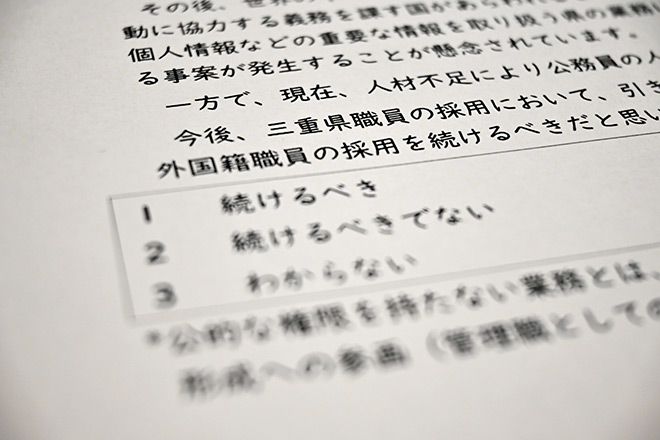 Mie Prefecture plans to distribute this questionnaire to local voters to ascertain opinions about hiring foreigners. (Takuya Kitazawa)
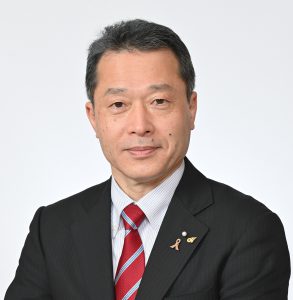
Mie Governor Katsuyuki Ichimi intends to review the prefectural government’s practice of hiring foreign nationals mainly for general administrative positions.
A final decision will be made following a survey of 10,000 Mie voters that begins Jan. 26.
Ichimi’s plan should be retracted.
From the 1970s, local governments began dropping the Japanese nationality requirement for hiring workers. At that time, calls started growing to remove the nationality condition to end discrimination toward ethnic Koreans seeking government jobs.
The central government’s position was that civil servants taking part in the exercise of public authority or in forming the will of the state should hold Japanese nationality. It added that it was inappropriate for local governments to hire those with foreign citizenship.
But in 1996, the home affairs minister issued a statement that said a resolution of the issue might be found if appropriate measures were taken while adjusting implementation of the hiring process.
That led to local governments in various areas to remove the condition as a way to overcome discrimination based on nationality and conform with moves toward internationalization.
Mie Prefecture abolished the nationality condition from its hiring exam for general administrative positions in fiscal 1999.
The condition remains for five job categories in which the majority of the work involves the exercise of public authority, such as granting approval or conducting searches.
According to the Mie prefectural government, 12 prefectures have done away with the nationality condition.
But Ichimi said prefectural government workers, even in general administrative positions, might handle personal information of Mie residents and other important data concerning the movement of dignitaries, infrastructure and seed and seedling development.
While not naming any specific nation, Ichimi said a review was needed because of the possibility that workers could leak confidential information to foreign nations.
It is highly likely he was concerned about China’s National Intelligence Law, which obligates Chinese companies and citizens to cooperate with intelligence-gathering activities.
But such thinking may lead to prejudice that equates foreigners with spies.
Regardless of nationality, there is always the possibility that government workers could leak information. What is needed are specific measures to prevent such actions.
When asked about the Mie policy, Aichi Governor Hideaki Omura criticized the resuscitation of the nationality condition.
He said Aichi government workers with foreign nationality have not divulged information because his prefecture has thoroughly educated all workers, including foreigners, about information management.
One question in the Mie survey focuses on whether foreigners should be hired despite concerns they might violate confidentiality obligations covering civil servants.
A number of mayors in Mie along with human rights groups said that question could foment discrimination and prejudice.
Mie Prefecture should remove that question from the survey.
An increasing number of South Americans of Japanese descent have worked in the automobile and electrical equipment industries in Mie Prefecture since the 1990s.
As of June 30, 2025, 71,000 foreigners were living in Mie.
In November, the National Governors’ Association compiled a joint declaration calling for bringing about a multicultural inclusive society.
The Mie policy goes against the current trend of local governments opening their doors to hiring foreigners as a means of including foreign residents into their local neighborhoods.
The prefecture should reconsider its plan.

- Previous Wall Street Journal: Top China general Zhang Youxia accused of leaking nuclear secrets to US
- Next Singapore dollar in highest level against the US dollar since 2014
You may also like...





Random news













About us
Our Newly established Center for study of Asian Affairs has
branches in Indonesia, Malaysia and Singapore, as well as freelances in some other countries.
For inquires, please contact: newsofasia.info@yahoo.com Mr.Mohd Zarif - Secretary of the Center and administer of the web-site www.newsofasia.net
Polls
 Loading ...