

Just the beginning and only enough for few weeks: Japan to release 20% of state oil reserves as crude supplies dwindle
By SATOSHI SHINDEN/ Staff Writer
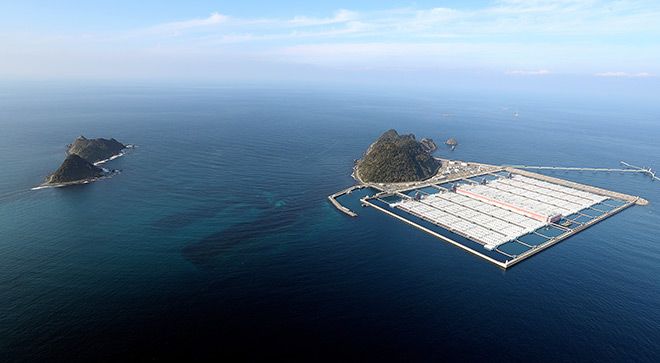 A national oil storage base on Shirashima island off Kita-Kyushu (Asahi Shimbun file photo)
Japan will begin releasing oil from its national reserves on March 26 as the de facto closure of the Strait of Hormuz sharply reduced crude oil shipments from the Middle East.
The government will sell about 53 million barrels, the equivalent of one month of domestic consumption, to four major oil wholesalers through negotiated contracts.
The plan was announced at a meeting of relevant Cabinet ministers on the Middle East situation on March 24.
The volume represents 20 percent of the country’s state stockpiles, which covered 146 days of domestic consumption as of March 21.
“We would like the government to swiftly decide on the next batch of release,” Shunichi Kito, president of the Petroleum Association of Japan, told reporters on March 24.
It will be the second release of national oil reserves under the law, following the one carried out in response to Russia’s full-scale invasion of Ukraine in 2022.
Oil will be transported to wholesalers’ refineries in stages via tankers and pipelines from 11 of the 20 storage bases, including those in Hokkaido and Kagoshima Prefecture.
It will be sold at crude oil prices prevailing before the surge triggered by escalating tensions in the Middle East, with total proceeds expected to be about 540 billion yen ($3.4 billion).
Separately from the national reserves, oil stored in private-sector tanks that are leased to petroleum companies from three oil-producing countries will be released for the first time by the end of March.
Under the joint stockpiling program, companies from Saudi Arabia, the United Arab Emirates and Kuwait use the facilities in Kagoshima and Okinawa prefectures as sales bases for the Asian market during normal times.
Japan is guaranteed priority access to supplies during emergencies.
While the tanks held the equivalent of six days of domestic consumption as of March 21, five days’ worth will be sold to the wholesalers.
The government lowered the legally mandated stockpiling requirement for oil wholesalers and trading houses from 70 days’ worth to 55 days on March 16, allowing them to draw down 15 days’ worth of reserves.
Taken together with releases from the private-sector reserves, the series of drawdowns will total about 90 million barrels, or the equivalent of about 50 days of domestic consumption.
Efforts are also under way to transport crude oil via routes that bypass the Strait of Hormuz.
Two tankers that departed from a port in northeastern UAE outside the strait and another along Saudi Arabia’s western Red Sea coast are expected to arrive in Japan at the end of March or later, according to the government.
While procurement through alternative routes could expand, volumes are expected to be limited.
The government and the Petroleum Association of Japan said they are considering increasing purchases of crude oil from the United States, but deliveries will not arrive until June or later.

- Previous With Russian RosAtom, Uzbekistan Launches First Concrete Works at Planned Nuclear Power Plant
- Next Mideast crisis bumps chemical prices along supply chain
You may also like...






Random news











About us
Our Newly established Center for study of Asian Affairs has
branches in Indonesia, Malaysia and Singapore, as well as freelances in some other countries.
For inquires, please contact: newsofasia.info@yahoo.com Mr.Mohd Zarif - Secretary of the Center and administer of the web-site www.newsofasia.net
Polls
 Loading ...