

Macron of France wants help of Japan on rare earths, safe Hormuz passage
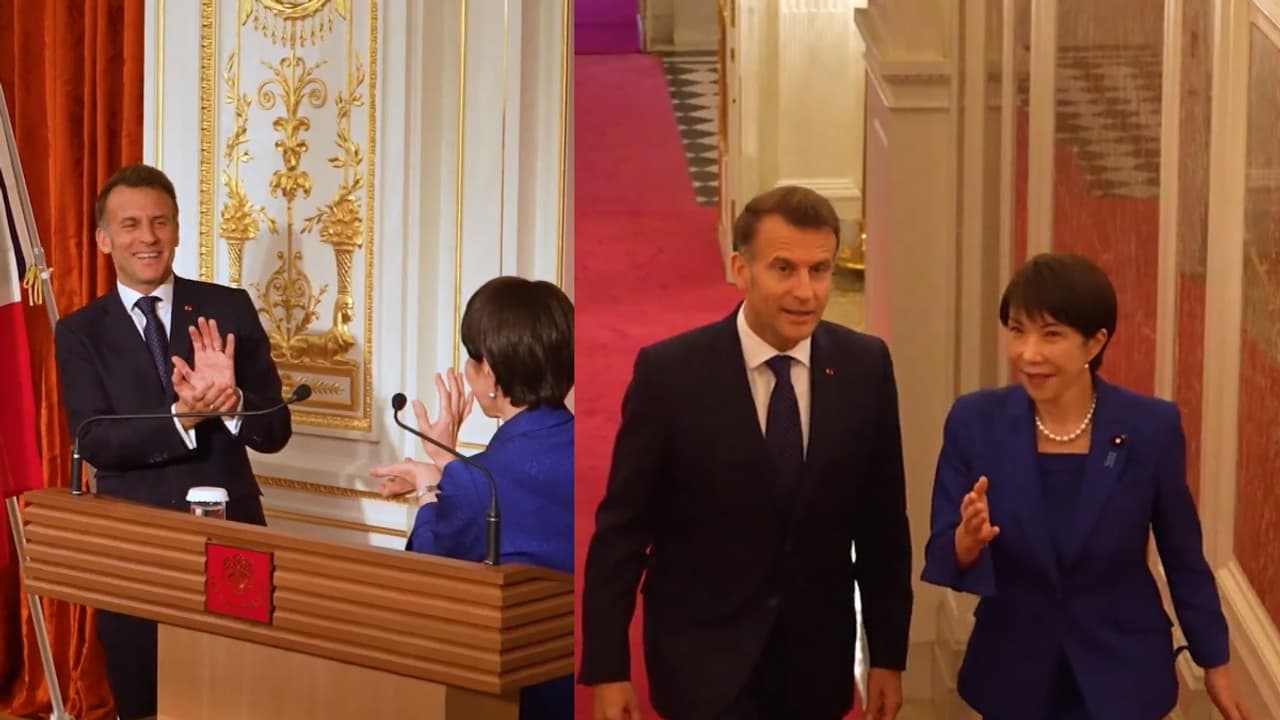
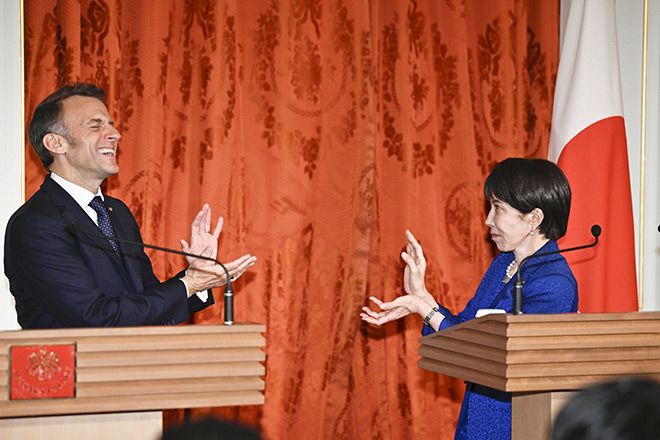 Prime Minister Sanae Takaichi and French President Emmanuel Macron cup hands in a gesture of a signature technique from the Dragon Ball series, a Japanese manga popular in France, at a news conference in Tokyo on April 1. (Pool)
Prime Minister Sanae Takaichi and French President Emmanuel Macron agreed to boost bilateral cooperation to diversify supply chains for critical minerals such as rare earth elements as China tightens export controls.
The two leaders, who met in Tokyo on April 1, also affirmed the importance of ensuring the safety of navigation in the Strait of Hormuz, which has been effectively closed amid escalating tensions in the Middle East.
Takaichi and Macron shared “grave concerns” over export restrictions on rare earths and other key materials.
The two countries will work together to broaden procurement sources and secure stable supplies.
On the Middle East, the two leaders agreed to maintain close communication toward an early de-escalation of the crisis.
At a joint news conference after the talks, Takaichi said, “Precisely because the international environment is so severe, it is meaningful for the leaders of Japan and France to deepen friendship and solidify cooperation.”
She described France as a “special partner” that shares values and principles, such as the rule of law, with Japan.
Macron said Japan and France believe in international law, the international order and democracy.
“Together, we defend the restoration of peace, a cease-fire and freedom of navigation in the Strait of Hormuz,” he said.
Macron also said the two countries share values grounded in international law even in a highly tumultuous world.
The joint statement released after the meeting confirmed cooperation not only in the field of economic security but also in nuclear energy, space and artificial intelligence technologies with civilian and military applications.
Japan and France will establish a high-level dialogue on dual-use AI technologies. They also plan to strengthen cooperation on next-generation nuclear reactors.
At a meeting of foreign and defense ministers on the same day, the two countries confirmed their intention to deepen defense cooperation through joint exercises and other activities.
It was Macron’s first visit to Japan as president in about three years, since the Group of Seven summit held in Hiroshima in 2023.
France will host the G-7 summit in June.
U.S. President Donald Trump has put forward a “Donroe Doctrine,” which prioritizes engagement in the Western Hemisphere, encompassing North and South America.
He has also carried out an attack on Iran in disregard of international law.
Against this backdrop, Japan and France have underscored their determination to deepen strategic cooperation across a wide range of fields as “special partners.”
The two countries aim to work together to secure safe passage in the Strait of Hormuz after the end of hostilities, building on the framework of a joint statement coordinated under British leadership.
On March 19, six countries, including Britain, France, Germany and Japan, issued a joint statement condemning Iran’s de facto blockade of the waterway and expressing their willingness to contribute to ensuring safe passage. The number of participating countries has since expanded to 35.
Tsuyoshi Goroku, an associate professor at Nishogakusha University, said France is seeking to enhance its strategic autonomy while keeping the United States engaged in European security amid growing uncertainty surrounding the Trump administration.
Goroku, who specializes in European security, said France is positioning Japan as an “important cross-regional partner” to that end.
(This article was written by Takashi Ogawa and Susumu Sakamoto in Paris.)

- Previous Japan to to fill defense ‘vacuum’ in Pacific to counter China
- Next China tries to broker peace between Afghanistan and Pakistan
You may also like...


Random news
About us
Our Newly established Center for study of Asian Affairs has
branches in Indonesia, Malaysia and Singapore, as well as freelances in some other countries.
For inquires, please contact: newsofasia.info@yahoo.com Mr.Mohd Zarif - Secretary of the Center and administer of the web-site www.newsofasia.net
Polls
 Loading ...