

Part of Japanese nation wants to defer succession rights for sons of adopted royals
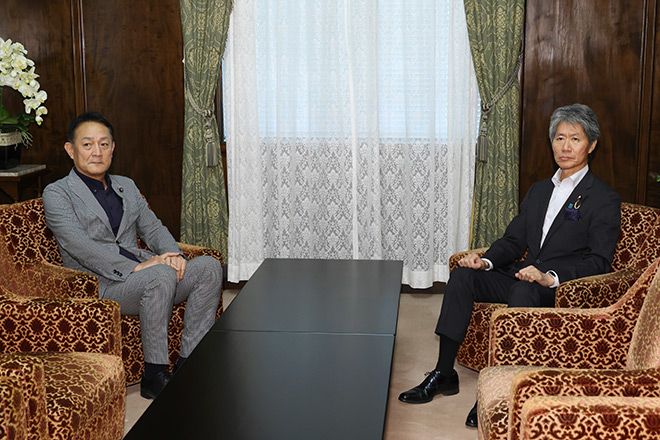 Yoshihiko Isozaki, right, chairman of the Liberal Democratic Party’s Diet Affairs Committee in the Upper House, meets with Yoshitaka Saito, his counterpart from the Constitutional Democratic Party of Japan, on July 6. (Takeshi Iwashita)
The Centrist Reform Alliance (Chudo) plans to call for changes to the wording of the resolution on the Imperial House Law revision bill that would postpone determining if sons of imperial adoptees could succeed the Chrysanthemum Throne.
The main opposition party in the Lower House is considering adding language to the supplementary resolution stating that whether to grant such eligibility will be “promptly examined,” party sources said.
This would position the issue as a matter for future consideration.

The bill, which is primarily aimed at securing a sufficient number of imperial family members, centers around a proposal to adopt male descendants from the patrilineal line of former imperial family branches.
It stipulates that sons born to adoptees would be eligible to succeed the throne.
Prime Minister Sanae Takaichi’s administration hopes to enact the bill during the current Diet session, which ends on July 17.
Specifically, Chudo is considering stating that “the pros and cons (of granting eligibility) shall be promptly examined, and if deemed necessary, required measures shall be taken.”
While supplementary resolutions are not legally binding, Chudo plans to call on other parties to support the language.
Article 2 of the Imperial House Law sets out the specific order of imperial succession.
The bill states that this article will not apply to adoptees themselves, but to any of their sons related by blood.
The presiding officers of the two Diet chambers compiled the “consensus of the legislature” on Imperial House Law amendments after consultations with representatives of the ruling and opposition parties.
It did not address the nature of imperial succession.
Opposition parties have criticized the government bill, arguing that it goes beyond the proposal based on the cross-party discussions.
LDP PROPOSES MEDIA BLACKOUT
The ruling Liberal Democratic Party, meanwhile, made an unusual proposal to prohibit TV and internet broadcasting of Upper House discussions on the Imperial House Law revision bill.
Yoshihiko Isozaki, chairman of the LDP’s Diet Affairs Committee in the Upper House, met with Yoshitaka Saito, his counterpart from the Constitutional Democratic Party of Japan, the main opposition party in the upper chamber, on July 6.
Isozaki conveyed the LDP’s intention to accommodate the opposition’s request to deliberate on the bill at a special committee.
He requested that the proceedings not be aired on TV or streamed online.
Diet discussions are open to the public, in principle.
While there is a procedure for closed-door “secret sessions,” such sessions have been held only in extremely limited cases, such as in connection with the Lockheed payoff scandal in the 1970s.
The July 2017 special committee sessions about the one-off legislation that allowed Emperor Emeritus Akihito to abdicate were also broadcast.
The LDP proposal on the bill, the biggest focus in the final stages of the current Diet session, drew backlash from opposition lawmakers.
“Do they have something they are so desperate to hide? Absolutely unacceptable,” one said.
Another said, “It makes no sense not to broadcast discussions at a special committee.”
The LDP originally insisted on holding deliberations at the Committee on Rules and Administration.
Isozaki pointed out that the cross-party discussions on the Imperial House Law were conducted behind closed doors.
“We would like (Diet) deliberations to proceed without broadcasting, just as is done in the Committee on Rules and Administration,” he told reporters.
However, even the committee has broadcast its sessions on occasion, such as questioning on personnel appointments requiring Diet consent.
The Lower House is expected to discuss the bill first.
The LDP in the Upper House plans to work out specific deliberation procedures with the opposition camp while monitoring developments in the lower chamber.

- Previous RM375 (less 100$) Kuching-KL fare to stabilise market, says AirBorneo
- Next Greeks are also against F-35 fighter jets for Türkiye but claims threat of war
You may also like...






Random news









About us
Our Newly established Center for study of Asian Affairs has
branches in Indonesia, Malaysia and Singapore, as well as freelances in some other countries.
For inquires, please contact: newsofasia.info@yahoo.com Mr.Mohd Zarif - Secretary of the Center and administer of the web-site www.newsofasia.net
Polls
 Loading ...