

US$128.3 billion – Malysian Bank Negara international reserves hit 11-year high


What caused Bank Negara’s reserves to reach an 11-year high in 2026?
How has Bank Negara’s reserves trended over the past decade?
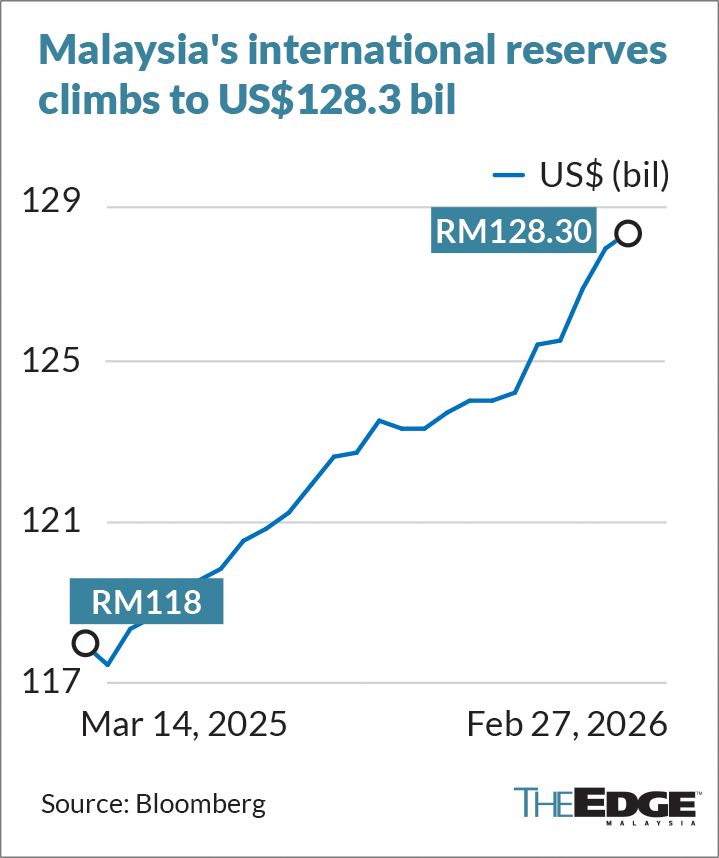
KUALA LUMPUR: Bank Negara Malaysia’s international reserves hit US$128.3 billion as of Feb 27, 2026, the highest level in more than 11 years, supported by stronger foreign exchange and gold accumulation.
According to Kenanga Investment Bank Bhd (Kenanga IB), reserves rose US$1.4 billion, or 1.1 per cent month-on-month (m-o-m), marking the highest level since August 2014.
“Despite the increase, import cover slipped to 4.7 months (January: 4.8), while the reserves-to-short-term external debt ratio remained unchanged at 0.9 times,” the investment bank said in a research note.
Kenanga IB noted that foreign currency reserves extended their uptrend for an 11th consecutive month, rising US$1.2 billion (1.1 per cent m-o-m) to US$112.5 billion, despite net capital outflows.
“Net forex reserves climbed to a 44-month high of US$79.5 billion in January (December: US$77.2 billion), reflecting a smaller predetermined short-term net drain,” it added.
Gold reserves also increased by US$0.2 billion (3.7 per cent m-o-m and 87.6 per cent year-on-year) to a record US$6.1 billion.

“This likely reflects another round of purchases after Bank Negara raised its holdings to 1.36 million fine troy ounces in January (February: 1.25 million), the first increase since October 2018,” Kenanga IB said.
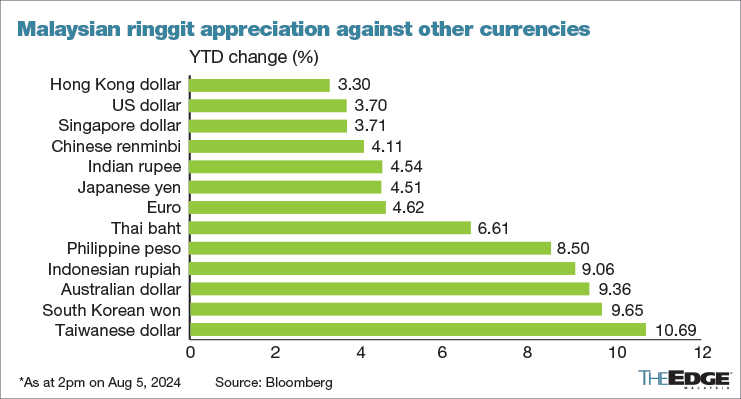
The ringgit strengthened for a fourth consecutive month in February, gaining 3.0 per cent and doubling January’s 1.5 per cent rise.

The US dollar-ringgit pair averaged 3.91 in February 2026 (January 2026: 4.03), its strongest level since April 2018.
“The move reflects a softer US dollar as investors increasingly sold into rallies rather than chase them. Conviction in the US dollar remains fragile, and ‘sell America’ sentiment continues to simmer.
“Markets also recalibrated trade risk after former President Trump replaced the International Emergency Economic Powers Act (IEEPA) tariff regime with a 15.0 per cent surcharge, trimming the tail risk of a sharper trade escalation,” the note added.
Kenanga IB maintained its end-2026 target of 3.95, though it noted that risk distribution has widened materially due to a structural ‘de-commoditisation’ of the ringgit.

- Previous Iran war March 9tj update: China says it opposes targeting of new Supreme Leader after Israel’s threat
- Next Indian Foreign Minister Jaishankar on Iran war – Interest of Indian consumer always overriding priority
You may also like...





Random news












About us
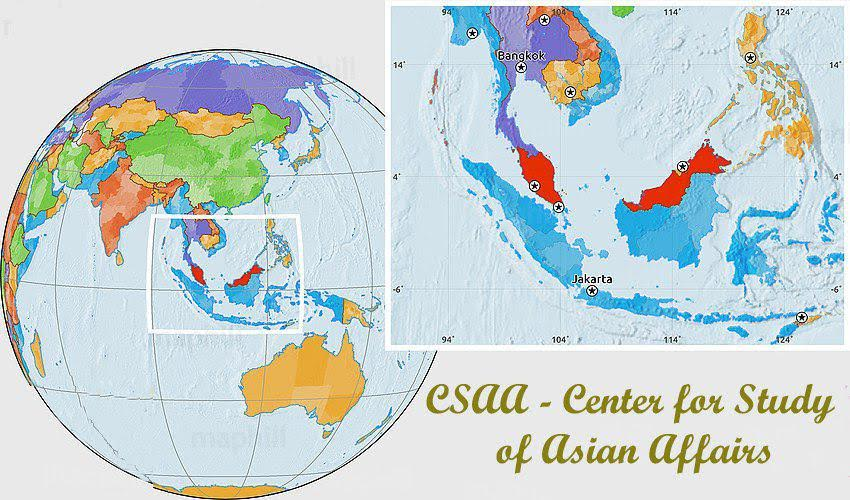
Our Newly established Center for study of Asian Affairs has
branches in Indonesia, Malaysia and Singapore, as well as freelances in some other countries.
For inquires, please contact: newsofasia.info@yahoo.com Mr.Mohd Zarif - Secretary of the Center and administer of the web-site www.newsofasia.net
Polls
 Loading ...