

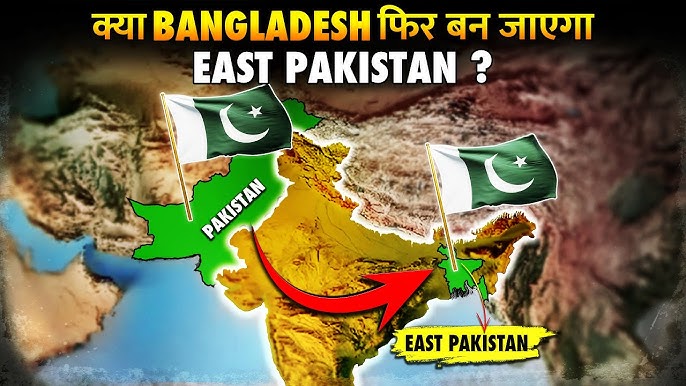
Will there be East Pakistan :) Pakistan’s growing ties to Bangladesh raise alarm bells in India
 By Muheet Ul Islam and Wasim Nabi
It was the first such trip by the head of Pakistan’s Inter Services Intelligence, or ISI, since the country’s independence from Pakistan in 1971.
Malik arrived in Dhaka via Dubai and was received by Lieutenant General Muhammad Faizur Rahman, the quartermaster general of the Bangladesh army.
The visit came months after the political ousting of Sheikh Hasina, Bangladesh’s longest-serving prime minister, who was unceremoniously removed by popular revolt in 2024.
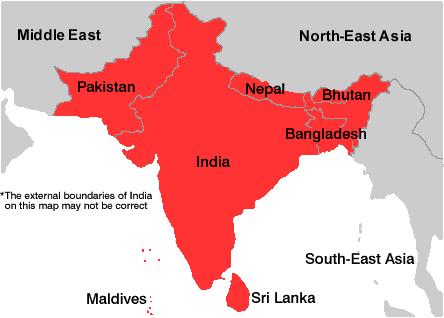
The renewed engagement between Dhaka and Islamabad has drawn close scrutiny in New Delhi, where security officials and analysts see echoes of Pakistan’s evolving defence relationship with Saudi Arabia, a partnership that has expanded over time from training and intelligence-sharing into deeper strategic coordination.
Indian analysts warn that if Bangladesh were to follow a similar trajectory, it could complicate India’s eastern security calculus and undermine New Delhi’s “Neighborhood First” policy at a moment of regional flux.
Hasina, who governed Bangladesh for much of the past two decades, was widely viewed in New Delhi as a stabilising force in bilateral relations, particularly for her administration’s cooperation with India on counterterrorism and its refusal to allow Bangladeshi territory to be used for cross-border militancy.

Her removal from power injected uncertainty into Dhaka’s foreign and security policy, intensifying concerns in India over possible shifts in Bangladesh’s regional alignments.
The Economic Times, one of India’s leading newspapers, reported that the ISI chief’s visit was aimed at expanding intelligence cooperation between Pakistan and Bangladesh. “The Indian security officials see the renewed military engagement as gaining momentum after Hasina’s exit, raising concerns in New Delhi about potential implications for India’s internal security and its eastern borders,” the report said.
Robinder Nath Sachdev, an international relations expert and president of the Imagindia Institute, said India’s influence in Bangladesh has weakened amid a seeming shift away from nationalism. He attributes the shift to both an ideological switch and a reaction to Hasina’s former rule.
“We have seen a trend in Bangladesh in which identity has shifted from being Bangla first and Muslim second, to one that increasingly emphasises being Muslim first and Bangla second,” Sachdev told Middle East Eye.
“Public opinion came to view Sheikh Hasina as acting in an autocratic manner because she was perceived to be supported by India. As a result, opposition to Hasina gradually turned into broader anti-India sentiment.”
Sachdev says that there’s also a growing perception in Bangladesh that the executions of members of Jamaat-e-Islami by the Hasina government were at the behest of India.
Military ties and strategic coordination
Pakistan–Bangladesh engagement has not been confined to just military ties. Civilian exchanges have also increased since 2024, signalling a reset in long-strained bilateral ties.
In August 2025, Pakistan’s deputy prime minister and foreign minister, Ishaq Dar, travelled to Dhaka, marking the first foreign ministerial visit from Pakistan in 13 years. Pakistan’s commerce minister, Jam Kamal Khan, also visited Bangladesh to advance trade talks and sign memoranda of understanding.

During that year, the military exchanges intensified, too. In January 2025, Bangladesh sent a high-level military delegation to Pakistan led by Lieutenant General SM Kamrul Hassan, marking one of the most significant defence exchanges between the two countries in years.
Pakistan’s chairman of the joint chiefs of staff committee, General Sahir Shamshad Mirza, visited Dhaka in October 2025, meeting chief adviser Muhammad Yunus and senior military leaders.
And in December, reports emerged claiming that Bangladesh and Pakistan were exploring a mutual defence agreement, following the signing of a landmark Strategic Mutual Defence Agreement, between Saudi Arabia and nuclear-armed Pakistan on 17 September 2025 in Riyadh.
CNN-News18, citing a senior source in Pakistan’s foreign ministry, reported that Islamabad and Dhaka had established a joint mechanism to finalise the scope and draft of the proposed agreement.
As of this year, Pakistan is in advanced negotiations to sell Bangladesh its JF-17 fighter jet, with some reports suggesting as many as 48 units making up the deal.
“The initiative reflects growing military-to-military engagement and strategic coordination between the two South Asian nations,” the report said.
‘Opposition to Hasina gradually turned into broader anti-India sentiment’
– Robinder Nath Sachdev, Imagindia Institute
The report added that Bangladesh’s military establishment was keen to pursue a strategic and defence pact with Pakistan, similar in scope to Pakistan’s defence cooperation arrangements with Saudi Arabia, and that multiple rounds of discussions had already taken place between senior military officials from both sides.
Under the Saudi-Pakistan agreement, both sides committed that any aggression against one would be treated as aggression against the other, formalising decades of military cooperation.
Lieutenant General Deependra Singh Hooda, a former general officer commanding-in-chief of the Indian army’s Northern Command, said any formal defence pact between Pakistan and Bangladesh would carry serious implications for the region if it were to materialise.
However, he expressed skepticism about the likelihood of such an agreement being finalised in the near term.
“The interim government is unlikely to take such a step with elections approaching,” Hooda told Middle East Eye. “I also do not think all political parties in Bangladesh would support a mutual defence treaty of this nature, which would be seen as directed against India.”
Limits of the relationship
India–Bangladesh relations, Hooda said, are currently strained, pointing to multiple sources of tension, including concerns in New Delhi over the alleged persecution of Hindu minorities in Bangladesh and a recent controversy involving India’s northeastern region.
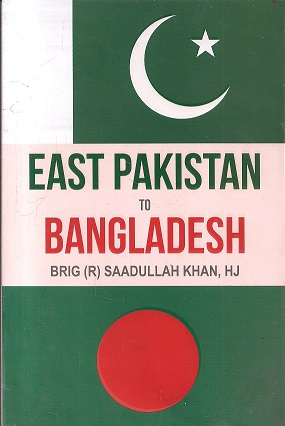
Hooda was referring to an incident during a visit to Bangladesh by Pakistani and Turkish representatives when caretaker Prime Minister Muhammad Yunus presented them with a map described by Bangladeshis as “Greater Bangladesh”.

The map showed India’s seven northeastern states – collectively known as the Seven Sisters – within Bangladesh’s boundaries. The gesture triggered backlash in India, where officials and commentators described it as provocative and insensitive.

“To what extent can Pakistan actually come to Bangladesh’s assistance if there is any problem on the India–Bangladesh border?” Hooda said.
“We need to look at pre-independence Bangladesh. One of the reasons the independence movement began in East Pakistan was the belief that West Pakistan was unable to provide security. The narrative at that time in West Pakistan was that the security of the East lay in the West,” he added.
Despite improving ties, Hooda said, Bangladesh is unlikely to entrust Pakistan with its security.
“I am not sure, looking at it practically, whether Bangladesh is willing to outsource its security to Pakistan in any way,” he said. “Yes, ties are growing. Relations between Bangladesh and Pakistan were in very bad shape and they are now trying to improve them.”
Neither Pakistan nor Bangladesh has accepted or dismissed the reports regarding a potential defence agreement.
MEE contacted Bangladesh’s foreign affairs ministry in Dhaka for comment, but did not receive a response by the time of publication.
Noor Ahmad Baba, a political scientist and former professor at the University of Kashmir, downplayed the possibility of any such deal between Bangladesh and Pakistan. He said that such agreements require a high degree of trust and careful preparation.
“For a long time, the two countries did not enjoy a warm relationship. It is only after the removal of Sheikh Hasina’s government that the two have begun expanding areas of cooperation,” Baba said.

“Beyond this, however, the current interim government in Bangladesh cannot enter into major defence agreements that would carry serious long-term strategic implications for the region,” he added.
In the context of the current cooling of India–Bangladesh relations, Baba added, Dhaka’s warming ties with Pakistan pose a challenge for Indian diplomacy, particularly at a time when New Delhi is already managing not-so-close relations with several of its neighbours.
“The ties between Pakistan and Bangladesh have only recently been revived. Signing an agreement similar to the one between Pakistan and Saudi Arabia would be difficult, as it requires a very high level of trust,” Baba said.
“I believe India will seek to revive its ties with Bangladesh, which is why we saw the Indian Foreign Minister, S Jaishankar, visit Dhaka following the death of former Prime Minister Khaleda Zia,” he added.
Speaking after his visit to Bangladesh, Indian External Affairs Minister Subrahmanyam Jaishankar outlined New Delhi’s neighbourhood policy as one that combines cooperation with firmness.
“India supports its neighbours through investment, development assistance and shared growth,” Jaishankar said, while warning that countries that tolerate terrorism “cannot expect the same approach”.
Referring specifically to Bangladesh, he said India’s economic growth benefits the wider region and expressed hope that bilateral ties would strengthen following Bangladesh’s elections.

- Previous $12 bn. Project Vault: A U.S. Role for Central Asia’s Strategic Minerals
- Next Ambitions, Water and Resources: UAE-Israel-Ethiopia vs Egypt-Saudi-Eritrea regional war is flaring in Sudan and Somali
You may also like...



Random news

About us
Our Newly established Center for study of Asian Affairs has
branches in Indonesia, Malaysia and Singapore, as well as freelances in some other countries.
For inquires, please contact: newsofasia.info@yahoo.com Mr.Mohd Zarif - Secretary of the Center and administer of the web-site www.newsofasia.net
Polls
 Loading ...