

India vs US: Ambassador Vinay Mohan Kwatra tries dispel misconceptions over the proposed FCRA amendment bill
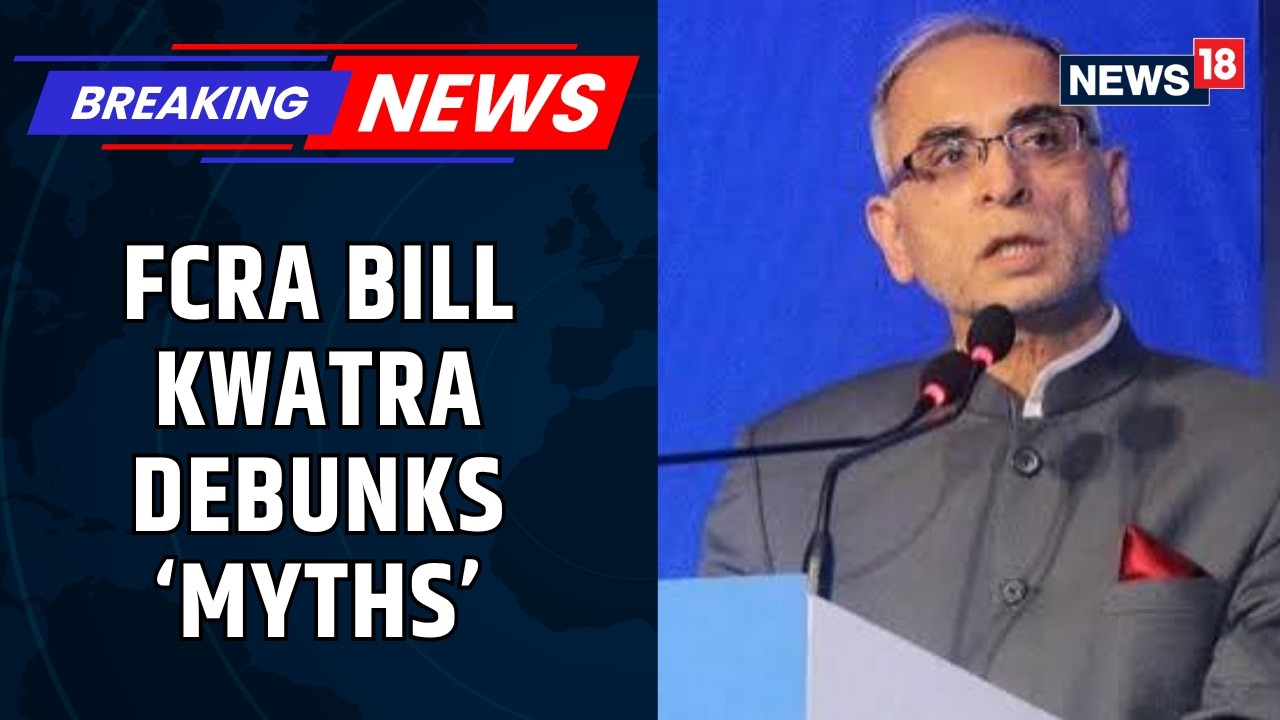
The intervention follows criticism in India and concern from a US lawmaker over foreign funding rules.
- Bu Akash Chatterjee
India’s Ambassador to the United States, Vinay Mohan Kwatra, has sought to counter what he described as “misunderstandings” surrounding the proposed Foreign Contribution (Regulation) Amendment Bill, 2026, saying the legislation does not seek to cut off foreign aid to civil society or target any particular religious community.
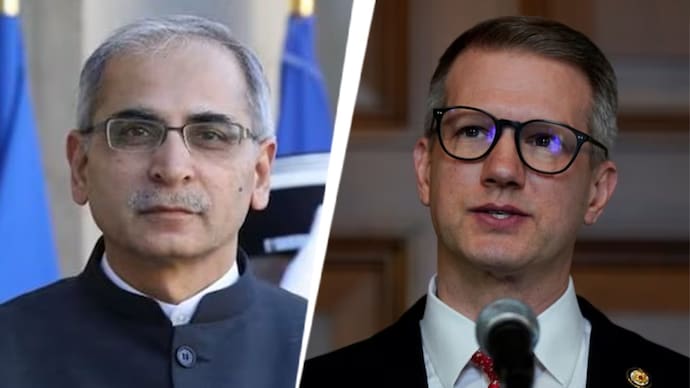
In a series of posts on X, Kwatra laid out what he called a “Myth vs. Reality check” on the proposed FCRA amendments. His comments came after US Congressman Riley Moore raised concerns over the proposed legislation and its potential impact on religious and civil society organisations.
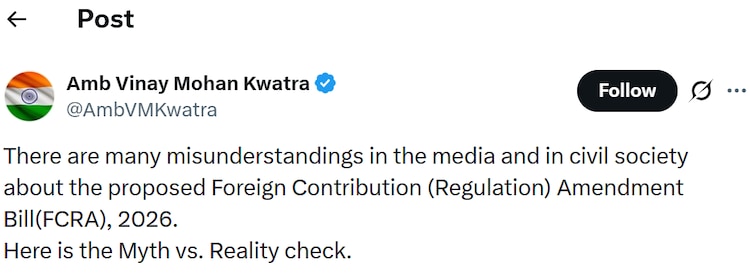
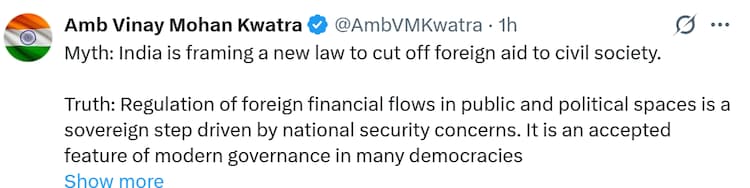
Kwatra said the debate around the bill had been clouded by misconceptions in the media and civil society. Addressing the claim that India was introducing a new law to stop foreign aid to civil society, he said regulating foreign financial flows was a sovereign function driven by national security concerns.
“Regulation of foreign financial flows in public and political spaces is a sovereign step driven by national security concerns,” Kwatra said, adding that such regulation is an accepted feature of governance in many democracies.
KWATRA REJECTS CLAIMS THAT FCRA WILL HURT NGOS
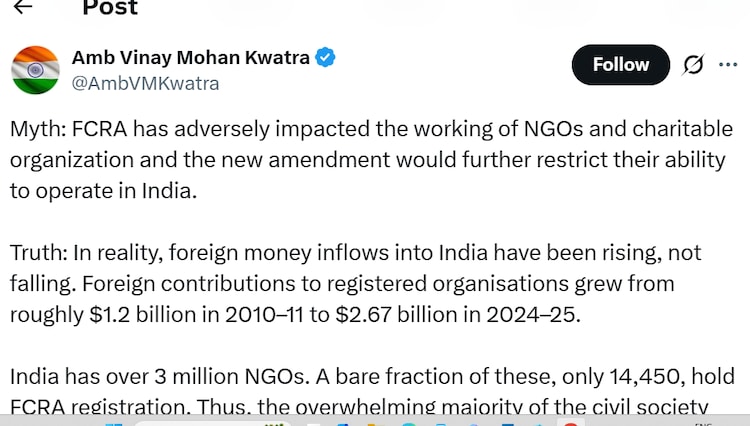
Responding to another claim that the existing FCRA framework had adversely affected NGOs and charitable organisations and that the proposed amendment would further restrict their operations, Kwatra pointed to foreign contribution figures.
He said foreign money flowing into India had been rising rather than falling, with contributions to registered organisations increasing from roughly $1.2 billion in 2010-11 to $2.67 billion in 2024-25.
Kwatra also highlighted the size of India’s civil society sector. According to him, India has more than 3 million NGOs, while only 14,450 organisations hold FCRA registration.
His argument was that the relatively small number of FCRA-registered organisations meant that the proposed amendments should not be viewed as restrictions on the overwhelming majority of civil society organisations operating in the country.
NO SEIZURE OF NGO, RELIGIOUS CHARITY ASSETS, SAYS KWATRA
Kwatra also addressed concerns that the proposed law would result in the seizure of assets belonging to NGOs, religious charities, places of worship, hospitals, schools and other organisations that depend on foreign donations.
He said India welcomes genuine international partnerships and has always maintained a legal framework under which foreign contributions can be received and utilised.
According to Kwatra, when an organisation’s FCRA registration is cancelled or surrendered, the foreign contributions and assets created from them already vest with a state government authority under the existing framework.
“This has been in force since 2010. It is not new,” he said.
Kwatra explained that the proposed 2026 Bill would introduce a designated authority to safeguard such assets, while also providing a mechanism for an organisation to regain them if its FCRA registration is restored.
FCRA DOES NOT TARGET ANY RELIGION, SAYS KWATRA
“Nothing could be farther from it,” Kwatra said, asserting that the law applies uniformly to organisations irrespective of their “religion, community or ideology.”
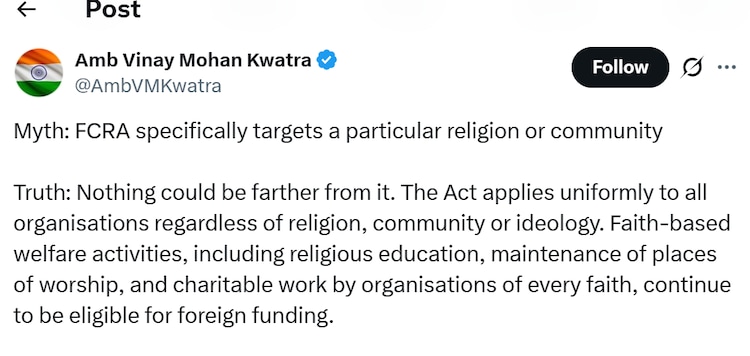
He further said faith-based welfare activities would continue to remain eligible for foreign funding. This includes religious education, maintenance of places of worship and charitable work undertaken by organisations belonging to different faiths.
Kwatra’s intervention comes amid a wider debate over the proposed amendments, with concerns being raised over the impact of tighter foreign-funding regulations on NGOs, charitable institutions and religious organisations.
WHAT IS THE FCRA BILL AND WHY IT HAS TRIGGERED CONTROVERSY
The Foreign Contribution (Regulation) Amendment Bill, 2026 seeks changes to the framework governing the receipt and use of foreign contributions by organisations in India. The proposed changes have triggered debate over government oversight of foreign-funded organisations and the handling of assets created using foreign contributions.
Critics have raised concerns that the amendments could place additional restrictions on NGOs and religious charities and give authorities greater control over assets funded through foreign donations. The government, however, has maintained that regulation of foreign contributions is necessary to ensure transparency, accountability and national security.
Kwatra’s posts seek to address these concerns by arguing that the proposed changes do not amount to a ban on foreign funding, do not target any particular faith and do not introduce the principle of vesting assets following cancellation or surrender of FCRA registration, which he said has existed since 2010.

- Previous India = Bangladesh#2: Now student protests flare up in Jarkand
- Next Bibi rejects Trumps’ 15-point Gaza proposal put forward by the Board of Peace
You may also like...






Random news












About us
Our Newly established Center for study of Asian Affairs has
branches in Indonesia, Malaysia and Singapore, as well as freelances in some other countries.
For inquires, please contact: newsofasia.info@yahoo.com Mr.Mohd Zarif - Secretary of the Center and administer of the web-site www.newsofasia.net
Polls
 Loading ...