

National Statistics vs Reality Check: Central Asia Growth Forecasts Differ So Sharply
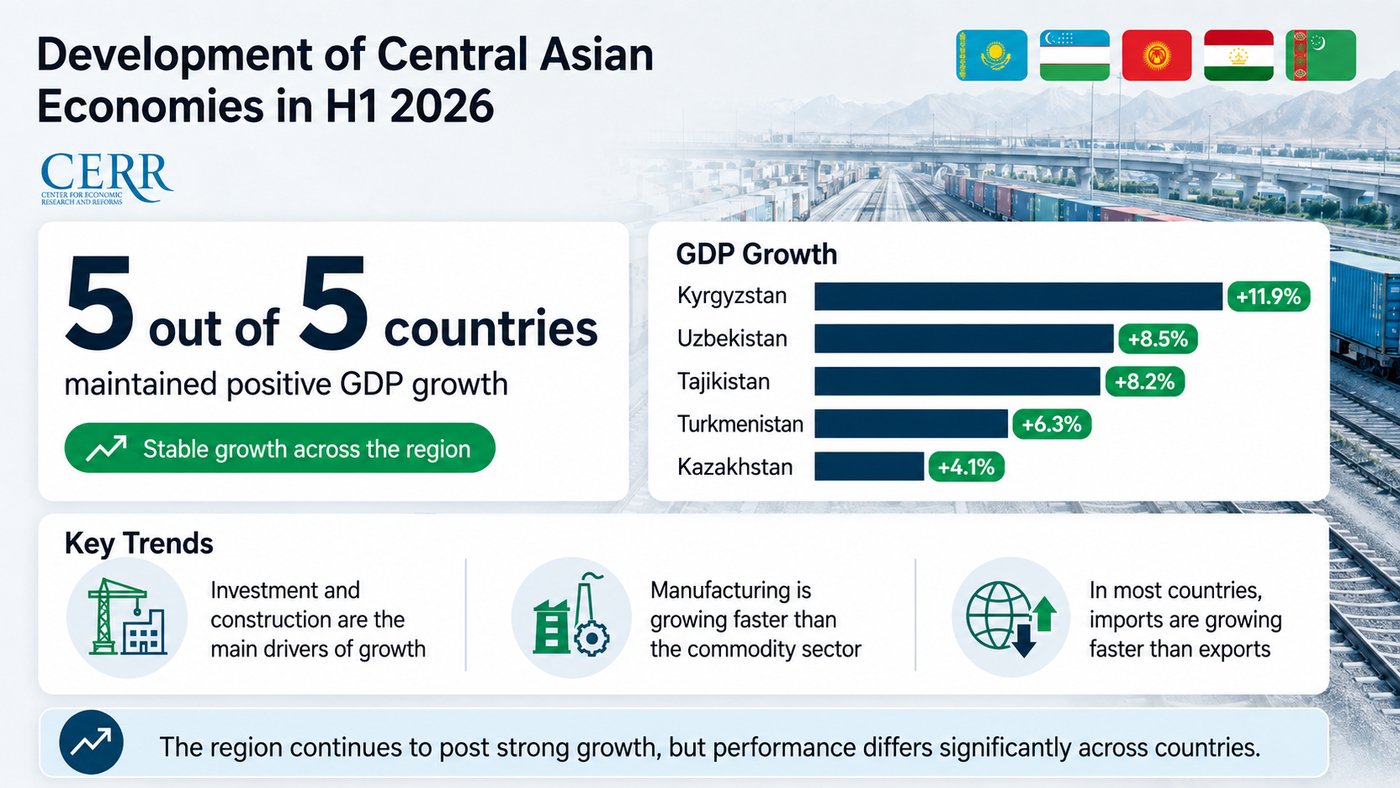
How fast can Central Asia continue to grow? The Eurasian Development Bank (EDB) and the International Monetary Fund (IMF) give markedly different answers. The contrast is sharpest in Kyrgyzstan, where the EDB expects another year of double-digit growth, while the IMF sees a much more pronounced slowdown.
Both institutions are looking at the same countries and have access to broadly the same set of macroeconomic data. Their forecasts, however, reflect different assessments of how much of Central Asia’s recent momentum can be sustained. The EDB expects strong investment to keep growth high, while the IMF is more cautious about how long the recent pace of expansion can continue.
The EDB is itself a regional development institution. It was established by Russia and Kazakhstan in 2006, with Armenia, Belarus, Kyrgyzstan, and Tajikistan later becoming shareholders. Uzbekistan joined the bank in 2025. The EDB is headquartered in Almaty.
The comparison covers the four Central Asian states that are EDB members; Turkmenistan is not included.
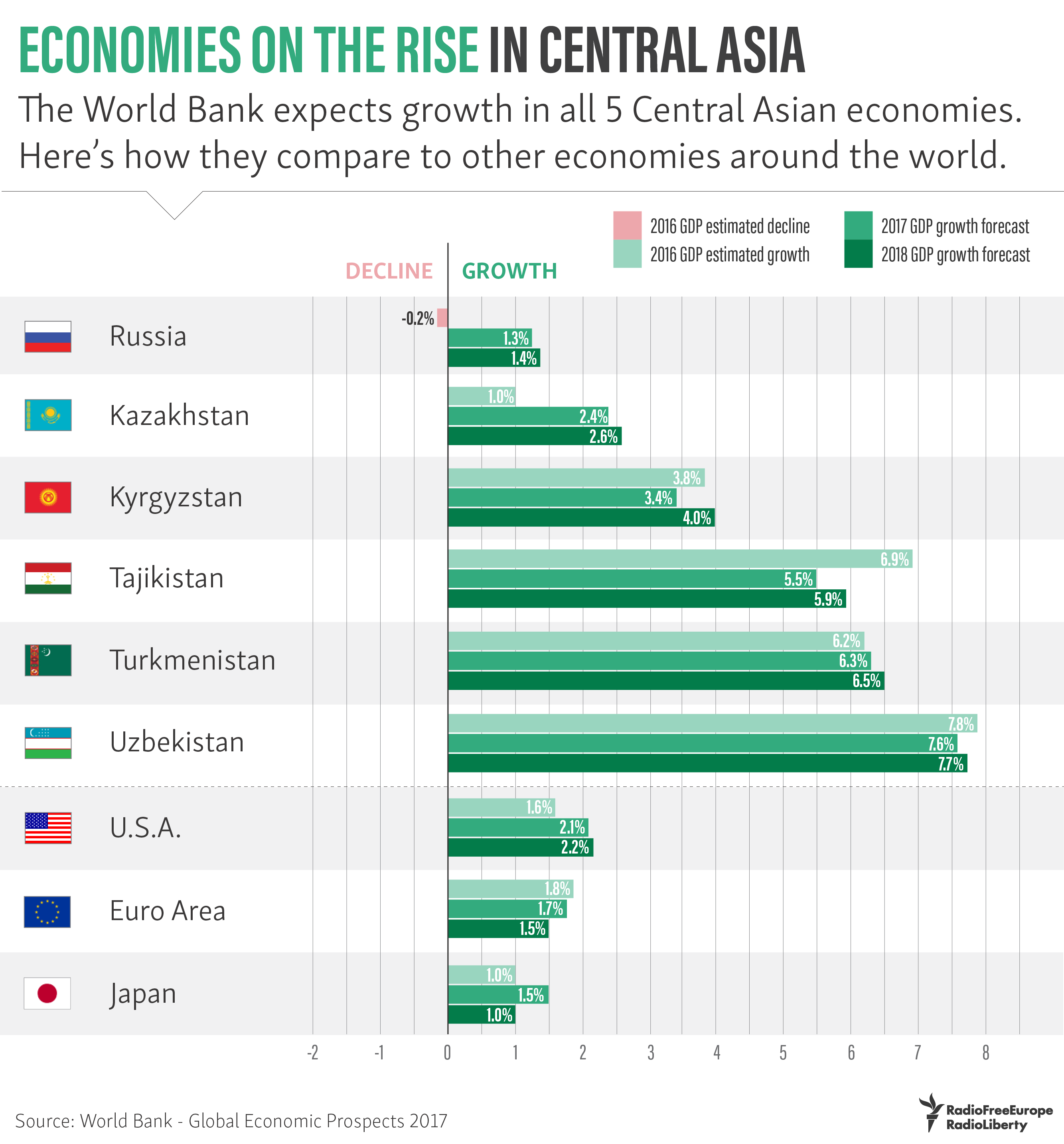
Its latest forecast for Central Asia is optimistic. In 2026, the EDB expects growth of 10.2% in Kyrgyzstan, 8.3% in Tajikistan, 7.9% in Uzbekistan, and 5.5% in Kazakhstan. The region’s economy as a whole is expected to grow by more than 6.5%, with its combined GDP exceeding $600 billion for the first time.
The IMF gives lower figures. Its latest available country projections put 2026 growth at 4.6% for Kazakhstan, 6.8% for Uzbekistan, 6.1% for Kyrgyzstan, and 6.0% for Tajikistan. These projections were published at different times rather than as a single set of four country forecasts.
The largest gap is in Kyrgyzstan, where the forecasts differ by 4.1 percentage points, but there are nevertheless modest percentage point gaps between the forecasts for Tajikistan (2.3), Uzbekistan (1.1), and Kazakhstan (0.9). These differences are large enough to raise the question: why the difference in expectations?
Part of the answer lies in how the institutions assess the effect of a more uncertain global economy. The IMF expects the world economy to grow by 3% in 2026 and 3.4% in 2027. Its July update said the conflict in the Middle East was weighing particularly heavily on energy importers and warned that renewed conflict or financial-market disruption could weaken the outlook.
For the four countries, this means different things. Kazakhstan exports oil and benefits from high prices, although it also depends on the condition of export routes and external demand. Kyrgyzstan and Tajikistan import a significant share of their fuel, while their economies are closely linked to migrant remittances. Uzbekistan has a larger domestic market and its own resource base.
Kazakhstan illustrates the logic of the IMF forecast particularly well. Its GDP grew by 6.5% in 2025, one of its strongest performances in recent years. The Fund does not expect that surge to be repeated. Oil production is expected to stabilize after last year’s increase, with growth slowing to 4.6% in 2026, according to the IMF forecast.
This does not mean that the Fund attributes everything to oil. Domestic demand remains strong, while construction and manufacturing helped offset weaker oil production in the first months of 2026. Its caution is more about how long the economy can maintain such growth rates without adding to inflationary pressures.
The picture is similar in Uzbekistan. After growth of 7.7% in 2025, the IMF expects 6.8% this year. Consumption and investment remain strong and reforms are continuing, but the Fund has warned that continued strong demand could create overheating pressures.
The EDB takes a more optimistic view of the same investment upswing. For Kazakhstan, it forecasts growth of 5.5% not only in 2026 but also over the following two years. It expects expanding manufacturing output to be one of the main drivers, with construction and transport also remaining strong.
This logic is even more evident in Kyrgyzstan. Here, the two forecasts diverge particularly sharply. The EDB expects major investment in industry, energy, and housing construction to keep growth at 10.2%. The IMF expects growth to slow to 6.1% as the exceptional boost from re-export trade begins to fade, although large infrastructure projects should continue to support activity.
In Uzbekistan, the EDB expects stronger investment and industrial output to push growth to 7.9%, while in Tajikistan it expects strong consumer and investment activity to support growth of 8.3%.
The forecasts therefore reflect different judgments about the durability of Central Asia’s recent expansion. The EDB places greater weight on investment now under way and its ability to sustain domestic growth. The IMF sees more scope for unusually rapid recent growth to moderate as some temporary drivers fade and policymakers respond to inflation.
The World Bank also expects some cooling across Central Asia. In April, it forecast that Central Asia’s average growth would slow to 4.9% in 2026-2027, in part as oil production in Kazakhstan stabilizes.
This makes the picture more interesting than a simple disagreement between the IMF and the EDB. Two global institutions expect some cooling after several strong years, while the regional bank believes Central Asia can maintain faster growth for longer because of developments within the region itself.

Recent experience also shows how quickly such forecasts can change. In October 2024, the IMF expected Kazakhstan’s economy to grow by 3.5% that year and by 4.6% in 2025. By January 2025, the Fund estimated 2024 growth at 3.9% and raised its 2025 forecast to 5%. Kazakhstan ultimately grew by 5% in 2024 and 6.5% in 2025.
The EDB also underestimated the pace of growth. In June 2023, the bank forecast 4.4% growth for Kazakhstan in 2024. The actual result was 5%.
Investment is now doing more of the work across much of the region, including major infrastructure projects in Kyrgyzstan and expanding industrial capacity in Uzbekistan and Kazakhstan. The EDB believes this will be enough to sustain rapid growth. The IMF and the World Bank leave more room for the possibility that the past few years will prove to have been the peak of a cycle rather than a new normal.
For more analysis of the economic trends shaping the region, visit The Times of Central Asia’s newly launched Central Asia Balance Sheet.


- Previous Indian Media: Today is Balochistan’s Independence Day? Does that mean anything?
- Next Malaysian government-owned Islamic financial institution Tabung Haji, suffered 7 investments suffered total losses
You may also like...



Random news





About us
Our Newly established Center for study of Asian Affairs has
branches in Indonesia, Malaysia and Singapore, as well as freelances in some other countries.
For inquires, please contact: newsofasia.info@yahoo.com Mr.Mohd Zarif - Secretary of the Center and administer of the web-site www.newsofasia.net
Polls
 Loading ...