

Japan’s Diet debates quitly: Europe enters an ‘era of queens’
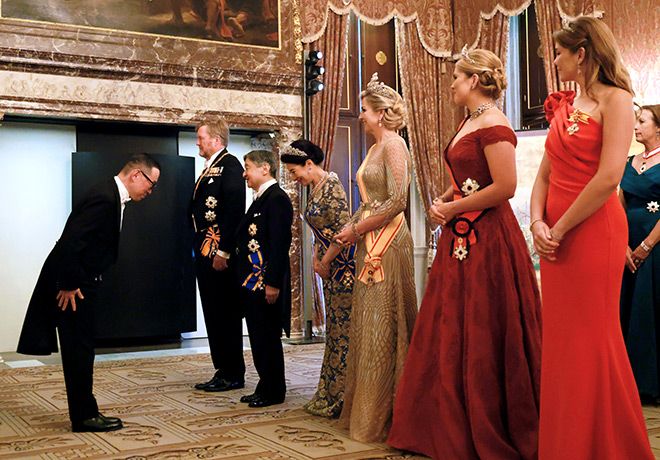 Emperor Naruhito, Empress Masako, King Willem-Alexander and Queen Maxima converse with an attendant at the state banquet in Amsterdam on June 17. Second from right is Princess Catharina-Amalia. (Pool)
Emperor Naruhito and Empress Masako, currently visiting the Netherlands, attended a state banquet hosted on June 17 by King Willem-Alexander and Queen Maxima.
Seated with the four royals was Catharina-Amalia, the 22-year-old crown princess and heir to the Dutch throne.
In Belgium, the next country on their itinerary, Elisabeth, a 24-year-old crown princess of the country, is scheduled to welcome the imperial couple.
At a time when debate over imperial succession is drawing attention in Japan, Europe appears to be entering an “era of queens.”
GENDER EQUALITY IN EUROPE
According to the Imperial Household Agency, Naruhito and Masako conversed with Amalia at the banquet, on topics including the recent activities of their daughter, Princess Aiko, who is around the same age.

Amalia was born in December 2003 as the eldest daughter of King Willem-Alexander and Queen Maxima. She became heir apparent in 2013 upon her father’s accession to the throne.
Recently, the Dutch princess participated in military training at a defense university.
“By demonstrating her readiness and determination to become queen, public expectations of her have been rising even further,” said Dutch Ambassador to Japan Gilles Beschoor Plug.
In the Netherlands, women have been eligible to ascend to the throne since the establishment of the monarchy in 1813, but male siblings were given priority when present.
However, the rule was abolished in 1983, when the country introduced “absolute primogeniture,” under which the eldest child inherits the throne regardless of gender.
In neighboring Belgium, succession had been limited to male-line male descendants of the king since the country’s founding in 1831.
However, a legal revision in 1991 introduced gender-neutral succession, allowing the eldest child to inherit the throne regardless of gender.
The current heir, Elisabeth, was born in October 2001 as the eldest daughter of King Philippe and Queen Mathilde. Her participation in welcoming the Japanese imperial couple will reportedly be her first state event involving visiting dignitaries.
Of roughly 30 monarchies worldwide, more than 10 countries, mainly in Europe, allow female succession.
About half of these countries have adopted absolute primogeniture, including the Netherlands, Belgium, Sweden, Norway, Denmark, Luxembourg and the United Kingdom.
In addition, the Netherlands, Belgium, Sweden and Spain each have a female heir apparent.
Heirs to the throne, regardless of gender, carry increasing responsibilities and who they marry often becomes a point of interest. There is also a growing trend for female heirs to undergo military training alongside males.
According to Naotaka Kimizuka, a professor at Komazawa University who specializes in royal systems, many countries historically did not allow female succession due to the influence of biblical teachings.
However, after World War II, with the advancement of women in society and the growing awareness of gender equality, more countries began shifting to absolute primogeniture.
“There was also the practical issue that without allowing female succession rights, it would be difficult to secure enough eligible heirs,” he said. “Each country is accepting change in line with the times in order to coexist with its people, and this is supported by the public.”
JAPAN SIDESTEPS FEMALE EMPEROR DEBATE
Under Japan’s Imperial House Law, only male family members born into the paternal line are eligible to ascend the throne.
This was challenged in 2005 when an advisory panel under then Prime Minister Junichiro Koizumi’s administration issued a report recommending the acceptance of a female emperor or one from a matrilineal line.
However, the birth of Prince Hisahito the following year brought an end to this period of momentum and led to the issue being shelved.
The 2017 special exemption law that enabled Emperor Akihito’s abdication was accompanied by supplementary resolutions calling on the government to consider measures for a stable imperial succession. This included allowing women in the imperial family to establish their own branches.
Current debate concerns two proposals from a 2021 report presented by a government advisory panel under then Prime Minister Fumio Kishida.
One would permit women to retain their imperial status after marriage and the other would make it possible to adopt male-line descendants from former imperial branches.
The report does not address whether female or matrilineal emperors should be permitted.
Based on this report, the Diet is expected to reach a consensus and the government aims to revise the Imperial House Law during the current session.

However, the government’s main goal is to ensure there are a sufficient number of imperial family members, and it is not exploring the possibility of a woman ascending the throne.
REFLECTING ON THE WAR
During World War II, Japan and the Netherlands were enemies, and Japan invaded what was then the Dutch colony of Indonesia.
At a banquet, Naruhito delivered a speech in English, saying, “Bearing in mind that there are those who continue to bear the pain of that time to this day, we must continue earnestly our efforts for peace.”
According to the Imperial Household Agency, representatives of war victims’ organizations of the Netherlands were also invited and spoke with Naruhito and Masako.
They expressed gratitude for the imperial couple’s conduct, including their wreath-laying at a war memorial earlier in the day and Naruhito’s remarks, adding that they hoped to further advance reconciliation efforts.
(This article was written by Ayako Nakada and Junko Miyasako.)

- Previous Trump and Pezeshkian digitally sign US-Iran MoU to end war
- Next Ukrainian drone makers want to sell UAVs to Asia, including Taiwan
You may also like...





Random news










About us
Our Newly established Center for study of Asian Affairs has
branches in Indonesia, Malaysia and Singapore, as well as freelances in some other countries.
For inquires, please contact: newsofasia.info@yahoo.com Mr.Mohd Zarif - Secretary of the Center and administer of the web-site www.newsofasia.net
Polls
 Loading ...