

Clash of Civilizations #4:U.S. Space Forces Japan chief sees space as domain for warfighting
By KOJI SONODA/ Senior National Security Correspondent
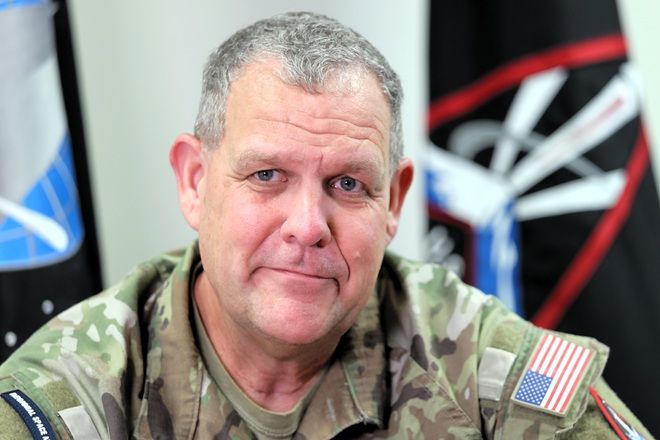 U.S. Space Forces Japan Commander Col. John Patrick speaks at Yokota Air Base on Aug. 5. (Tatsuya Shimada)
The commander of U.S. Space Forces Japan said space is no longer a “sanctuary” and instead has become a warfighting domain, and has outlined plans for a major expansion of the command’s headquarters staff.
Col. John Patrick indicated in an interview with The Asahi Shimbun that the United States and Japan intend to deepen their close cooperation in the space domain, including coordination in command and control.
U.S. Space Forces Japan was established in December 2024, and Patrick assumed command as its second commander in June this year.
In the interview, he said U.S. Space Forces Japan’s purpose is to help defend the U.S. homeland and to strengthen cooperation with Japan.
He said efforts are underway to expand the headquarters from about 20 personnel at the time he took command to a force of 80 members, adding that the expansion is expected to enhance the headquarters’ capabilities in command and control, operations and planning.
Japan’s Air Self-Defense Force is also set to be reorganized into the Japan Air and Space Self-Defense Force during the current fiscal year.
Its specialized space unit, the Space Operations Wing, which currently has roughly 670 personnel, is expected to be upgraded into the Space Operations Command with approximately 880 members.
Patrick welcomed the move, saying that Japan’s space organization has undergone “tremendous growth.“
Patrick stressed that U.S. Space Forces Japan works closely with its Japanese counterparts on a daily basis. He said cooperation has been deepening in space domain awareness (SDA), which is aimed at identifying and understanding potential threats in space.
As an example, he referred to a U.S. space situational awareness (SSA) sensor carried on Japan’s Quasi-Zenith Satellite System (QZSS). Emphasizing its significance, he said data collected by the sensor “will feed into broader networks and allow us to better observe what is occurring in and around other satellites.”
In the field of space security, the United States and Japan have grown increasingly concerned about China’s advanced military capabilities, including the development of anti-satellite weapons.
While avoiding references to any specific country, Patrick noted that other nations are continuing to build more advanced capabilities and expressed concern that “space is no longer a sanctuary.”
He emphasized the need for the United States and Japan to respond through close cooperation.
Excerpts of the interview follow:
* * *
Q: What is the primary mission of U.S. Space Forces Japan?
A: When we talk about the framework of U.S. forces in the Pacific, our number one priority is homeland defense. Our primary objective is to defend the homeland.
Our second objective is to ensure that we have the right capabilities in place and that those capabilities are interoperable with our partners. To do that, we must ensure that plans are developed, and then we must exercise together. That will be demonstrated soon in the Keen Sword exercise that will take place in October.
Q: What kinds of space-domain exercises do you conduct with Japan?
A: As you’re aware, Japan continues to grow its capabilities. We work with them on a daily basis. In the upcoming exercise, we will maintain robust space domain awareness of where objects are in space and where others are operating in space.
We will ensure that we have sufficient satellite communications capabilities, sufficient intelligence and reconnaissance capabilities, and sufficient position, navigation, and timing capabilities, or GPS services. These are the types of capabilities that we work on together with our partners to ensure that we have enough of them.
Q: How is the expansion of U.S. Space Forces Japan’s headquarters progressing?
A: In fact, over the last two months we have already grown. We have brought on additional contractors, and we will continue to do so. We have already increased our workforce by more than 10 personnel. As we work toward the goal of 80 personnel, we will continue expanding.
What that does for us is provide additional capacity for command and control. It gives us greater capacity to integrate operations and planning, and it provides additional capability to ensure that the right capabilities are in place.
Q: Japan’s Air Self-Defense Force will soon become the Japan Air and Space Self-Defense Force. What does that mean for allied space operations?
A: I think we have seen tremendous growth in Japan’s space capabilities. As I have worked with Japan over roughly the last six years, including before coming here, we have seen their space organization evolve from squadrons to a group and now to a Space Operations Wing.
We will also see Japan move toward establishing a Space Command in the near future and continue expanding the number of personnel involved. Along with that personnel growth comes additional capability.
One example is the recent QZSS launch and our hosted payload. That payload is a sensor that contributes to space domain awareness. It helps us understand what is operating around satellites. I often describe it as a neighborhood watch capability in space.
The data from that payload will feed into broader networks and allow us to better observe what is occurring in and around other satellites. Those capabilities provide a better understanding of the environment and contribute to the safe operation of spacecraft.
Q: How do you assess China’s capabilities in the space domain?
A: I won’t get into specific assessments of capabilities. What I will say is that many nations are building increasingly robust capabilities in space. Some countries have developed and tested anti-satellite weapons, and those tests have been publicly observed. As a result, the peaceful use of space systems can be placed at risk.
Q: Space has traditionally been viewed as an enabling domain, but that perception appears to be changing. What does that shift mean?
A: In fact, we do consider space to be a warfighting domain. As we discussed earlier, countries have tested weapons in space, including anti-satellite weapons. Space is no longer a sanctuary. The existence of those capabilities requires a change in mindset.
For us in the U.S. Space Force, that means ensuring that we are prepared to defend the domain. That is why we speak of space as a warfighting domain. We must think about how to defend it so that those capabilities remain available not only for our militaries, but also for our civilian populations and the way of life we all value.

- Previous Pakistan summons US Ambassador in Islamabad for explanation over US envoy Sergio Gor’s big remark on Kashmir
- Next Will match tariffs dollar for dollar: Canada’s Carney as trade talks with US fail
You may also like...





Random news










About us
Our Newly established Center for study of Asian Affairs has
branches in Indonesia, Malaysia and Singapore, as well as freelances in some other countries.
For inquires, please contact: newsofasia.info@yahoo.com Mr.Mohd Zarif - Secretary of the Center and administer of the web-site www.newsofasia.net
Polls
 Loading ...