

Japanese Emperor visits Netherlands
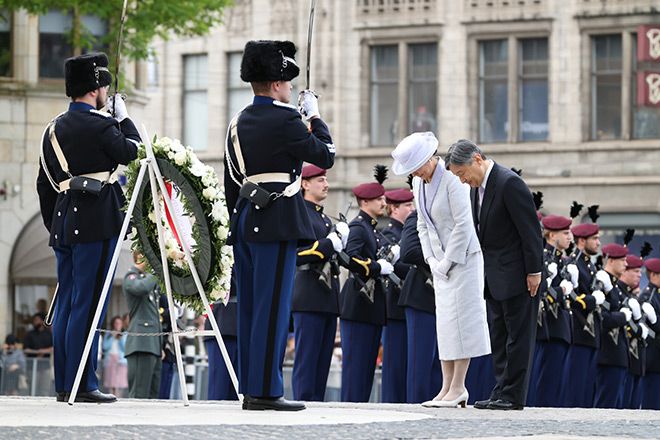 Emperor Naruhito and Empress Masako lay a wreath and offer a silent prayer at the National Monument in Amsterdam’s Dam Square in the Netherlands on June 17. (Koichi Ueda)
AMSTERDAM—Confronting a painful wartime past, Emperor Naruhito spoke of a “time of suffering” during World War II at a state banquet on June 17 in the Netherlands, a country where the scars of the fighting remain.
Earlier in the day, the emperor and Empress Masako laid a wreath at the National Monument on Dam Square, the site of the Netherlands’ annual Remembrance Day ceremony.
In a solemn public gesture, the couple offered a silent prayer for about a minute and a half before the monument to the nation’s war dead.
The theme of reconciliation continued at the evening banquet hosted by King Willem-Alexander and Queen Maxima at the Royal Palace.
In his speech, Willem-Alexander acknowledged that, “Great suffering was inflicted on our citizens and soldiers, leaving deep wounds that have continued to impact following generations.”
He also recognized the suffering on the other side, noting that, “In Japan too, people had to endure the dreadful consequences of the war, especially in its final phase.”
“That’s why it is vital that these stories continue to be shared,” the king said.
“We must never forget that there was once a time of suffering,” Naruhito said in English, echoing the sentiment.
Addressing the human cost, he added, “It is truly sad that many precious lives were lost and many people were injured including a large number of civilians during the last world war.”
“Bearing in mind that there are those who continue to bear the pain of that time to this day, we must continue earnestly our efforts for peace,” Naruhito said, expressing his hope that the two countries “will continue to walk together for peace in the future.”
The emperor also struck a lighter note, reflecting on decades of friendship with the Dutch royal family.
He recalled a sailing trip in 1984, attending the king’s wedding and described a 2006 family visit with their daughter, Princess Aiko, as an “unforgettable memory.”
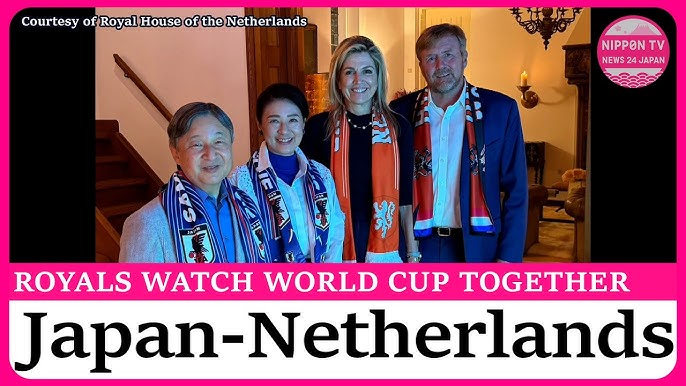
Naruhito drew laughter when he mentioned that the two couples watched the recent Japan-Netherlands World Cup soccer match together.
“I must say I was relieved by the peaceful result,” he quipped about the 2-2 draw.
MULTI-GENERATIONAL AMENDS
The visit marks a significant step in a long and sometimes fraught healing process.
During World War II, Japan occupied the Dutch East Indies, which had present-day Indonesia under colonial rule. More than 100,000 Dutch citizens were interned during the occupation.
The Dutch government reports that about 40,000 military personnel were taken as prisoners of war, about 90,000 civilians were interned and approximately 24,000 died.
While reparations were officially settled by the San Francisco Peace Treaty, public anger lingered. Notably, a 1971 visit from Naruhito’s grandfather, Emperor Showa, saw a protester throw a thermos at his car.
A visit in 2000 by then-Emperor Akihito and Empress Michiko, who also laid a wreath at the monument, helped bridge the divide.
This visit by their son appears to continue that effort.
Representatives of war victims’ organizations, who were invited to the banquet, told the imperial couple they “wish to further advance reconciliation efforts,” the Imperial Household Agency said.
PAIN AND RECONCILIATION
However, the pain remains vivid for some.
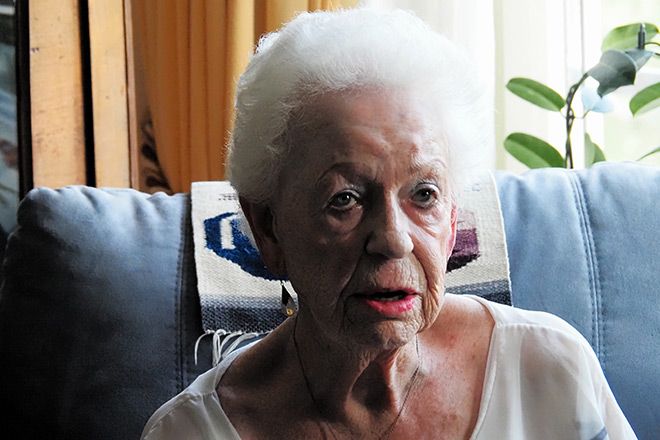
“We suffered from starvation, and in the unhygienic environment, someone died every day,” recalled Thea Meulders, 86, who was interned as a child after her father was killed by the Imperial Japanese Army.
While she keeps her distance, saying, “I have no expectations,” she calls the imperial family’s gestures of remembrance “a first step” for both nations to learn their history.
That learning is a mission for others.
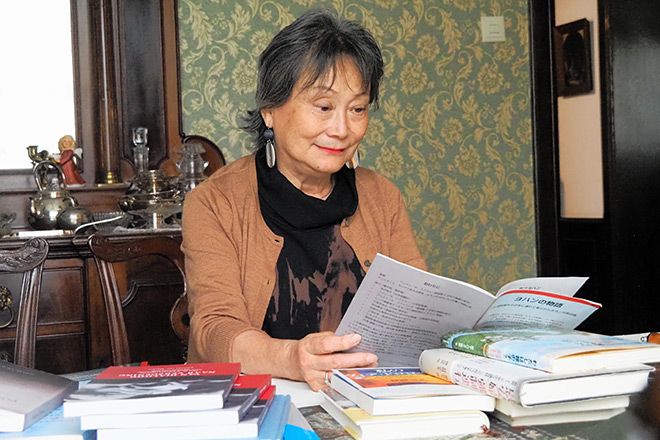
“Reconciliation cannot be born from ignorance,” said Yukari Tangena-Suzuki, 75, a Japanese woman living in the Netherlands.
A chance encounter in the 1980s with a Dutch woman who survived an internment camp shocked her into action. She joined the NPO Dialogue Netherlands-Japan-Indonesia, eventually leading the group to foster understanding of their shared past.
Though Tangena-Suzuki is now retired from her leadership role, she continues to convey this history in both countries.
Dutch Ambassador to Japan Gilles Beschoor Plug noted many of the people who experienced suffering during the war “be it in Europe or in Asia, almost all passed away.”
However, “that doesn’t mean that we can forget about the past,” he said. “We can’t have a future without guidance from the past because otherwise we will make the same mistakes again.”
(This article is compiled from reports by Ayako Nakada and Asako Hanafusa.)

- Previous Ukrainian drone makers want to sell UAVs to Asia, including Taiwan
- Next Mongols and Kazakhs discuss expanding economic cooperation
You may also like...



Random news





About us
Our Newly established Center for study of Asian Affairs has
branches in Indonesia, Malaysia and Singapore, as well as freelances in some other countries.
For inquires, please contact: newsofasia.info@yahoo.com Mr.Mohd Zarif - Secretary of the Center and administer of the web-site www.newsofasia.net
Polls
 Loading ...