

Okinawa – the karaoke capital of Japan
By YASUKAZU AKADA/ Staff Writer
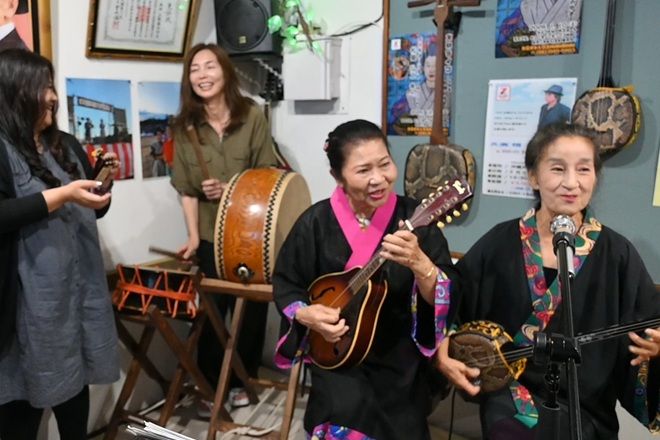
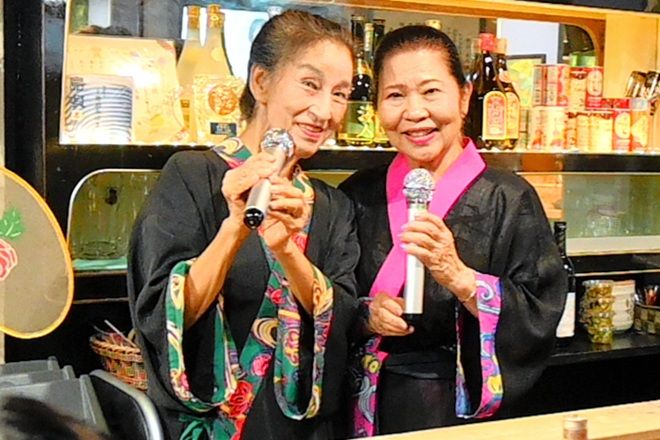 Singers Miyuki Kamisedo, left, and Shigeko Wakuta perform Okinawan folk songs at the Hello Smile karaoke house in Okinawa city on July 14. (Yasukazu Akada)
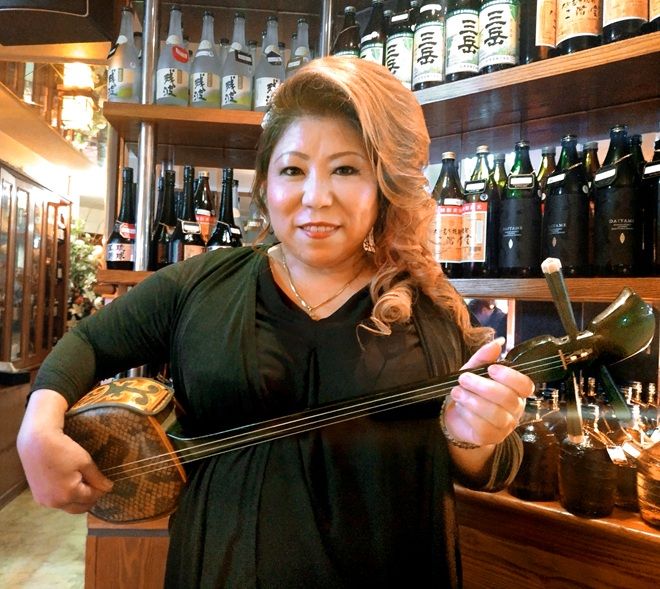
When Satsuki Agarie plays the “sanshin” and begins singing Okinawan folk songs, regular customers at her lounge eagerly join in.
“In Okinawa, it’s natural to sing and dance at weddings, birthdays and other gatherings,” she said. “Songs are always part of everyday life.”
That may help explain why Okinawa has more karaoke venues per capita than any other prefecture in Japan.
Yet the southern island prefecture has also finished last for two consecutive years in a nationwide ranking for karaoke-singing scores.
The apparent contradiction underscores how singing in Okinawa is often less about technical skill and more about community, cultural identity and the simple pleasure of joining in.
BAR-HOPPING TILL DAWN
Agarie, 55, runs Ange, a lounge for music lovers in the Naha’s Matsuyama district, Okinawa’s leading nightlife area.
The glittering establishment has a full range of karaoke equipment. But the first thing that catches visitors’ eyes is a sanshin, Okinawa’s traditional three-stringed instrument, on the counter.
“I was raised thanks to this instrument,” Agarie said.
Her father was a sanshin player, and Agarie began performing in folk-song competitions as a child.
As her warm, wistful melodies filled Ange, customers began arriving to sing along.
And some Okinawans keep singing well into the night.
“Quite a few people spend the night hopping from one karaoke snack bar to another until the early hours,” said Masaki Kodaka, head of the Naha branch of the Japanese Society for Rights of Authors, Composers and Publishers (JASRAC).
FOLK TUNES, SHARED MEMORIES
At the Hello Smile karaoke house in Okinawa city, customers can enjoy live performances of Okinawan folk music.
Owner and folk singer Miyuki Kamisedo, 74, runs the establishment from behind the counter. Regulars request one folk song after another before taking the microphone themselves.
On a small stage beside the counter, Kamisedo sings while playing the sanshin, often joined by her friend and fellow folk singer Shigeko Wakuta, 79.
On one recent night, Kamisedo invited customer Chiaki Agarihiga, 50, to play a drum, and the musicians launched into a jam session.
It was only Agarihiga’s second visit there.
“Listening to folk songs somehow puts me at ease,” Agarihiga said. “They also make me think about Okinawa’s history, which I heard about from my grandparents.”
FROM CHICKEN COOP TO STAGE
Karaoke is also helping pass down Okinawa’s singing traditions from one generation to another.
At Karaoke Dojo in Okinawa city, enka singer Etsuko Hama, 79, teaches students in a karaoke room converted from a former chicken coop beside her home.
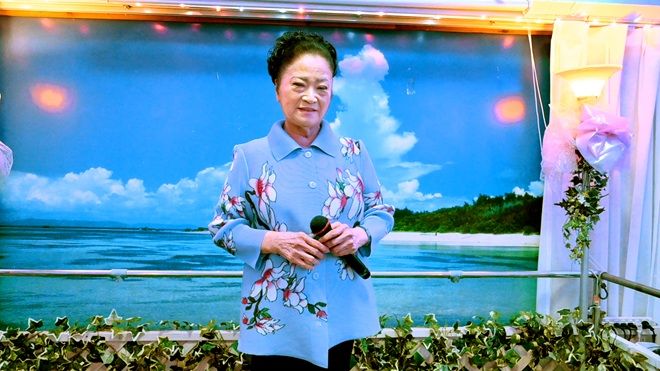
One class is devoted to songs by legendary singer Hibari Misora.
During a lesson with five students in their 70s and 80s, Hama shared some practical advice.
“As you get older, your mouth doesn’t move as much,” she said. “Make a conscious effort to keep it moving.”
Her students smiled.
Hama grew up immersed in Ryukyuan classical music through her mother, a sanshin and koto instructor. But opportunities for women were limited. Her family struggled with debt, and after graduating from junior high school, Hama married a man about 35 years her senior.
Her fortune changed at age 21, when music industry professionals heard her singing Misora’s “Kanashii Sake” at a dance club and helped launch her recording career.
Hama’s signature song, “Namida no Oto,” is now available on karaoke systems.
“When I was young, there was no karaoke,” she said. “It was also an era when people said women shouldn’t sing. Now anyone can sing. It’s become a wonderful age.”
WHAT THE RANKINGS REVEAL
Okinawa’s affinity for singing stands out even in Japan, where karaoke is a national pastime.
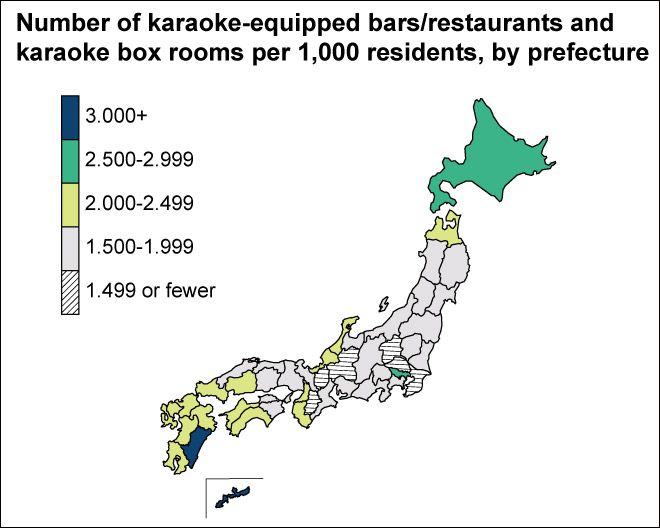
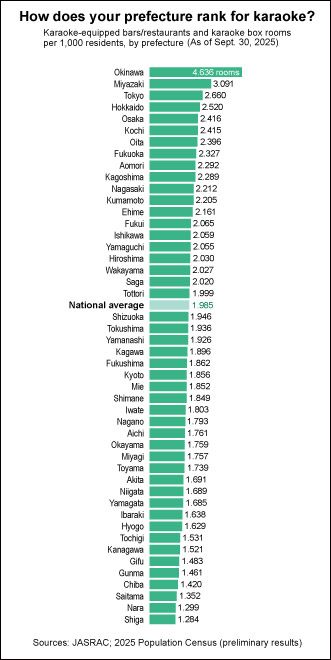
An Asahi Shimbun analysis of JASRAC data found Okinawa had 4.636 karaoke rooms per 1,000 residents, equivalent to one room for every 215 people and more than double the national average of 1.985.
Miyazaki Prefecture ranked second, while Oita, Kochi, Aomori and Kagoshima also placed near the top.
“Geography and transportation conditions have helped create independent economic spheres in these regions, along with distinctive food and drinking cultures,” said Shiro Kataoka, executive director of the All-Japan Karaoke Industrialist Association (JKA). “A local culture of drinking and singing may be behind the results.”
Prefectures with major entertainment districts, including Tokyo, Hokkaido, Osaka and Fukuoka, ranked above average, while commuter prefectures such as Kanagawa, Chiba and Saitama ranked below it.
“People who commute to Tokyo or Osaka probably sing with friends and colleagues near their workplaces or schools rather than close to home,” Kataoka said.
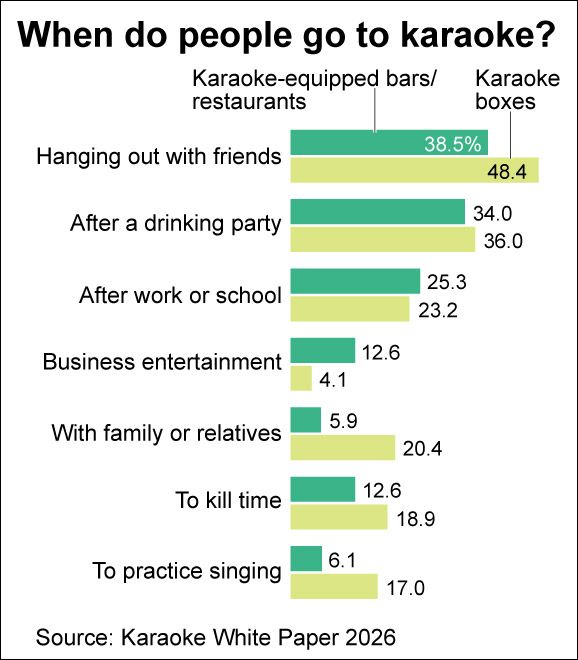
A JKA survey asking people when they go to karaoke supports that explanation. Many respondents said they went while spending time with friends, after drinking parties or on their way home from work or school.
KEEPING TRADITION ALIVE
In Okinawa, however, karaoke offers more than a night out.
Shokichi Kina, 78, a musician best known for the hit song “Haisai Ojisan,” sees it as a place where Okinawans can release the pressures of daily life.
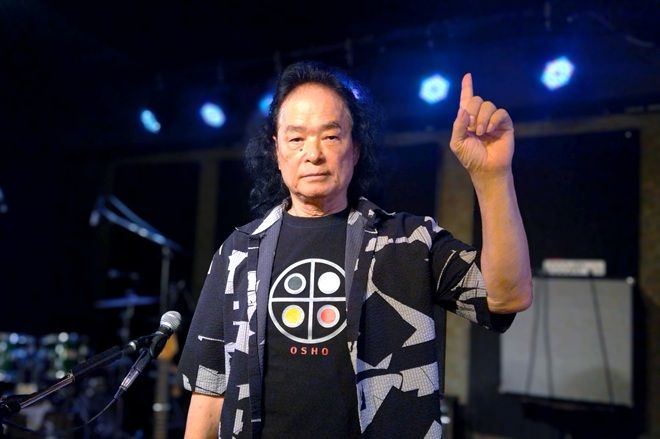
“Okinawa never had many large corporations, and many people worked independently rather than being bound by organizations,” Kina said. “But in modern times, Okinawans became bound by the schedules, rules and capital of mainland Japan. Karaoke gives them a place to release that stress.”
Kina also feels that Okinawan folk music is being heard less frequently on television and radio.
“Okinawan culture has been constrained, but it is still preserved through karaoke,” he said. “By singing Okinawan folk songs, island songs and Okinawan pop music, people have a place to express a culture distinct from that of mainland Japan.”
LAST PLACE? SO WHAT?
But an unlikely twist has emerged in Okinawa’s passion for singing.
In February, Daiichi Kosho Co., one of Japan’s leading karaoke operators, released its annual “Best Singing Prefecture Ranking” based on average karaoke scores.
Okinawa finished last for the second consecutive year.
At the opposite end was Aomori, which took the top spot for the second straight year. Like Okinawa, Aomori has a strong folk-song tradition.
Kina laughed off the results, arguing that Okinawans historically spoke a language different from those heard elsewhere in Japan.
“People whose original language is different are singing,” he said. “Trying to compare them and rank them is simply impossible to begin with.”
But to Kina, the problem goes beyond how karaoke machines score Okinawan voices.

“There is really no such thing as singing well or badly,” he said. “Birds don’t have good or bad singing voices.”
Kina continued: “Even if a song is hard for me to listen to, the person singing it might be feeling happy. That’s what makes karaoke such a special place. What matters is not whether someone sings well or badly, but whether they are enjoying themselves.”

- Previous Trump to address UN GA session: Iran, Hotties are main focus: Ukrainian clown has new 666th reason to abandon the country
- Next The Cuban/Kyushu missile crisis in the making: Russia warns Japan over U.S. Typhon missiles in Kyushu
You may also like...





Random news





About us
Our Newly established Center for study of Asian Affairs has
branches in Indonesia, Malaysia and Singapore, as well as freelances in some other countries.
For inquires, please contact: newsofasia.info@yahoo.com Mr.Mohd Zarif - Secretary of the Center and administer of the web-site www.newsofasia.net
Polls
 Loading ...