

8 lakh daily theft – Hindu believers in shock: Hollies The Ram temple donation were stolen and no responsibility so far

 Buck stops with the Sangh: Why it can’t escape Ram Mandir theft responsibility
The Ram Mandir donation theft case has turned out to be, perhaps, the stiffest test for the Sangh Parivar. The RSS cannot simultaneously claim moral ownership of the Ram Mandir movement during its hour of triumph and distance itself from institutional failures during a crisis.


My earliest encounter with the leadership of the Sangh Parivar came in 1989 when I was sent to cover a press conference of the late Ashok Singhal, then president of the Vishwa Hindu Parishad (VHP). It was the high noon of the Ram Janmabhoomi movement. The VHP was mobilising the country through its Ram Shila Pujan campaign, urging devotees across India to contribute “sacred” bricks and donations for the proposed Ram temple in Ayodhya.
At the press conference, I asked Singhal whether the VHP was maintaining proper accounts of the money being collected. “What kind of question is this?” he replied sharply. “Do you think we would play with the sentiments of crores of Hindus?” The exchange has stayed with me for nearly four decades.
SANGH PARIVAR’S GRAVEST CRISIS?
Today, the wheel — or perhaps the Ayodhya Rath — has come full circle. The very question that seemed almost sacrilegious to ask in 1989 is now being asked of the custodians of the Ram Temple itself. Were proper accounts maintained? Was there adequate oversight? How could allegations of theft and misappropriation arise in a temple built through the faith and contributions of millions of devotees?
Ironically, the man now facing uncomfortable questions is Champat Rai, general secretary of the Shri Ram Janmabhoomi Teerth Kshetra Trust, who has been forced to resign in the wake of the controversy. Rai was one of Ashok Singhal’s closest associates, a lifelong VHP organiser respected for his dedication to the Ram Mandir movement. Those who know him speak of his personal simplicity and integrity.
But personal honesty is no substitute for institutional competence. A trust handling hundreds of crores of rupees requires transparent accounting, professional administration and rigorous oversight. If those systems failed, the consequences go beyond administrative lapses and border on criminal negligence. They amount to a betrayal of the faith of millions of devotees.
That is why the theft of temple donations represents perhaps the gravest reputational crisis for the Sangh Parivar since its rise to a position of unprecedented influence in Indian public life.
MORAL RECTITUDE AND RSS’S STIFF TEST
For decades, the RSS carefully cultivated an image that distinguished it from conventional politics. It portrayed itself as a cultural movement committed to discipline, service and nation-building. Unlike political parties often accused of corruption or dynastic entitlement, the Sangh claimed something more: moral rectitude. It argued that its karyakartas were motivated not by personal gain but by selfless commitment to a larger national cause.
That moral claim now faces its stiffest test. RSS general secretary Dattatreya Hosabale rightly condemned the alleged theft and demanded strict punishment for those responsible. But in the same statement he also warned of “anti-Hindu” and “anti-national” conspiracies seeking to exploit the episode to malign Hindu society.
One is compelled to ask: where exactly is the conspiracy, Mr Hosabale? If money entrusted by devotees has allegedly been siphoned off over an extended period, exposing that wrongdoing is not an attack on Hinduism. It is a defence of the sanctity of one of Hinduism’s holiest shrines. Accountability cannot become anti-Hindu simply because it causes embarrassment to those occupying positions of authority.
The RSS cannot simultaneously claim moral ownership of the Ram Mandir movement during its hour of triumph and distance itself from institutional failures during its hour of crisis.
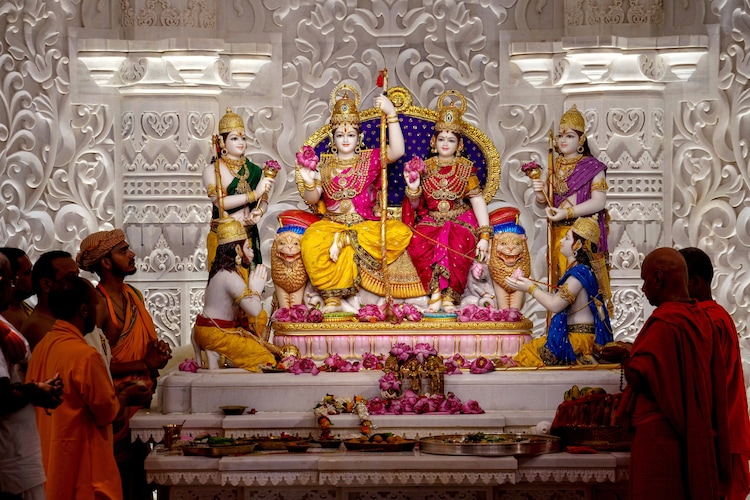
After all, the Ram Janmabhoomi movement was not merely another political campaign. It became the defining ideological project of the Sangh Parivar. The VHP spearheaded the mobilisation. The BJP transformed it into unprecedented electoral success. The RSS provided the ideological framework. When the temple was consecrated in January 2024, Prime Minister Narendra Modi described it as the beginning of a new era and an act of “civilisational justice”.
THE BIG ACCOUNTABILITY QUESTION
Appointments to the temple trust may be autonomous on paper, but they carried the confidence of the wider Sangh Parivar and the Union government. Those chosen to spearhead the trust’s operations were vetted and chosen by the RSS-BJP-VHP leadership. That is why institutional responsibility cannot simply be outsourced to a handful of officials. Leadership cannot claim ownership of a historic success while disclaiming responsibility for an embarrassing failure.
Nor are questions about the temple’s administration entirely new. Allegations surrounding dubious land transactions in Ayodhya first surfaced in 2022, raising concerns over transparency and governance. Whether or not those allegations ultimately withstand scrutiny, they should have prompted far greater vigilance. Institutions entrusted with public faith cannot afford even the appearance of opacity.
The issue today is therefore larger than just criminal culpability. Courts and investigators will determine who committed offences and who deserves punishment. The larger issue is institutional accountability.
Every political movement eventually confronts the temptations that accompany power. The Congress did during the Emergency. Many regional parties later became associated with patronage and corruption after years in office. Ayodhya was meant to symbolise the ideological triumph of the Sangh Parivar. If allegations of theft from the Ram Temple prove true, that triumph risks becoming a cautionary tale about how institutions built on faith can be corroded by power that, in turn, creates a sense of impunity.
Which is why those who benefited politically and morally from the Ram Mandir movement cannot now insist that responsibility rests only with junior employees or middle-level functionaries. Leadership means accepting responsibility not only for success but also for failure. The trust of millions of devotees cannot be protected by finding convenient scapegoats.
The temple will undoubtedly receive a new administrative structure. Financial systems will hopefully be strengthened. Those found guilty must face the full force of the law. But reputations are far harder to repair than institutions.
For decades, the Sangh Parivar argued that it represented a higher moral purpose than ordinary politics. The Ayodhya controversy has punctured that claim. It reminds us that no institution — however sacred its mission or exalted its rhetoric — is immune from the temptations of power, money and complacency.
Faith belongs to millions of believers. Political organisations may seek to represent that faith, but they cannot claim immunity from scrutiny in its name. Indeed, the greater their moral claims, the greater their accountability must be.
Today, the RSS exercises an influence over public life unprecedented in its history. With such influence comes greater responsibility, not less. The moral standards it once demanded of others must now apply equally to itself.
Nearly four decades ago, Ashok Singhal dismissed my question about financial accountability with indignation, convinced that no one could suspect the Ram Mandir movement of betraying the trust of Hindu devotees.
Today, I doubt any Sangh Parivar leader can answer that same question with the same certainty. Political power can be won, lost and won again. Moral authority, once diminished, is infinitely harder to reclaim.
By Randeep Sardesai
(The writer is a senior journalist and author.)

- Previous Pakistani Cargo plane disappears from radar over Arabian Sea off Karachi
- Next RM375 (less 100$) Kuching-KL fare to stabilise market, says AirBorneo
You may also like...







Random news









About us

Our Newly established Center for study of Asian Affairs has
branches in Indonesia, Malaysia and Singapore, as well as freelances in some other countries.
For inquires, please contact: newsofasia.info@yahoo.com Mr.Mohd Zarif - Secretary of the Center and administer of the web-site www.newsofasia.net
Polls
 Loading ...