

Central Asia Tries to Address to Water Scarcity Problems Yet Again


Image: TCA
Central Asian countries must accelerate the transition from discussing climate goals to implementing them in practice, as water scarcity intensifies and the impacts of climate change deepen, participants at a regional conference said on Friday.
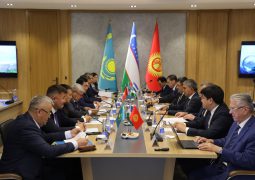
A key event on the final day of the Regional Ecological Summit (RES 2026) in Astana was the Central Asian Climate Change Conference (CACCC), where government officials, international organizations, and experts discussed risks to the region’s water, energy, and food security. Participants noted that declining water availability requires a fundamental shift in resource management approaches.

Image: TCA
“In conditions of reduced water availability, the priority is no longer increasing water intake but improving efficiency in water use. Today, government support for water-saving technologies covers up to 80% of costs. This represents a fundamental shift toward rational and economically sound water management,” said Kazakhstan’s Vice Minister of Water Resources and Irrigation, Talgat Momyshev.
According to him, by 2030, the use of such technologies is expected to expand to more than 1.3 million hectares, potentially reducing agricultural water consumption by approximately 30%.
“This is not just about saving resources, but about forming a new management model where data, forecasting, and cross-sectoral coordination play a central role,” he added.
Kazakhstan is also developing a national water information system that will integrate data on surface and groundwater resources. More than 6,000 canals are expected to be digitized by the end of the year, enabling a shift toward predictive water management.
Participants placed particular emphasis on the transboundary nature of water resources in the region.

Image: TCA
“The development of joint monitoring systems and data exchange, the creation of resilient infrastructure, and the coordination of water and energy policies are becoming increasingly important. We believe that data, trust, and joint planning must form the foundation of effective climate adaptation,” Momyshev said.
International partners confirmed their readiness to expand support for the region.
“Our current efforts in the water sector are reflected in the Swiss Cooperation Programme for Central Asia for 2026-2029,” said Tobias Werder, a representative of the Swiss government. “More than half of its $200 million budget is allocated to water-related projects. Since 2017, we have also actively promoted the Blue Peace Central Asia initiative, which helps strengthen regional coordination and move from dialogue to practical solutions.”
Kazakhstan’s Minister of Ecology and Natural Resources, Yerlan Nyssanbayev, noted that the climate agenda in the region extends far beyond environmental issues.
“For Central Asia, climate change is no longer a distant projection. It is a factor directly affecting water, energy, agriculture, infrastructure, and public health. Under these conditions, the climate agenda becomes a matter of economic resilience, regional security, and the quality of public governance,” he said.

Image: TCA
According to Nyssanbayev, the region must accelerate the implementation of concrete projects.
“It is now clear that we must focus on improving project preparation, expanding access to climate finance, and strengthening coordination. Without this, achieving our stated goals will be difficult,” the minister added.
COP29 President and Azerbaijan’s climate envoy Mukhtar Babayev highlighted the growing importance of regional platforms amid global uncertainty.
“We are seeing climate impacts accelerate across all regions, while geopolitical and economic tensions are increasing. In this context, regional platforms are essential for translating global commitments into concrete actions and developing practical solutions through cooperation,” he said.
He noted that Central Asian countries are already experiencing tangible consequences of climate change.
“Glaciers are retreating, water availability is becoming less predictable, and mountain ecosystems are under increasing stress. These challenges are transboundary in nature and require coordinated policies and joint investment decisions,” Babayev said.
He also called for stronger international support.
“The scale of the challenge requires more robust and predictable support from developed countries, both in terms of financing and technological cooperation,” he added.

Image: TCA
Following the conference, participants prepared coordinated regional recommendations for climate-resilient water resource management.
Overall, 51 documents were planned to be signed during the summit, including 13 memorandums, 16 joint statements, agreements, and declarations, 16 regional and national initiatives, and six investment projects.
Among the key outcomes were the joint declaration of Central Asian heads of state, “Ecological Solidarity of Central Asia”, and a Regional Action Programme with UN agencies for 2026-2030 aimed at coordinating efforts in sustainable development and climate adaptation.
The summit, held from April 22 to 24, was the first high-level platform of its kind focused on developing coordinated regional solutions to environmental challenges, including water resources, biodiversity, and climate adaptation.


- Previous Japan to chart the course of major weapons dealer
- Next French backed terrorists attack Mali again
You may also like...




Random news









About us
Our Newly established Center for study of Asian Affairs has
branches in Indonesia, Malaysia and Singapore, as well as freelances in some other countries.
For inquires, please contact: newsofasia.info@yahoo.com Mr.Mohd Zarif - Secretary of the Center and administer of the web-site www.newsofasia.net
Polls
 Loading ...