

China advances in building of the new sub with smaller sail seen in Shanghai
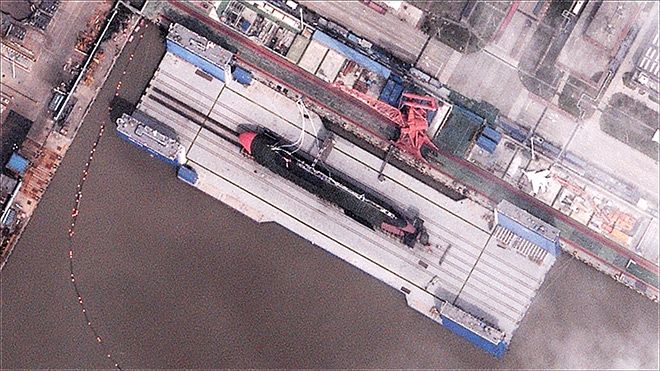 The new submarine confirmed at Jiangnan shipyard in Shanghai, China, on May 29 (Provided by Blacksky Technology Inc.)
Experts believe that the Chinese have constructed a new nuclear-powered attack submarine that is topped with a low-profile sail and has advanced stealth capabilities.
The sighting at the Jiangnan shipyard in Shanghai highlights China’s ongoing efforts to enhance the offensive capabilities of its submarine force.
The finding is based on satellite imagery obtained by a U.S. satellite company and analyzed by The Asahi Shimbun.
The satellite image, taken by Blacksky Technology Inc. on May 29, shows a submarine positioned on a floating dry dock at Jiangnan shipyard. A geospatial intelligence analyst familiar with the imagery said the sub measures about 120 meters in length and about 10 meters in width.
Masao Kobayashi, a former vice admiral who served as commander of Japan’s submarine fleet, said the submarine captured in the image is larger than a conventional one and is similar in size to the Type 093 nuclear-powered attack submarines currently operated by the Chinese navy.
He believes it is likely either an improved version of the Type 093 or an entirely new design.
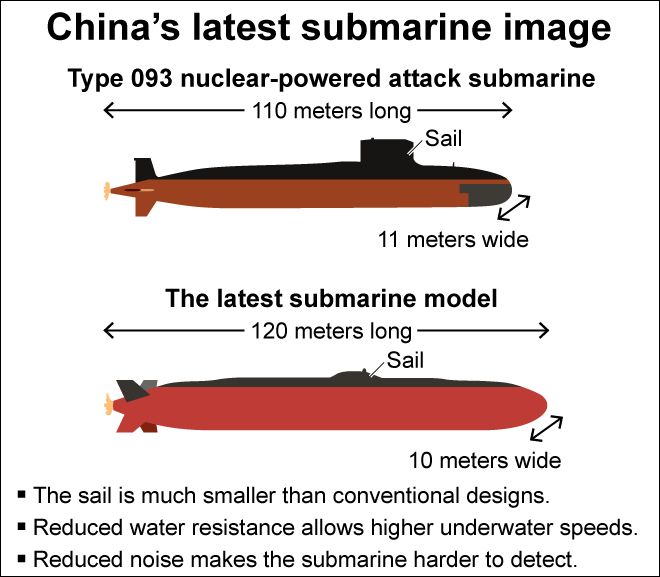
A key difference from existing Type 093 submarines is that the sail, the raised structure from which commanders operate the vessel using periscopes and other equipment, appears so small that it is difficult to identify in the satellite imagery.
A sleeker sail can reduce water resistance and noise while submerged, enabling higher speeds and making detection more difficult.
Kobayashi suggested that the submarine’s role may be “to approach U.S. aircraft carriers quietly underwater and attack them.”
CHINA BOOSTS NUCLEAR SUB BUILDING CAPACITY
China has been rapidly expanding its capacity to build nuclear-powered submarines.
According to the International Institute for Strategic Studies (IISS) in Britain, China launched 10 nuclear-powered submarines between 2021 and 2025, with a combined full-load displacement of about 79,000 tonnes, exceeding that of the United States during the same period.
The newly photographed submarine is also believed to be nuclear powered, suggesting that China may now possess the capability of building nuclear submarines at multiple shipyards.
On May 29, Blacksky photographed the submarine on a floating dry dock at Jiangnan shipyard on Changxing Island, near Shanghai. Another U.S. satellite company captured images on June 1 showing a submarine moored at a pier near the same floating dock at the same shipyard.
After analyzing the two sets of images, Kobayashi concluded that the submarines were nearly identical in size and shape and that the vessel observed on the floating dock had likely entered the water.
The Chinese navy currently possesses several classes of submarines, including the Type 094 nuclear-powered strategic submarine of about 137 meters in length, which carries nuclear weapons; the Type 093 nuclear-powered attack submarine of about 110 meters long, which carries conventional missiles; and the conventional Type 039 submarine of about 75 meters in length.
According to Kobayashi’s analysis, the newly photographed vessel is between 105 and 120 meters long and 10 to 12 meters wide.
It is smaller than the Type 094 nuclear-powered submarine, which can carry submarine-launched ballistic missiles (SLBMs) capable of reaching the continental United States, but significantly larger than the conventional Type 039 submarine.
Because its dimensions are close to those of the Type 093, he believes it is likely a nuclear-powered attack submarine.
Western military analysts have also analyzed the satellite photographs.
Immediately after the images were taken, some analysts speculated that the vessel represented a new type of submarine with no sail, since no obvious raised structure could be identified.
Subsequent analysis, however, suggested that a small protrusion resembling a sail is present, though it appears to be dramatically smaller than those found on conventional submarines.
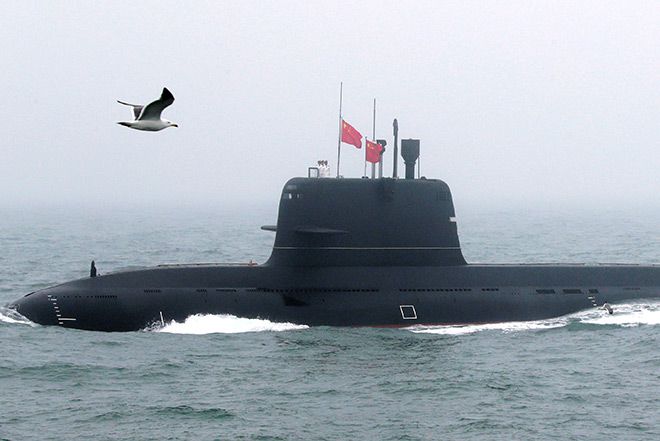
According to Kobayashi, the United States previously built an experimental submarine with a smaller sail. But if China successfully deploys such a design in operational service, it would become the first country in the world to do so.
At the same time, the sail also serves as an observation and command center when the submarine is on the surface.
“The height of the sail is important because it provides room for periscopes and masts, which contain antennas and radar equipment, to extend above the surface,” Kobayashi said. “It is also difficult to operate a vessel safely without a sufficiently high observation point. A shorter sail could create challenges for safe navigation.”
Yoji Koda, a former commander in chief of the SDF Fleet, similarly pointed out that reducing the size of the sail would make command and navigation functions more difficult and said it remains unclear whether such a design is truly operational.
Kobayashi likewise said that the possibility that the vessels are experimental submarines cannot be ruled out.
Because submarine construction and design are highly classified, the Chinese military rarely discloses information regarding such programs.
CHINA MAY HAVE ADDED NUCLEAR SUB SHIPYARDS
Traditionally, China’s nuclear-powered submarines have been built at Bohai shipyard in Liaoning province.
Jiangnan shipyard, in comparison, has primarily focused on surface vessels, including the aircraft carrier Fujian, which entered service last autumn.
If the newly observed submarine has a nuclear propulsion system, it could indicate that China now possesses the capabilities to build nuclear-powered submarines at multiple shipyards in northern and southern China.
“China may have begun investing in facilities to increase the number of nuclear-powered submarines it can produce,” Koda said.
In February, Jiangnan shipyard received approval from the Chinese government to install civilian nuclear-safety equipment, and it was officially recognized as having advanced manufacturing capabilities in the nuclear sector.
Some analysts believe this approval is related to the construction of nuclear-powered aircraft carriers and submarines.
According to the IISS, China launched 10 nuclear-powered submarines during the five years through 2025, compared with seven commissioned by the United States.
This represented a reversal from the preceding five-year period ending in 2020, during which the United States launched seven submarines and China only put two into operation.
The institute reported that Bohai shipyard expanded its facilities between 2019 and 2022, during which time multiple Type 094 and Type 093 submarines were launched.
U.S. STILL HOLDS THE EDGE
The IISS assesses that the United States still maintains a significant advantage over China in the number of nuclear submarines, their offensive capabilities, and their acoustic stealth. Nevertheless, the institute views China’s growing shipbuilding capacity as a threat.
Earlier this month, China announced that it had fired a strategic missile packing a training warhead from a ballistic missile submarine capable of carrying nuclear weapons.
The missile, believed to have been a submarine-launched ballistic missile, was reportedly launched from waters near China toward the southern Pacific.
China is strengthening not only the size of its nuclear-submarine fleet but also its broader nuclear capabilities.
The United States, Japan, Australia and other countries are closely monitoring these developments with growing concern.
(This article was written by Taishi Sasayama and Atsushi Okudera, senior staff writer.)

- Previous Japan to start extracting rare earths in deep-sea mud off remote island
- Next New U.S. tariffs – Round 3: Reason – claims of foreign forced labor dismay and anger trading partners
You may also like...




Random news











About us
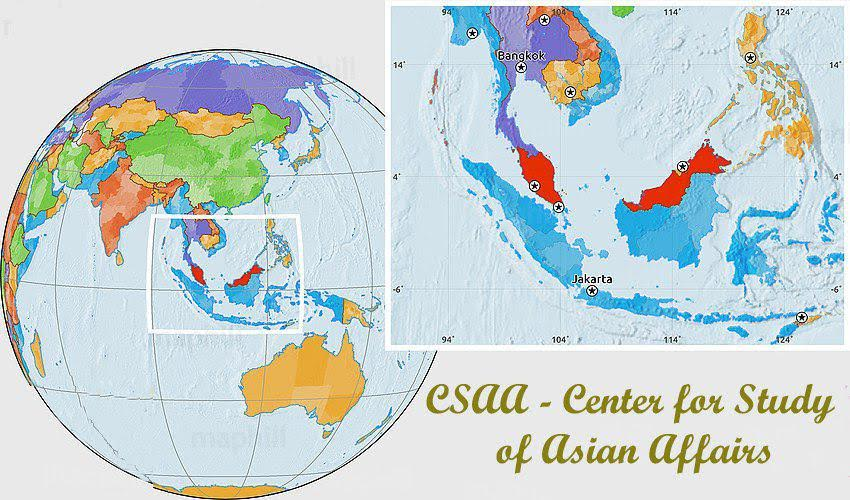
Our Newly established Center for study of Asian Affairs has
branches in Indonesia, Malaysia and Singapore, as well as freelances in some other countries.
For inquires, please contact: newsofasia.info@yahoo.com Mr.Mohd Zarif - Secretary of the Center and administer of the web-site www.newsofasia.net
Polls
 Loading ...