

U.S.-Iran ‘deal’: what is Japan’s SDF mission after
By RYOHEI MIYAWAKI/ Staff Writer
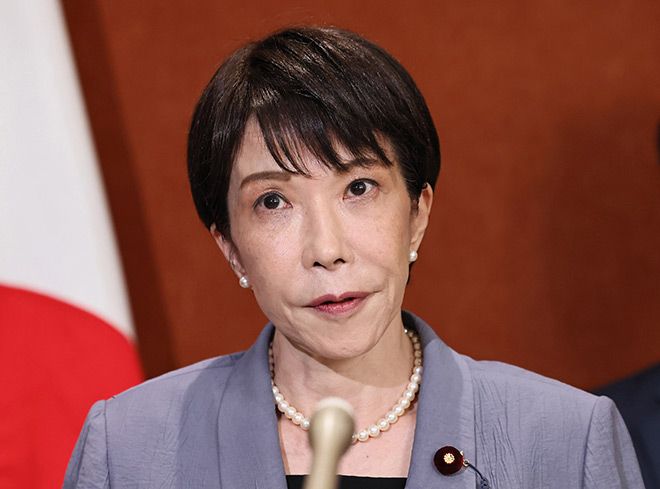 Prime Minister Sanae Takaichi meets with reporters in Rome on June 15. (Pool)
Japan is expected to accelerate discussions on possibly dispatching the Self-Defense Forces to the Strait of Hormuz following the announcement of a preliminary U.S.-Iran agreement to end hostilities in the Middle East.
“(The agreement) is a major step toward resolving the situation, and we welcome it,” Prime Minister Sanae Takaichi told reporters in Rome on June 15.
Speaking about upcoming talks between Washington and Tehran, Takaichi said, “What matters is that free and safe navigation in the Strait of Hormuz is genuinely secured, and that a final agreement on Iran’s nuclear issue is reached as soon as possible.”
Takaichi also expressed her intention to sign a joint statement originally issued by Britain, France, Germany and Italy.
“The urgent re-opening of the Strait of Hormuz with unconditional and unrestricted freedom of navigation is essential,” the statement said. “We are committed to playing our part to achieve this–in accordance with our respective constitutional requirements–including through a strictly defensive and independent mission to reassure commercial shipping and conduct mine clearance operations.”
The Japanese government has considered several options for deploying SDF vessels to the Strait of Hormuz after the end of the war.
They include: minesweeping operations; dispatching destroyers and other assets for “maritime security operations” to protect lives and property at sea; and sending destroyers exclusively for intelligence gathering.
However, at a news conference on June 15, Chief Cabinet Secretary Minoru Kihara said about a possible SDF dispatch, “Nothing has been decided whatsoever.”
A senior aide to the prime minister suggested that the government could intensify debate on the issue after Takaichi attends the Group of Seven summit, which begins in Evian, France, on June 15.
“Japan will likely align its approach with other G-7 members at the summit,” the aide said.
A government source revealed the underlying sentiment.
“We need to carefully assess what the international community expects of Japan,” the source said. “If possible, we would prefer to limit our role to logistical support.”
At a meeting in Italy on June 15, Takaichi and Italian Prime Minister Giorgia Meloni welcomed the preliminary U.S.-Iran agreement and confirmed close coordination on ensuring free and safe navigation in the Strait of Hormuz.
The previous day, Takaichi met with British Prime Minister Keir Starmer in Britain and affirmed the importance of opening the crucial artery for energy transport from the Middle East.
However, given the constant volatility in the region, governments remain on edge that the U.S.-Iran agreement could fall apart.
Japanese Foreign Minister Toshimitsu Motegi held a telephone conversation with Abbas Araghchi, his Iranian counterpart, on June 15 and received a briefing on the outlook for the upcoming U.S.-Iran talks and Tehran’s position.
According to the Foreign Ministry, the two ministers agreed to continue maintaining close communication toward the early realization of a final agreement.
Motegi also spoke by phone with Ishaq Dar, Pakistan’s deputy prime minister and foreign minister, and expressed deep respect for Islamabad’s “proactive mediation efforts” leading up to the preliminary agreement.
In mid-May, Defense Minister Shinjiro Koizumi participated in an international online meeting to discuss plans for mobilizing a multinational force to the Middle East.
He said three conditions must be met for an SDF dispatch: a U.S.-Iran cease-fire agreement, lines of communication with Iran, and a reduction of threats on the ground.

- Previous Indonesia’s sliding currency, but Batam Island is a rare bright spot
- Next Disgusting habits – Vietnam police rescue 500 cats from meat ring
You may also like...




Random news



About us
Our Newly established Center for study of Asian Affairs has
branches in Indonesia, Malaysia and Singapore, as well as freelances in some other countries.
For inquires, please contact: newsofasia.info@yahoo.com Mr.Mohd Zarif - Secretary of the Center and administer of the web-site www.newsofasia.net
Polls
 Loading ...