

50% seniors want to work – today 1 in 4 workers in Japan older 65: for money, other concerns
By KENICHI EZAKI/ Staff Writer
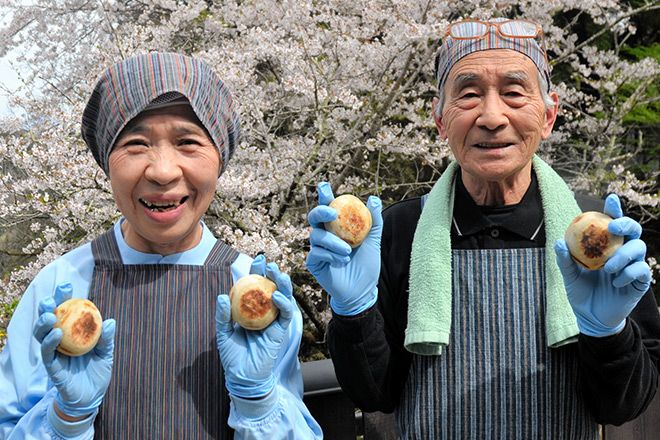 Fumiko Obinata, left, and Takashi Onishi, both in their 80s, work at Oyaki Village in Ogawa, Nagano Prefecture, on April 17. (Kenichi Ezaki)
Five days a week, Fumiko Obinata drives herself to work in Ogawa in Nagano Prefecture, a village of roughly 2,000 people, surrounded by high peaks.
Her work day runs from 8 a.m. to 5 p.m., including breaks. Her job is making “oyaki,” Nagano’s traditional stuffed dumplings.
In front of customers, she wraps wheat-flour dough around fillings such as “nozawana” pickled greens, turning out 100 to 150 dumplings a day — and as many as 350 when business is brisk.
Obinata, who is 81, is an employee at a sightseeing facility named Village, where employees in their 80s still work on the front line.
“I’m healthy, after all. And if I stayed home all day, I’d only end up getting sick,” Obinata says.
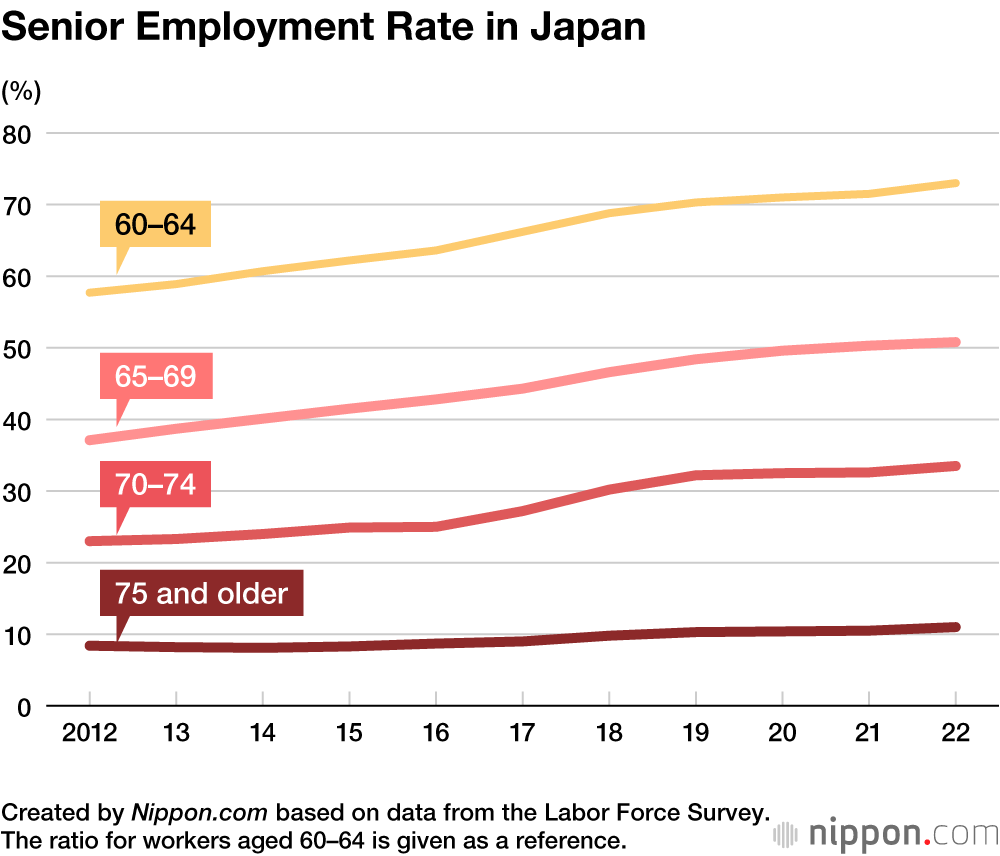
In a country that has aged faster and further than almost any other major nation, Japan’s older citizens are refusing to disappear from the workforce.
Today, one in four people aged 65 or over is still working — a reflection of both longer lives and economic necessity.
Obinata worked at a paper-processing plant until she was 70 before taking up her current job. Now in her 12th year as a full-time employee, she earns about 180,000 yen ($1,130) a month, with bonuses twice a year.
“Talking with customers is fun, and it keeps me alert,” she says. “As long as I’m healthy, I want to keep working.”
Many seniors say they continue working because they need the money. But behind that simple explanation lies a more complex, regional story.
Across the country, local industries, population decline, health conditions and household finances are combining to determine who keeps working — and who can afford to stop.
The number of working seniors is rising steadily. A quarter of Japanese aged 65 and over now hold jobs, and in every one of the country’s 47 prefectures, the share is higher than it was a decade earlier.
But when the figures are broken down by region, sharp differences emerge.
Using data from the government’s 2022 Employment Status Survey, The Asahi Shimbun independently calculated the percentage of people aged 65 and over who were working in each prefecture.
Fukui Prefecture ranked first, at 30.9 percent, followed by Yamanashi at 30.6 percent, Nagano at 30.1 percent, Saga at 28.5 percent and Kagoshima at 28.3 percent. At the other end of the scale was Nara, in 47th place, at 21.9 percent. The national average stood at 25.3 percent.
By industry, the largest number of older workers were employed in wholesale and retail trade, followed by medical care and welfare, and services not elsewhere classified.
WHAT EXPLAINS THE REGIONAL DIFFERENCES?
In Fukui, the top-ranking prefecture, local officials are cautious about drawing a conclusion.
But a prefectural government official pointed to a combination of factors: a strong manufacturing base, employment conditions that make it easier for older people to keep working, and a relatively low share of residents certified as needing nursing care.
The official also cited an active participation in volunteer work — a sign of a strong desire among older residents to remain active in society.
Nagano, which ranked third, cited its thriving agricultural sector, where there is no mandatory retirement age, as one reason for the high employment rate among seniors.
Officials also pointed to the prefecture’s healthy life expectancy — calculated from average life expectancy and the level of need for nursing care — which is among the highest in Japan.
Another factor, they said, is the broad participation in Nagano Prefecture’s “Senior University,” a lifelong-learning program designed to help older residents develop themselves, build social ties and become more involved in their communities.
Another pattern also emerges: prefectures with a higher share of working seniors tend to spend less on health care.
According to the government’s Analysis of Regional Differences in Medical Expenses for fiscal 2023, annual medical spending per person among those aged 75 and over stood at 905,289 yen in Fukui, 866,730 yen in Yamanashi and 852,189 yen in Nagano — all below the national average of 946,520 yen.
The pattern, however, does not hold in every prefecture.
WHY DO OLDER PEOPLE KEEP WORKING?
Makoto Fujimoto, a researcher at the Japan Institute for Labour Policy and Training, an independent administrative agency, points to regional industrial structure as one factor behind the geographic disparities.
In areas where agriculture and fisheries remain strong, a certain number of people continue working well into old age.
“The factors are varied,” Fujimoto says. “It is not just about health, but also about a region’s industries, its population size and individuals’ economic circumstances.”
For many seniors, the motivation is straightforward. According to the government’s 2025 Annual Report on the Aging Society, 49.6 percent of working men aged 65 and over and 42.8 percent of working women in the same age group said they worked “for the income.”
OLDER PEOPLE STARTING BUSINESSES
Older entrepreneurs are also on the rise.
According to Teikoku Databank Ltd., a major Japanese provider of corporate credit research and business information, people aged 60 and over accounted for 20.5 percent of those who founded new companies in 2025 — the highest share on record.
The government, too, is taking steps to support older people who want to remain in the workforce. One such measure is an overhaul of the earnings-tested, old-age employees’ pension system.
Under the system, people receiving an Old-age Employees’ Pension while continuing to work may have part of their pension suspended if their combined monthly wages and pension benefits exceed a set threshold.
From April 2026, that threshold was raised from 510,000 yen to 650,000 yen.
The change is intended to respond both to seniors who want to work more and to companies facing chronic labor shortages.
Across Japan, the number of workers aged 65 and over reached 9.3 million in 2024 — an all-time high and the 21st consecutive annual increase.
In workplaces of every kind, older people have become an indispensable part of the labor force. The reliance on them is only deepening.
Nagano Prefecture is aging quickly, like much of Japan. One in three residents is 65 or older. Yet the prefecture is also known for the strong presence of seniors in the workplace.
For roughly one in four working residents aged 65 and over in Nagano, the workplace is agriculture or forestry — sectors where the shortage of people to carry them forward is especially acute.
Against that backdrop, Ogawa no Sho, the company that operates Oyaki Village, promotes what it calls “a working life with no finish line.” It puts that idea into practice by hiring people at 60 and setting no retirement age.
Of its 76 employees, 21 are aged 65 or over. The average age is 52.4. The oldest employee, Harumi Okubo, 84, says, “Working is the secret to staying healthy. I’m grateful there’s no retirement age here.”
Koryu Gonda, the company’s 55-year-old president, says older workers play an essential role.
“They are not a stopgap for a labor shortage,” he says. “Without the strengths older people bring — their knowledge and experience — the business would not hold together.”
In recent years, the company has also stepped up its hiring of new graduates. Having different generations support one another, Gonda says, has helped bring new energy to the workplace.
NO AGE LIMIT AT KAGOSHIMA WORKPLACE
Kagoshima Prefecture offers another revealing example.
The southernmost prefecture on Kyushu, Japan’s southernmost main island, recorded the second-largest rise in the share of working people aged 65 and over between 2012 and 2022 — an increase of 8.4 percentage points, behind only Okinawa’s 9.0 points.
At Rupin no Sato, a nursing-care facility for older people in the town of Higashikushira on the Osumi Peninsula, the trend can be seen in human terms.
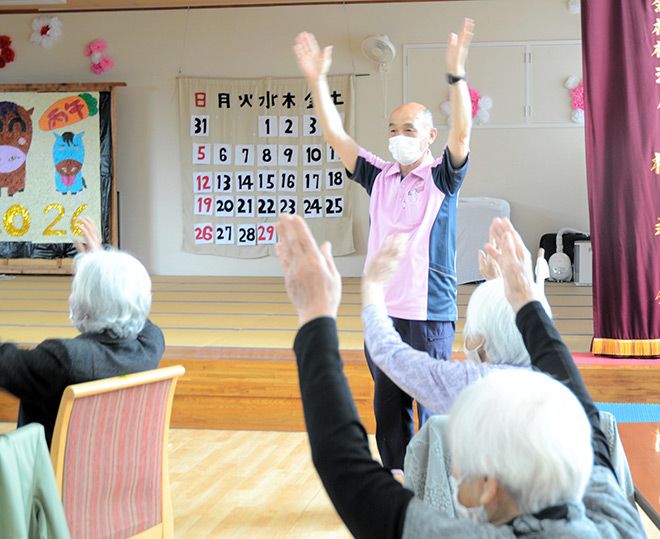
The facility has introduced a re-employment system with no upper age limit, responding to employees who want, or need, to continue working. It was once recognized in a corporate contest honoring workplaces where older people play active roles.
At Fukujukai, the social welfare corporation that operates the facility, 17 of its 130 employees are now aged 65 or over.
Toshiko Takeuchi, 67, who helps care for residents, is in her sixth year on the job.
“I’m glad there is a place that will take me on even at my age,” she says.
Kazunori Nakayama, 69, a former Self-Defense Forces member, says continuing to work provides him with both income and peace of mind.
“I need money for my hobbies and for time with my grandchildren,” he says. “My pension alone makes me uneasy.”
In recent years, only one Fukujukai employee has retired upon reaching 65. Yet, Toshiro Fukudome, the corporation’s 53-year-old director, says the organization hired no new graduates this fiscal year.
“Young people leave for other towns and other prefectures, and they don’t come back,” he says.
The varied experience of older staff members is a strength, Fukudome says. But he also acknowledges a harsher reality: without them, the operation could not function.
A Kagoshima prefectural official describes the rising share of working seniors as “the fruit of efforts to realize a society of lifelong engagement.”
At the same time, the official notes that the prefecture’s high proportion of residents aged 65 and over is itself one factor behind the increase.
Fukudome also senses economic anxiety behind the decision of many older people to keep working.
“Life in old age has changed,” he says. “For many seniors, living on their pension alone means barely getting by. More people have no choice but to work.”
Makoto Fujimoto, vice research director for career development at the Japan Institute for Labor Policy and Training, says the issue needs to be understood not only in terms of how many older people are working, but also what kinds of jobs they are doing.
According to the Ministry of Internal Affairs and Communications’ 2023 Labor Force Survey, the share of workers in clerical jobs drops sharply after age 65.
By contrast, the shares working in services and in agriculture, forestry and fisheries rise. In other words, the nature of work changes significantly as people grow older.
The contrast is especially clear in primary industries. Among workers aged 60 to 64, only 3.2 percent are employed in agriculture, forestry or fisheries. Among those aged 75 and over, the share rises to 17.5 percent.
Fujimoto says industrial structure is one of the key factors behind regional differences in the percentage of working seniors. In areas where agriculture, forestry and fisheries remain strong, a certain number of people continue working into old age, pushing the overall share higher.
Population size also matters. Jobs such as building, cleaning and security require a certain population base to support them. In regions where the population is shrinking, there are fewer workplaces available.
Taken together, this means the figures cannot be reduced to a simple formula: a high share of working seniors does not necessarily mean a healthy, vibrant region.
In some cases, older people are being drawn into the labor force by a combination of factors — a skewed industrial structure, population decline and economic necessity.
Japan’s labor market is expected to become even more dependent on older workers. Fujimoto said it will be essential to strengthen vocational guidance and job training tailored to seniors, and to expand opportunities for matching older workers with suitable jobs.
The employment of older people, he argues, should be reconsidered not only in terms of quantity, but also in terms of quality — and of the circumstances that lie behind the numbers.

- Previous Israel says no more 50 million cubic meters mandated by the 1994 Israel–Jordan peace treaty.
- Next EU Christians vs Turkish Moslems: European Parliament’s Cyprus resolution – Ankara it is ‘null and void’
You may also like...






Random news











About us
Our Newly established Center for study of Asian Affairs has
branches in Indonesia, Malaysia and Singapore, as well as freelances in some other countries.
For inquires, please contact: newsofasia.info@yahoo.com Mr.Mohd Zarif - Secretary of the Center and administer of the web-site www.newsofasia.net
Polls
 Loading ...