

Hurdles and Opportunities for Central Asian Business in a New Era: Logistics, Raw Materials and Manufacturing Capacity Building in Cooperation with the United States of America
Events in international relations, world and regional economics as well as intra-regional logistics develop rather rapidly, often in an unpredicted direction and take an unexpected turns. That said, these days apply also to system of international trade and decades long established logistics and transportation of viral cargoes and goods. Events in Middle East, Black Sea region and Eastern Europe/Ukraine have been major issues, needed to be addressed in order to overcome the stockpiling set of increasingly complex problems.
If we look how tall these impacts situation in Central Asia, it indeed requires rather quick and flexible reaction, rapid adaption to the ongoing change of environment around the region.
Based on my professional experience in “Uztrade” JSC, the first and foremost issue and problem Uzbekistan have been facing was the logistics. All of our neighboring states, Afghanistan, Turkmenistan, Kazakhstan, Kyrgyzstan and Tajikistan are landlocked countries, but Uzbekistan is only of the two nations in the World that is double-landlocked[1].
So, in order to export our goods or bring foreign products from abroad Uzbek government have to cross physical and customs’ borders of at least two states. At times, this led not only the long delays of commodities, but also was the reason of doublings and tripling the prices of the commodities.
For example, at this very moment, shipping 20 tons container from Pakistan to Uzbekistan costs anywhere between 5.7 thousand to 8.8 thousand dollars via road transport, while cost of the products, being imported add up to 25 percent to 200 percent to the final price, dependent on type of commodity. For comparison – standard port-to-port maritime freight rates from Karachi to Dubai range from $1400 to $2000 per 20 ft container, to London 1500-3000 dollars, to Rio de Janeiro, Brazil – 2500-4500 dollars per 20 ft container.
Furthermore: to compare – the sea distance from Karachi, Pakistan to Rio de Janeiro, Brazil is approximately 21,800 to 23,100 kilometers, whereas distance from Karachi to Termez is just less than 1900 km, or more than 11 times less than distance to Brasil, but shipping cost is more than 2,3 times.
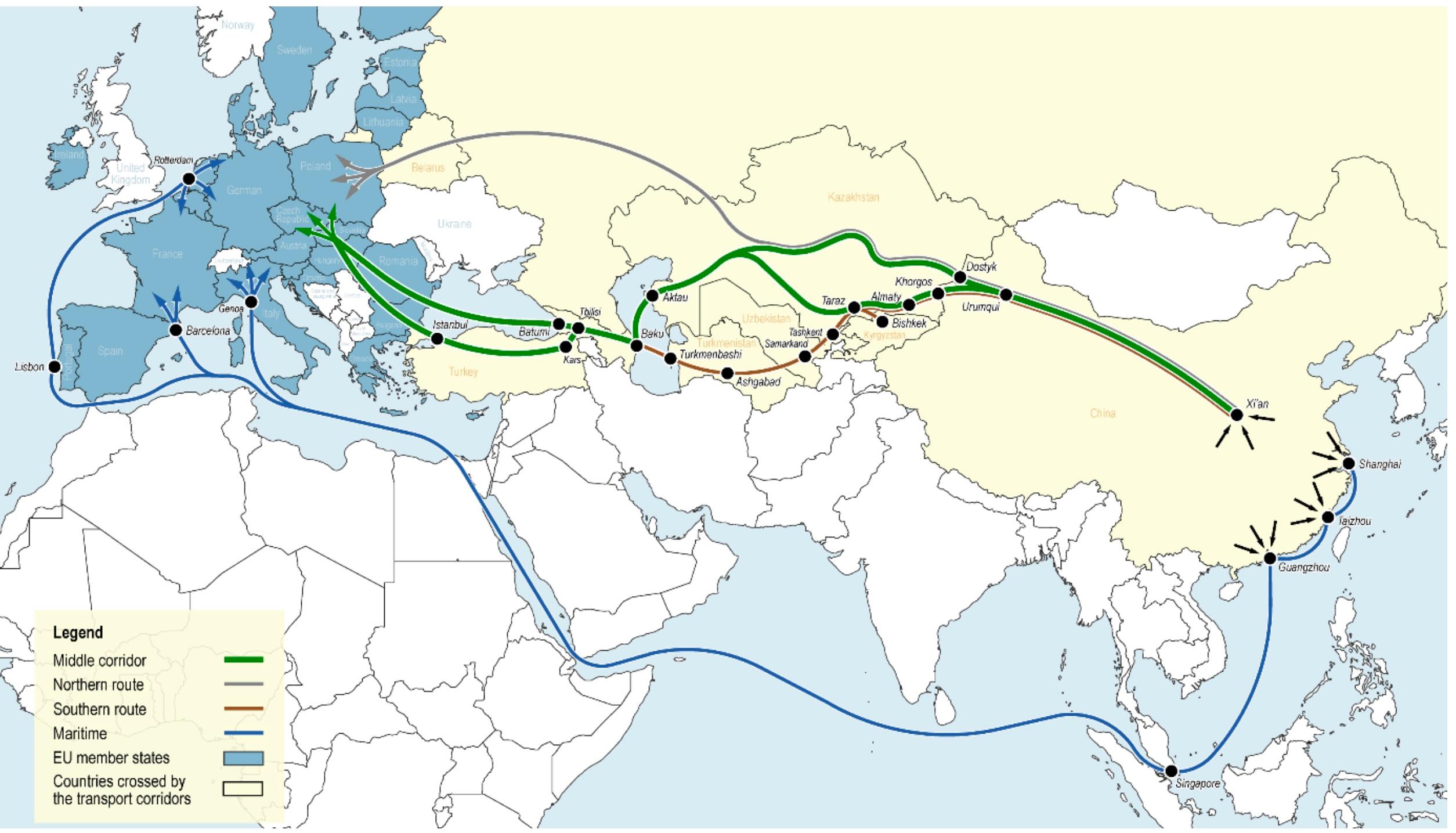
Years of 2025 and 2026 showed than vital routes could instantly, out of nowhere could be blocked by flaring and lingering unsolved international security problems. In 2025, both Afghan-Pakistan and Iran transit routes were closed and rendered ineffective due to major international military conflict. This teaches a lesson to use every opportunity to have keep opened any other alternative transit route for export and import if goods: That means northern corridor through Kazakhstan and Russian; Middle Corridor – Uzbekistan-Turkmenistan-Azerbaijan-Georgian Black Sea ports or Uzbekistan-Kazakhstan-Azerbaijan-Georgian-Black Sea ports and finally Chinese ports of Lianyungang and Shanghai in the Pacific through Kazakhstan and Kyrgyzstan.
In order to optimize the utilization of the southern route, on July 21st 2026, Uzbekistan and Pakistan had signed an agreement for transit and transportation of goods along the route Andijan (Uzbekistan)-Osh-Irkeshtam(Kyrgyzstan)-Kashgar(China) – Sost Dry Port – Karachi (Pakistan).
As local media says, “the amendment will formally add the China corridor to the available routes under the agreement, allowing goods to move through the Sost Dry Port and western China before entering Central Asia. The protocol is aimed at expanding transit options and ensuring uninterrupted movement of goods between the two countries despite evolving regional security challenges”[2].

The situation when transportation costs are higher than export or import products themselves often lead that we were left no option but to focus on dealings with high-end manufactured goods.
For success in export market, it is crucial to develop the following features:
– Successful export marketing often starts by selling the country before the product. Think of how Colombia branded its coffee, or how Switzerland positions its watchmaking. Creating a high-quality reputation for the national “umbrella brand” lifts all individual exporters.
– Necessity to develop B2B Ecosystem. Extensive marketing in international trade relies heavily on establishing relationships with foreign distributors, wholesalers, and retail giants. This is achieved through aggressive participation in international trade fairs, trade missions, and diplomatic commercial channels.
– Localized digital footprints—ranging from targeted B2B campaigns on platforms like LinkedIn or Alibaba to localized social media marketing that builds direct-to-consumer demand in the target nation.
One need to have deep understanding of the demand side of American consumer market. There is no single “American consumer.” Instead, the market is a massive collection of micro-markets segmented by geography, income, age, and cultural background. Understanding American demand requires analyzing why they buy. This involves tracking core consumer values that often conflict but drive immense volume. While a growing segment of the population demands corporate sustainability, ethical sourcing, and clean ingredients, price sensitivity remains incredibly high. Brands must balance purpose with tangible economic value.
In the U.S., demand is heavily mediated by massive retail gatekeepers and specific regulatory environments.
Existing and developing political dialogue on highest level lays our necessary conditions for cooperation between Uzbekistan and US.

Based on my professional experience at “Uztrade” JSC, I believe, that one of the vehicles for lowering cost of products is setting up joint venture companies to products high end manufactured products. Manufacturing high-end products requires enormous upfront capital, highly specialized technical expertise, and complex supply chains. For an expanding enterprise, trying to build all of this from scratch independently drives unit costs to prohibitive levels.
Setting up a Joint Venture solves this dilemma by turning a massive capital expenditure into a shared, highly efficient operational structure. Here is how a strategic alliance directly drives down the cost of producing high-end manufactured goods.
When two strategic partners pool resources, they unlock deep financial and operational efficiencies across four key areas and lead to the cost reduction. By combining the market demand of both partner networks (e.g., local distribution channels paired with the foreign partner’s global export routes), the JV can instantly scale production volumes. As output increases, the fixed costs of factory overhead, tooling, and specialized machinery are distributed across a larger number of units, sharply reducing the cost per unit.
It is also requires producing advanced goods demands premium raw materials or complex sub-components. A joint venture leverages the combined purchasing power of both parent companies. This stronger position allows the JV to negotiate bulk discounts, secure long-term pricing contracts, and streamline logistics channels that neither partner could manage alone.
Attempting to manufacture high-end goods alone means absorbing 100% of the risk, capital requirements, and operational inefficiencies. A joint venture spreads the financial weight, bypasses expensive technology development cycles, and instantly maximizes production capacity – making it one of the fastest, most effective vehicles for driving down final product costs.
World Bank gives credit to the government of Uzbekistan for continued and multifaceted approach in creative way to reform and modernize the national economy. According to estimates of this international organization today, “Uzbekistan has one of the most diversified economies in the region. The government’s Central Asia–oriented and proactive foreign policy enables the country to play a leading role in promoting regional economic cooperation, including in the water, energy, transport, and trade sectors”[3].
Population numbers in 1991, year we gained Independence was 20.6 mln. populations, today 39.1 mln. population. The near-doubling of Uzbekistan’s population over the last 35 years – surging from 20.6 million in 1991 to 39.1 million today – has fundamentally transformed the country, its economy, its geopolitical standing and its place in the evolving system of international relations and regional security[4].

Furthermore, urban centers – particularly the Tashkent – have expanded rapidly, concentrating demand and creating severe localized logistical bottlenecks. As a result, the country faces a constant battle against transit delays, high domestic storage costs, and cargo shrinkage during long-haul deliveries from deep-sea ports.
Setting up of logistical hubs at Black Sea, East and West coast of US seaports or Uzbekistan export products could prove and efficient vehicle for expanding export and import trade volumes between Uzbekistan and United States.
Uzbekistan and Kazakhstan has been together developing corridor Beyney-Aktay. On July 23rd 2026, “the Prime Ministers of Uzbekistan and Kazakhstan, Abdulla Aripov and Olzhas Bektenov, discussed prospects for increasing cargo shipments along the Trans-Caspian International Transport Route (TITR).The heads of government visited the Aktau International Sea Commercial Port—a key facility of the TITR—where they toured the site and inspected the enterprise’s infrastructure and port facilities”[5].
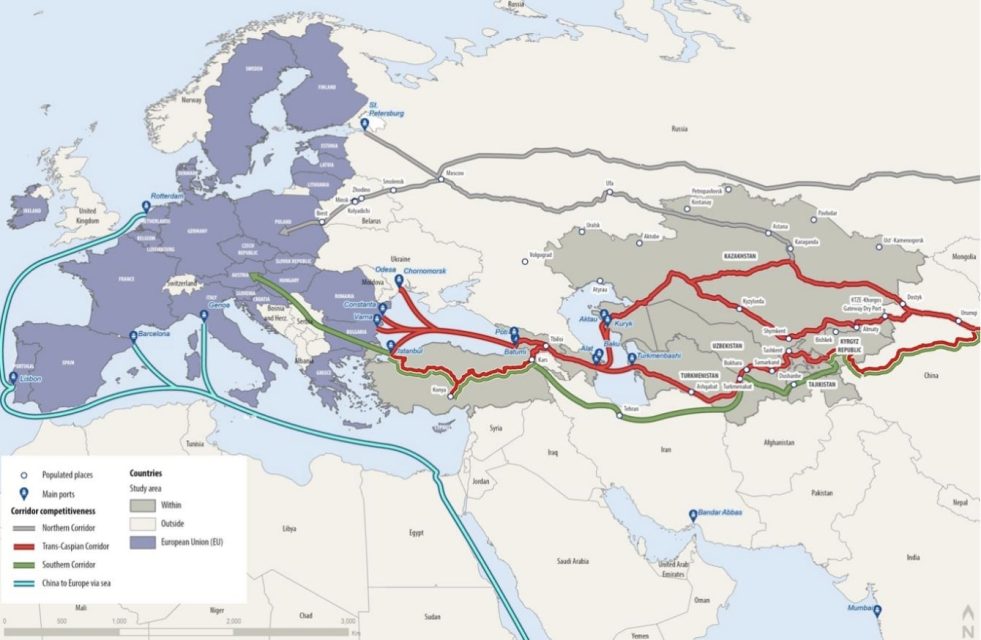
In modern terminology this route now called Middle Corridor. As one local expert describes, Uzbekistan pursues “close interaction with Azerbaijan, the largest economy in the Transcaucasia region, which acts as a connecting link between two strategically important transport hubs – the Trans-Caspian and Trans-Caucasian corridors”[6].

In this regard, the attached map of the Middle Corridor and its connections with the adjacent transportation directions show the evolving network of current logistics of not only Uzbekistan, but also of Central Asia and South Caucasus. regions[7].
As it is well known now, Uzbekistan country at this time operate 24 transport and logistics centers have been granted the status of international dry ports. The decision was made at the sixth meeting of the Working Group on “Dry Ports” in Bangkok under the “Intergovernmental Agreement on Dry Ports” of the United Nations Economic and Social Commission for Asia and the Pacific (UN ESCAP). This network of dry ports includes “seven in Tashkent, four in Tashkent Region, three each in Fergana and Surkhandarya Regions, two in the Republic of Karakalpakstan, and one each in Jizzakh, Navoi, Samarkand, Namangan, and Bukhara Regions”[8].
Uzbekistan’s dry port network system and its connection to the Black sea ports, Georgian Batumi and Poti, Romanian Constanta or Turkish Trabzon, should constantly adjust to the changes in each and every country its connects, whether in terms of national legislation, tariff policy, constrains of railways and highways, and even to the electricity of consumer goods shortages. It serves as the primary maritime exit point for the Middle Corridor (Trans-Caspian Route) and the CASCA+ rail network[9].
- Purposeful policy of our government is dedicated to creating Uzbek logistical hub, hat will contribute greatly to the changes the dynamics of Eurasian trade and serves to the following aims:
– Freight and Goods Consolidation, Increase in “Dry Port” Functionality and Ease of Transportation Hurdles: Instead of sending fragmented rail cars or trucks across multiple borders, Uzbek exporters can send cargo in bulk to a centralized Black Sea facility, easing the clearance through customs and borders check-up, and containerized for maritime freight;
– To Mitigate Geopolitical, Cost and Network Risks: Geopolitical instability and rising transit costs through traditional southern routes, like Iran’s Bandar Abbas or near permanent skirmishes in Af-Pak border are giving hard times to Central Asia states for finding secure and reliable routes to export and import of goods. That is why is its essential to use Black Sea ports as an alternative. It allows Uzbek textiles, copper, and agricultural products to flow uninterrupted into the European Union under preferential trade agreements like GSP+ to the markets 450 million people of EU nations. As it has been noted in EU statement, “since Uzbekistan acceded to GSP+ its exports to the EU have seen a historic boost. Between 2019 and 2022, the value of goods imported to the EU from Uzbekistan under GSP has more than quadrupled, reaching more than 450 million euros in 2022. Uzbek export of GSP eligible goods was 93 million euros in 2019, it was – again – 450 million in 2022”[10].
- Setting up Entry Hubs of Uzbekistan’s Export and Import from US, at American East and West Coast Hubs. Setting up logistical facilities directly inside major U.S. gateway seaports, such as New York/New Jersey on the East Coast and Los Angeles/Long Beach on the West Coast, will help to transition Uzbekistan from a distant supplier to a local fulfillment partner. This will also facilitate to solve the following issues:
– To Remove the Lead-Time Barrier: American buyers expect rapid, reliable delivery. By maintaining a dedicated warehouse facility t at U.S. ports, Uzbekistan can pre-export high-demand goods, like manufactured apparel, processed foods, or industrial components. It is necessary to note that major part of Uzbekistan’s export to US in 2024, 2025 and first quarter of 2026 consisted of aforementioned types of products.
When a U.S. buyer places an order, the product is shipped domestically from the coastal hub, reducing delivery times from months to mere days.
– To Optimize Two-Ocean Logistics: The dual-coast strategy ensures efficient supply chain mapping. Products bound for the eastern and midwestern U.S. flow through the Atlantic via the Black Sea/Mediterranean route to the East Coast. Conversely, goods destined for the western U.S. can utilize the upcoming China-Kyrgyzstan-Uzbekistan railway to reach Pacific ports, routing efficiently to the West Coast.
- Task to Improve Logistics and Increase Us-Uzbekistan bilateral trade.
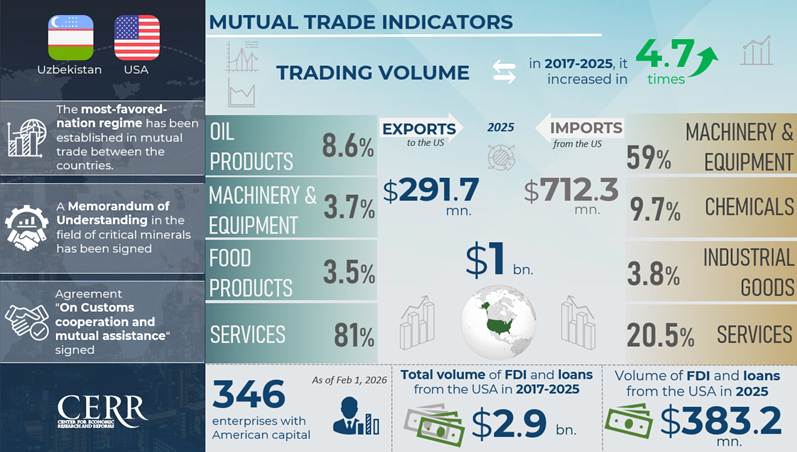
Uzbekistan’s trade relations with the United States have shown steady expansion over the past decade. In 2024, Uzbekistan exported $431mn worth of goods to the U.S. – a tenfold increase compared to 2014 ($42.4 million)[11]. The share of the U.S. in Uzbekistan’s total exports rose from 0.3% in 2014 to 1.6% in 2024, reflecting gradual diversification toward high-value markets.
As US trade representatives puts data, in during last 2,5 years, US-Uzbek bilateral trade has been witnessing major boost. U.S. goods and services trade estimated $1.0 billion in 2024, up 8.1 percent ($76.5 million) from 2023. U.S. goods trade with Uzbekistan totaled an estimated $1.0 billion in 2025. U.S. goods exports to Uzbekistan in 2025 were $473.9 million, up 24.5 percent ($93.2 million) from 2024[12].
US “goods imports from Uzbekistan totaled $574.4 million in 2025, up 1253.5 percent ($531.9 million) from 2024”[13]. It is stated that the U.S. goods trade balance with Uzbekistan shifted from a goods trade surplus of $338.3 million in 2024 to a goods trade deficit of $100.5 million in 2025.
Furthermore, Uzbekistan’s trade turnover with the United States reached $93.3 million in January 2026, increasing by 69.6% compared to $55.0 million recorded in the same period of 2025. It is said that in the same timeframe, “Uzbekistan’s export figures to the United States hit $32.1 million, representing 34.4% of the overall trade, whereas imports soared to $61.1 million, making up 65.6%, highlighting a trade structure heavily reliant on imports”[14].
Sentiments among Uzbek exporter and experts are similar. They opt for expansion, diversification and easing regulation in our bilateral trade.
Expanding of trade with the United States stays as an important strategic goal for Uzbekistan’s long-term diversification agenda. The country’s improving export capacity, combined with its moderate exposure under the new U.S. tariff regime, provides a unique opportunity to reposition itself as a competitive, tariff-neutral hub for manufacturing and re-export within the region. As an Uzbek expert M.Sultanova puts – “achieving this will require sustained institutional coordination, improved logistics and certification frameworks, and proactive engagement in regional and global trade partnerships”[15].
Uzbek GDP, thanks to well thought, steady and comprehensive reforms of all sides of national economy, regulatory system and foreign trade under the leadership of the President Shavkat Mirziyoev grew for the last 7 years – from 2020 to 2025 – more than doubled: from $70,127 bn in 2020 to $147.069 bn, according to the International Monetary Fund. The GDP growth rate in 2026 is 6.5%. GDP per Capita in Uzbekistan (with a population of 37,724,223 people) is $4,661 in 2026, an increase of $814 from $3,846 in 2025; this represents a change of 21.2% in GDP per capita[16]. Nominal, current GDP of Uzbekistan is $181,5 bn as of 2026, according to IMF.
One of the key institutionalized venues that emerged as a driving tool for development and expanding of US-Central Asia, i.e. means also US-Uzbekistan political and trade-economic cooperation is C5+US dialogue. This venue lead to setting up also a business-dialogue venue B5+Us, where businessmen from all states of our region and US have opportunity directly engage in discussing priority projects of bilateral and multilateral interests.
Washington-devised initiative to promote business ties between the five countries of Central Asia and the United States. The forum’s significance is highlighted by the fact that event was attended in person by President Donald Trump’s Special Representative for South and Central Asia – Sergio Gor, native of Uzbek capital Tashkent[17].
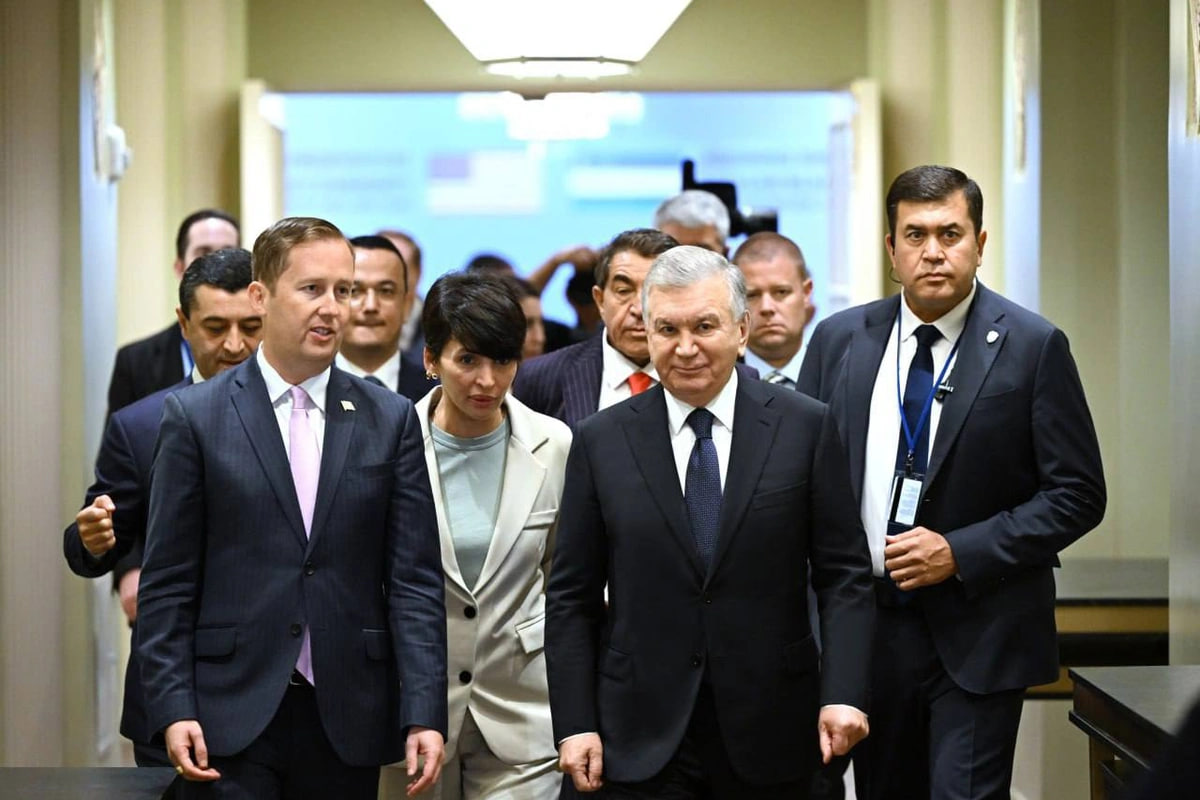
As organizers of the event summarize, “the rationale of the B5+1 Forum is to bring American and Central Asian business leaders and government officials together to foster trade and investment. But as the proceedings at the Sheraton unfolded, it became clear that a more comprehensive, longer-term discussion addressing broader and emerging challenges was largely absent”[18].
Of course, of other ley area was and are stay the development logistic husband transportation routes.
Major milestone decisions have already been taken in moving forward to develop bilateral relations in all areas of mutual interest to advance bilateral cooperation between Uzbekistan and United States. These efforts can considered and structured into broader efforts of Uzbek government to develop national economy, system of logistics and foreign trade. However, much has to be done and it requires continued and tireless efforts to move further in order to achieve tangible results in comings years.
________________________________________________________________________
[1] The other one is tiny European state Liechtenstein with the size of 160 km2 in Europe, surrounded by Switzerland and Austria.
[2] Shahzad Paracha, “Pakistan, Uzbekistan turn to China corridor as Afghan, Iran routes falter”, Pakistan Today, July 20th, 2026, https://profit.pakistantoday.com.pk/2026/07/20/pakistan-uzbekistan-agree-to-use-china-corridor-for-transit-trade
[3] World Bank group, https://www.worldbank.org/ext/en/country/uzbekistan
[4] World Bank group, https://www.worldbank.org/ext/en/country/uzbekistan
[5] “Uzbekistan and Kazakhstan plan to increase transportation through Transcaspian route”, 24.07.2026, https://www.gazeta.uz/ru/2026/07/24/cargo-transportation/
[6] Nargiza Umarova, “How does Uzbekistan Develop Transport Links with South Caucasus”, 03/14/2025, https://www.caspianpolicy.org/research/economy/how-does-uzbekistan-develop-transport-links-with-the-south-caucasus
[7] Ibid.
[8] Uzdaily,com news website, 17/11/2025, https://www.uzdaily.uz/en/24-transport-and-logistics-centers-in-uzbekistan-granted-status-of-international-dry-ports/
[9] CASCA+ is a joint initiative of the state railways of Azerbaijan, Georgia, Kyrgyzstan, Turkmenistan, Turkey, and Uzbekistan. The “+” sign indicates a willingness to accept new potential participants in achieving the goal to connect transport routes to Southeast Asia, particularly China, with Europe, “Times of Central Asia”, “CASCA+ Transport Corridor Freight Transit”, 31 May 2024, https://timesca.com/casca-transport-corridor-freight-transit/
[10] EEAS – European External Action Services, “GSP+ a real success story”, 09/01/2024, https://www.eeas.europa.eu/delegations/uzbekistan/gsp-real-success-story-uzbekistan_en
[11] News web-site “Daryo.uz”,”Uzbekistan–United States trade: emerging upward dynamics”, 03.11.2025, https://daryo.uz/en/pE4IeVzDR/
[12] Office of United States Trade Representative, Uzbekistan Trade Summary, https://ustr.gov/Uzbekistan
[13] Ibid.
[14] K.Ismailov, “Trend.az” news web-site, “Uzbekistan sees nearly 70% leap in trade with U.S.”, 12/03/2026, Uzbekistan sees nearly 70% leap in trade with U.S.
[15] News web-site “Daryo.uz”,”Uzbekistan–United States trade: emerging upward dynamics”, 03.11.2025, https://daryo.uz/en/pE4IeVzDR/
[16] Worldometer, “Uzbekistan GDP 2026”, https://www.worldometers.info/gdp/uzbekistan-gdp/
[17] Serg Gor or Sergey Gorokhovsky was born on November 30, 1986, in Tashkent, then in the Uzbek Soviet Socialist Republic. His family moved to Malta by 1994, when his mother established a business.[1] He was raised in Cospicua[2] and attended De La Salle College, a Catholic boys’ school. Borg, Jacob (July 8, 2025). “Top ‘Maltese’ Donald Trump aide actually born in Soviet Union”. Times of Malta. Retrieved August 1, 2025.
[18] Aida Aidarkulova, Central Asian Policy Studies, “Central Asia and the United States: What was (and wasn’t) discussed at the B5+1 Forum”, 19/02/2026, Central Asia and the United States: What was (and wasn’t) discussed at the B5+1 Forum – capsunlock
________________________________________________________________________
About the author: Mr. A. Kurbanov had served as Chairman of the Management Board of JSC “Uztrade”, a state-owned major foreign-trade company from 2021 to 2026, with 17 years of work of experience in the field of international trade and logistics with Central Asian countries, United States, Russia, China and the member-states of European Union.

- Previous The US helps to strengthen Japanese yen
- Next Central Asian states and Azerbaijan sign cooperation roadmap
You may also like...




Random news





About us
Our Newly established Center for study of Asian Affairs has
branches in Indonesia, Malaysia and Singapore, as well as freelances in some other countries.
For inquires, please contact: newsofasia.info@yahoo.com Mr.Mohd Zarif - Secretary of the Center and administer of the web-site www.newsofasia.net
Polls
 Loading ...