

The New Tool of Asymmetric War of Beijing: Chinese militia using fishing boats to form ‘walls’ at sea

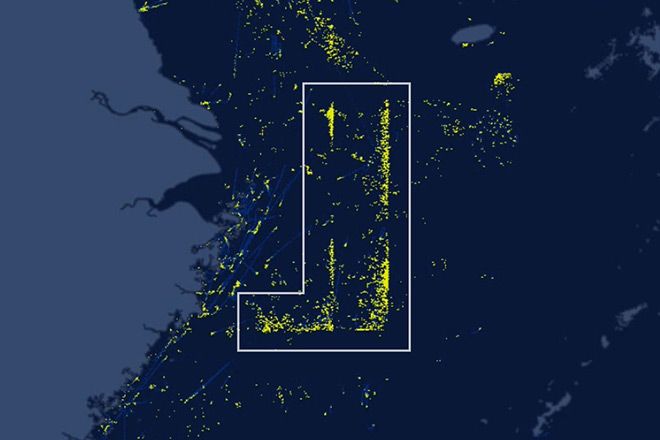 The yellow dots represent Chinese fishing vessels from Dec. 23 to 26, 2025, based on data provided by Global Fishing Watch. (The Asahi Shimbun)
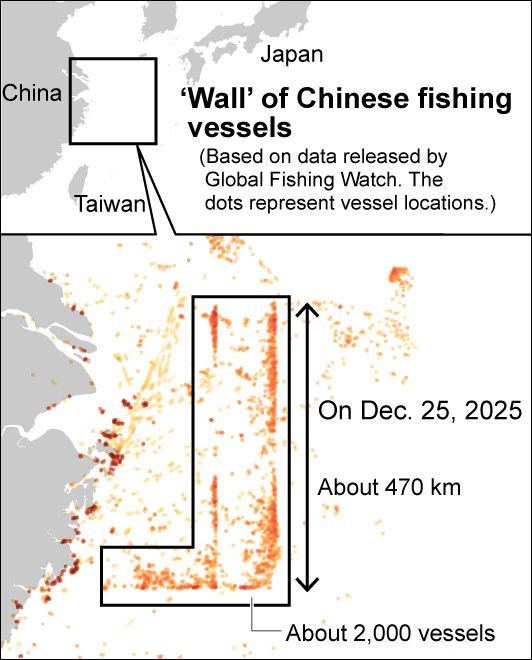
Hundreds and even thousands of Chinese fishing vessels have repeatedly formed lengthy “walls” in the East China Sea that are apparently “maritime militia” training maneuvers aimed at augmenting actual military action.
Such “walls” are designed to obstruct shipping routes, assert China’s territorial claims and intimidate vessels from other countries, experts said.
Because the militia measures using fishing boats are not technically a show of military force, the moves are categorized as “gray-zone operations” that may not be covered under international law.
The “walls” were formed on at least four occasions since October 2024, sources said.
Two took place before and after Chinese military exercises around Taiwan. The experts say Japan is likely also a potential target of the militia maneuvers.
The Asahi Shimbun confirmed the Chinese vessels’ movements through data from Global Fishing Watch (GFW), a nonprofit organization that identifies maritime positions through signals from the Automatic Identification System (AIS), as well as satellite images.
The first “wall” of Chinese vessels was observed around Oct. 19, 2024, off the eastern coast of China’s Zhejiang province.
The line of vessels extended along 123.5 degrees east longitude for more than 100 kilometers southward from a point at 30 degrees north latitude.
According to GFW, about 770 Chinese vessels were involved, and most remained in the same location for roughly 24 hours.
The “wall” was created after Chinese military exercises simulated the encirclement of Taiwan, which began five days earlier on Oct. 14.
The largest number of vessels used in a “wall” was observed around Dec. 25, 2025. About 2,000 vessels created a wall consisting of two reversed L-shaped formations spanning about 470 km from north to south.
This formation occurred just days before Chinese military exercises started on Dec. 29, during which Taiwan was again encircled.
Around Jan. 11 this year, about 1,400 fishing vessels formed a wall extending roughly 220 km north to south.
And the fourth wall, seen around March 2, was created about 100 km farther north in waters closer to Japan’s Kyushu region.
Professor Chisako Masuo of Kyushu University, an expert on China’s maritime affairs, said the formations involved the maritime militia, a quasi-military organization supporting the Chinese armed forces.
“China’s maritime militia is training to line up at sea,” she said. “In disputes with Japan, such as over the Senkaku Islands, or in a possible contingency involving Taiwan, China will likely deploy the maritime militia at first.”
She noted that such gray-zone operations using mobilized fishing vessels fall into a legally ambiguous category under international law, and Japan and Taiwan may be slow to initially respond to such action.
China’s maritime militia existed before the founding of the People’s Republic of China in 1949, according to reports.
Under the system, fishermen and others receive instructions from Chinese military authorities to undertake missions related to national defense and the protection of maritime interests.
Some estimates suggest there are around 200,000 members of the maritime militia.
‘I AM A MILITIAMAN’
Asahi Shimbun reporters traced the routes of fishing vessels that formed the “wall” on Jan. 11. Many of the vessels had returned to a fishing port in Zhoushan, Zhejiang province.
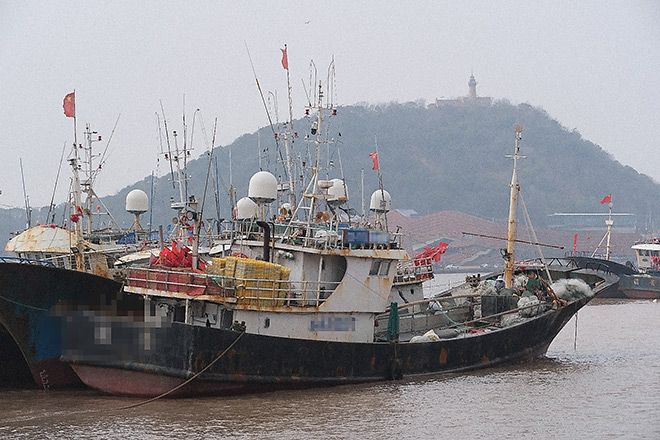
In early February, ahead of the Lunar New Year, the port was filled with fishing boats docked after their trips.
Based on identification numbers painted on the boats, GFW data confirmed that several of the docked vessels were in waters where the “wall” was formed.
When asked about the militia activity, a fisherman sorting nets on deck said his vessel did not take part.
“Only the lead vessels in each fleet participate,” he said.
According to GFW data, his vessels and several other boats departed on the morning of Jan. 11. One boat broke away around 8 p.m. and joined the “wall” for about eight hours.
It rejoined the group after the formation dissolved. The other vessels had continued fishing slightly south of the “wall.”
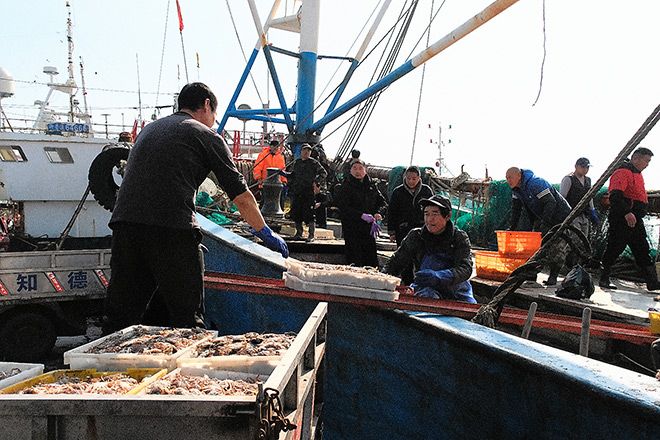
A typical fishing group in the East China Sea consists of seven to 10 vessels, with each carrying eight to nine crew members, multiple fishermen said.
The captain, usually from Zhejiang province, owns the vessel, while other crew members are migrant workers from inland provinces like Anhui and Guizhou.
“I am a militiaman,” one captain, who leads a fleet, said.
He allowed Asahi Shimbun reporters aboard his boat, which featured a panel displaying the Chinese Communist Party’s membership oath on a wall.
He said he was the only militiaman among the crew.
“In the event of war, the migrant workers will return to their hometowns, but I must sail if ordered by the military,” he said.
He said he participates in several days of “military training” as instructed each year, typically around August.
Participants receive daily compensation of 200 to 300 yuan (about $29 to $44) as well as fuel costs, he said.
Although GFW data showed his vessel was near the “wall” on Jan. 11, he said it did not join it.
“There was no notification from the military for this voyage. The vessels involved in this training must belong to a different group,” he said.
PRETEXT FOR FORCE
Masahiro Yumino, a former Foreign Ministry analyst specializing in Chinese militias, says China maintains a “national defense mobilization” system that broadly incorporates citizens and resources.
Yumino said local People’s Armed Forces Departments oversee the maritime militia.
The Chinese government reported 8 million militia personnel nationwide in 2011. They have been deployed for public security in urban and rural areas, as well as disaster relief.
Yumino estimates the maritime militia component alone holds 200,000 to 300,000 members.
Their missions include deployment to disputed areas while posing as ordinary fishing vessels, coordination with Chinese coast guard ships, and obstruction or intimidation of foreign vessels.
It is believed that maritime militia members are sometimes ordered to collide with other ships.
Jason Wang, chief operating officer of the U.S.-based geospatial intelligence firm ingeniSPACE, which identified the post-December 2025 “wall” activities, said the maritime militia conducts intelligence gathering and patrols, serving as the “eyes and ears” of the Chinese military.
The “walls” of thousands of fishing vessels could block commercial shipping and effectively close sea lanes, he said.
“Activities of the Chinese maritime militia target not just Taiwan but also commercial shipping to Japan and South Korea,” Wang said.
These forces are trained for maritime interdiction and armed conflict scenarios, and could disrupt routes used by oil, LNG tankers and container ships.
Masuo of Kyushu University also said Japan is likely a primary target of these “wall” formations, as most of the vessels involved have departed from Zhejiang province, which is closer to Japan than Fujian province across from Taiwan.
If tensions escalate over the Senkaku Islands in Okinawa Prefecture, the maritime militia could surge into Japanese territorial waters or even land on the islands, creating a pretext for Chinese military intervention, Masuo said.
(This article was compiled from reports by Ryo Inoue and Atsushi Okudera, senior staff writer, in Tokyo and Nen Satomi in Zhejiang province.)

- Previous Iran talks with Oman over ‘permanent toll’ system for Hormuz
- Next 1st electric 3-row Lexus SUV for release in winter – TOYOTA
You may also like...




Random news








About us
Our Newly established Center for study of Asian Affairs has
branches in Indonesia, Malaysia and Singapore, as well as freelances in some other countries.
For inquires, please contact: newsofasia.info@yahoo.com Mr.Mohd Zarif - Secretary of the Center and administer of the web-site www.newsofasia.net
Polls
 Loading ...