

Takaichi is unique in a ‘charm offensive’ on foreign leaders: many left cringing
By NARUMI OTA/ Staff Writer
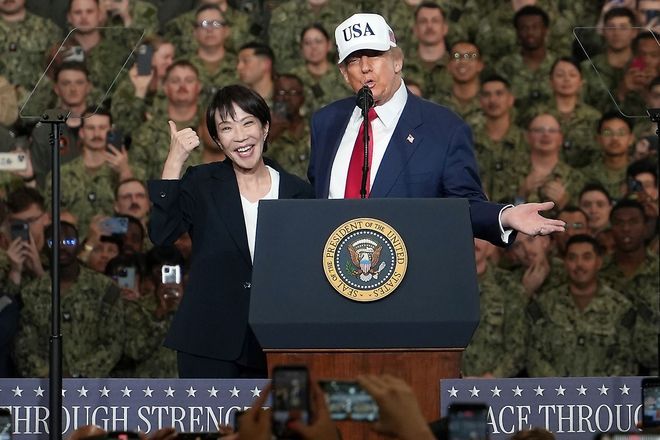 Prime Minister Sanae Takaichi and U.S. President Donald Trump aboard the USS George Washington at the Yokosuka Naval Base on the outskirts of Tokyo in October (Asahi Shimbun file photo)
When Prime Minister Sanae Takaichi met South Korean President Lee Jae-myung last month in his hometown, the Japanese leader was all smiles.
“You look great in those glasses!” she exclaimed twice when he donned a new pair of glasses that she gave him, in Andong.
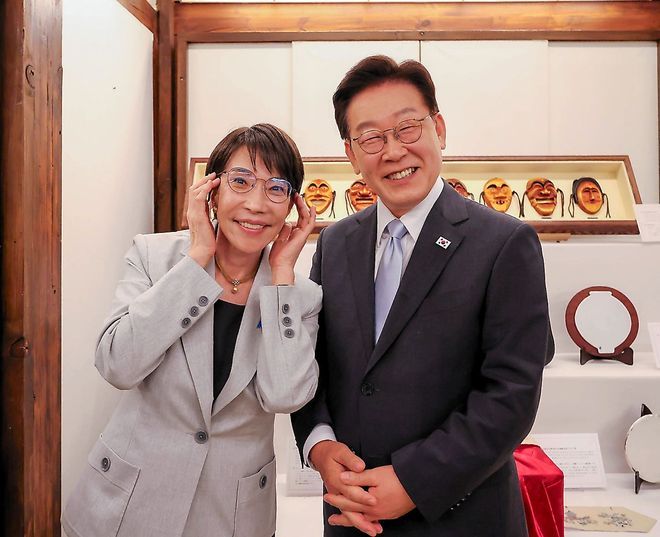
Takaichi then asked photographers, “Take our picture,” and snatched Lee’s glasses to wear for a photo of the two beaming bespectacled leaders.
At a joint news conference, the prime minister, grinning ear to ear, said, “Maybe a hot spring resort or somewhere else,” on the venue for their next summit in Japan, while bringing both her clenched hands close to her face in seeming exuberance.
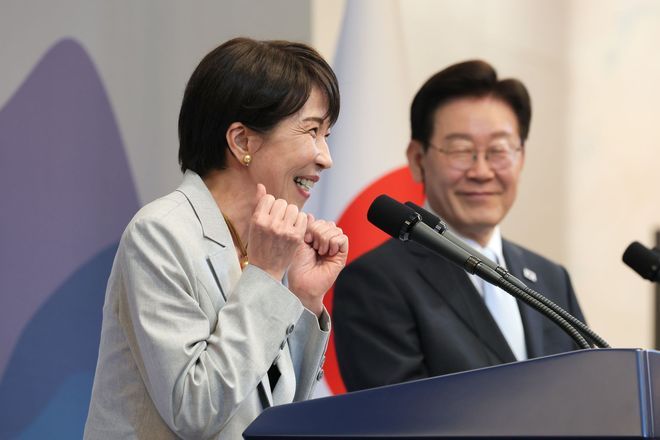
As was exemplified in her summit with Lee and other leaders, Takaichi’s diplomatic style is to thrust her approachability to the forefront with frequent friendly gestures to try to forge close ties with her counterparts.
But Japan’s first female prime minister has been accused of “excessive flattery” to many among her domestic audience who expect their leader, representing their country, to act more dignified.
Some rebuke her for what appears to be playing the “woman card” to curry favor with powerful politicians, a tactic that they suspect she honed in Japan’s predominantly male political world.
ON A FIRST-NAME BASIS
Takaichi, 65, has now met in person with all leaders of the Group of Seven nations during their visits to Japan and her overseas tours since taking office in October.
One of her diplomatic niceties is to address them by their first names.
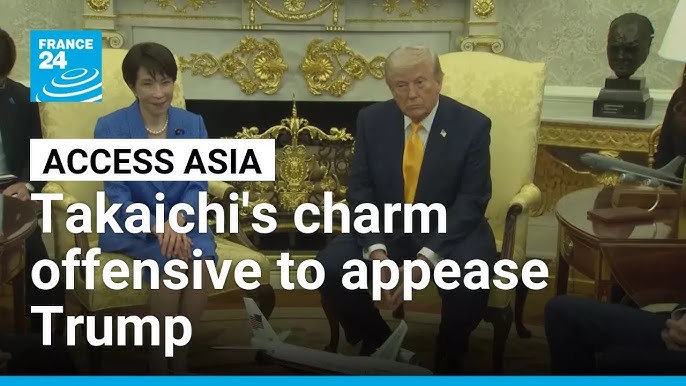
At the high-stakes summit with U.S. President Donald Trump at the White House in March, Takaichi addressed Trump as “Donald” repeatedly.
She also did the same with French President Emmanuel Macron, Italian Prime Minister Giorgia Meloni and British Prime Minister Keir Starmer.
Incidentally, Shigeru Ishiba, Takaichi’s immediate predecessor, addressed the U.S. leader as “President Trump” at a bilateral summit.
Wataru Yamaguchi, associate professor of history of Japan-U.S. relations at Kansai University and author of “U.S.-Japan Summits,” said that addressing her counterparts by their first names is rather “an act designed to impress the Japanese public.”
“Such a casual approach itself would not have the effect of bringing them closer in real terms,” he said.
It is uncommon for top leaders to hold talks on a first-name basis at a formal setting in Japan.
But Yamaguchi acknowledged that it has been “one of the points that the Japanese press takes note of in their coverage of summit talks,” particularly with presidents of the United States, Japan’s chief ally.
The practice dates to when Yasuhiro Nakasone was in power from 1982 to 1987. His relationship with U.S. President Ronald Reagan was dubbed “Ron, Yasu” after Reagan reportedly asked Nakasone to, “Call me Ron,” at their meeting.
The gesture is said to have been scripted by government officials of both sides in advance. Reagan similarly addressed British Prime Minister Margaret Thatcher and other heads of major countries.
Since then, many Japanese prime ministers have been eager to show their close connections with U.S. presidents by calling each other by their first names.
Takaichi, noted Yamaguchi, is more motivated to do so than others, given that she has touted herself as the successor of the policy line set by her mentor, the late Prime Minister Shinzo Abe.
Abe’s close bond with Trump was often described as “Donald, Shinzo.”
DANGER OF GOING OFF SCRIPT
Many details of such crucial meetings as bilateral summits are usually closely coordinated by officials of the respective governments.
But the proceedings can veer off script, particularly with the mercurial Trump, who is known to be unpredictable.
“Trump tends to ignore the carefully choreographed script for the meetings to strike a deal,” Yamaguchi said.
The shouting match between Trump and Ukrainian President Volodymyr Zelenskyy that erupted during talks at the White House last year is a good example.
The Japanese prime minister’s meeting with the U.S. president in March came as Trump was growing irritated with allies as they refused to offer military support amid the U.S. and Israeli attacks on Iran.
Prior to the talks, Japanese officials were concerned that a frustrated U.S. president might demand the deployment of Japan’s Self-Defense Forces to the Strait of Hormuz when the two leaders met.
The deployment was considered in conflict with the Japanese Constitution and polls had shown that Japanese voters were decidedly opposed to the Iran War.
As soon as Takaichi emerged from her car at the doorstep of the White House, she dashed to Trump to hug him, rather than to shake hands, as he waited outside.
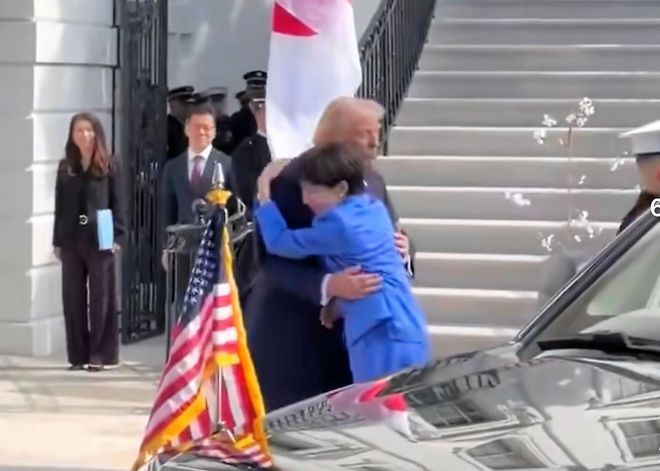
In the talks, she stroked his ego, saying, “I firmly believe it is only you, Donald, who can achieve peace and prosperity across the world.”
“The prime minister must have thought that the hug and flattery would be a plus to bring the meeting to a successful conclusion though she anticipated the media reports at home and abroad would cast her action in an unflattering light,” Yamaguchi said.
But Takaichi managed to avoid the “worst case scenario” by dodging any troop request from the U.S. president.
Yamaguchi positively assessed Takaichi’s handling of the summit.
“By showing her trust in Trump, in the middle of the conflict, and underscoring the amicable bilateral ties to the global audience, she emerged largely unscathed from the high-risk, low-return talks,” he said.
DIPLOMATIC STYLE CAUSES UNEASINESS
Prior to the Japan-U.S. summit, some government officials said they felt fortunate to have a woman at the top. The reason is that Trump is said to be kinder to women.
Takaichi, as Japan’s first female prime minister, cannot avoid the spotlight when she stands with global leaders. At these high-profile gatherings, she uses praise and frequent gestures to win over her counterparts.
When she accompanied Trump on his visit to the aircraft carrier USS George Washington at Yokosuka Naval Base south of Tokyo in October, Takaichi, grinning broadly, raised her fist and pranced around him during his speech.
The pair’s time was marked by constant physical contact, including a hug and walking hand in hand, though it is not part of Japanese culture.
But her style of diplomacy has caused unease among some people for what they viewed as being uncharacteristic of a national leader.
Ki-young Shin, professor of politics and gender with Ochanomizu University, said Takaichi’s approach is associated with the fact that she is from the Liberal Democratic Party.
The LDP, a party that has almost uninterruptedly dominated postwar Japanese politics, remains overwhelmingly male-dominated.
In the Lower House elections in February, the ratio of female LDP lawmakers who won seats stood at 12.3 percent, one of the lowest figures among major parties.
Takaichi, a hard-line conservative, joined the LDP in 1996, three years after she was first elected to the Lower House as an independent.
It wasn’t until 2008, when Yuriko Koike, now Tokyo governor, became the first woman to run in the LDP presidential race.
“Takaichi acted in that manner in diplomatic settings as natural expression of her survival tactics she has internalized over the years in the conservative party controlled by men,” Shin said.
Shin said a political leader is a symbolic figure of the country and her remarks and deeds inevitably mirror the gender dynamics of Japanese society.
Some middle-aged or older Japanese women who have endured being in male-centric organizations were made “uncomfortable” by how Takaichi acted, she added.
“There are women who have been conflicted because they have seen other women leverage their femininity to survive in organizations,” she said.
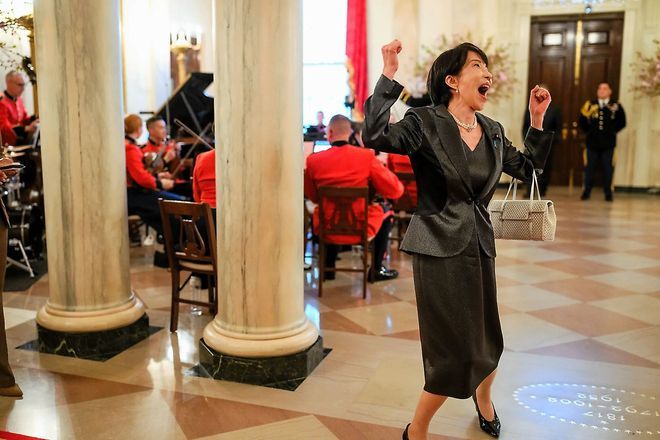
Shin also said Takaichi’s actions at the White House shed light on the disturbing aspect of the bilateral relations: the unequal partnership between Tokyo and Washington became even more apparent.
“The problem with Japanese politics is that the number of women legislators is small in the first place and that political parties lack systemic programs to nurture them for leadership roles,” she said.
In the February Lower House elections, 68 women were elected, only 14.6 percent of the total.
Shin noted that “female politicians in other countries usually rise to the top after assuming pivotal Cabinet posts and accumulating experiences in foreign affairs.”
Takaichi had held important Cabinet and party posts before becoming prime minister, but she had little experience in diplomacy.

- Previous Mongolia and China to cooperate in mineral resources
- Next The Main Malaysian Airport, KLIA, in 2026 nets nets 653kg of cannabis buds
You may also like...





Random news








About us
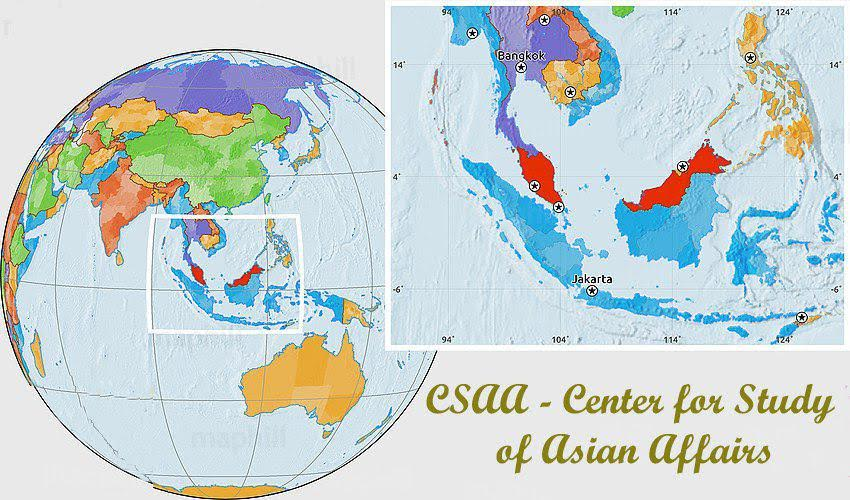
Our Newly established Center for study of Asian Affairs has
branches in Indonesia, Malaysia and Singapore, as well as freelances in some other countries.
For inquires, please contact: newsofasia.info@yahoo.com Mr.Mohd Zarif - Secretary of the Center and administer of the web-site www.newsofasia.net
Polls
 Loading ...