

Central Asia: How Iran War Will Impact Transit Routes Through Afghanistan and Pakistan?

@TCA
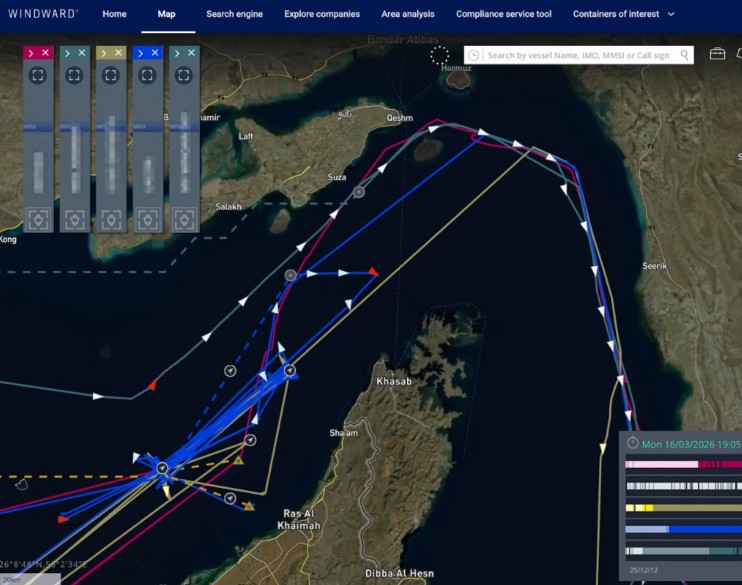
The Strait of Hormuz has long been regarded as a central artery of global energy trade. A substantial share of oil and gas exports moves through this corridor, and regional crises are often framed in terms of energy security. For Central Asia, however, current tensions carry broader implications. They may increase demand for alternative food supply chains and transit routes linking the region to the Arabian Sea and Gulf markets.
Recent tensions involving Iran also point to the strait’s growing role in food logistics. For Gulf states, Hormuz remains an energy chokepoint and a vital route for essential goods. For Central Asian policymakers, this shift matters. Any prolonged disruption could raise the region’s importance as both a supplier of agricultural commodities and a transit hub.
Member states of the Gulf Cooperation Council (GCC) are among the world’s most import-dependent food markets. According to Reuters, between 80% and 90% of food consumed in GCC countries is imported. This reliance creates external demand that could increasingly draw Central Asia into Gulf food security planning.
At the same time, the geography of these supplies remains relatively concentrated. Analysts estimate that more than 70% of the region’s food imports transit the Strait of Hormuz. This pattern could heighten interest in Central Asia as a source of food exports and a transit route.
Amid ongoing regional tensions, this dependence has attracted growing attention from experts. Reuters described recent developments as “the greatest test of the Gulf countries’ food strategy since the 2008 global food crisis.”
In recent years, regional governments have sought to diversify suppliers and build strategic reserves. Analysts nevertheless warn that stockpiles and diversification measures may provide only limited protection. If disruptions persist, logistical constraints could drive up prices and extend delivery times. This would create both a market shock and new commercial opportunities in Central Asia.
Under such conditions, GCC food security depends on access to global markets as well as the resilience of transport routes. This is where Gulf vulnerabilities begin to intersect more directly with Central Asia’s economic geography.
The infrastructure of major regional ports plays a central role in this system. One of the key logistics hubs is Jebel Ali Port in Dubai, the largest container port in the Middle East and a major re-export center. A substantial share of food shipments destined for GCC states and neighboring markets passes through this facility.
Estimates suggest that disruptions at major logistics hubs such as Jebel Ali could affect supply chains on which tens of millions of people depend. This concentration of logistics flows increases the region’s strategic exposure to maritime instability. For Central Asian economies, this raises the strategic value of diversified overland and multimodal routes.
Food security concerns are also linked to agricultural inputs. Industry analyses suggest that roughly 25–30% of global nitrogen fertilizer exports transit the Strait of Hormuz, including about 31% of global urea trade.
During the initial weeks of heightened tensions, urea prices in Middle Eastern markets reportedly rose by about $70–80 per ton, from roughly $470 to $550–590 per ton, an increase of 17–20%.
These shifts have broader implications. Disruptions in fertilizer supplies affect both the cost of imported food and the future cost of agricultural production worldwide. The crisis therefore impacts food systems through two channels at once: logistical constraints and rising input costs. Central Asia is exposed on both sides of this equation.

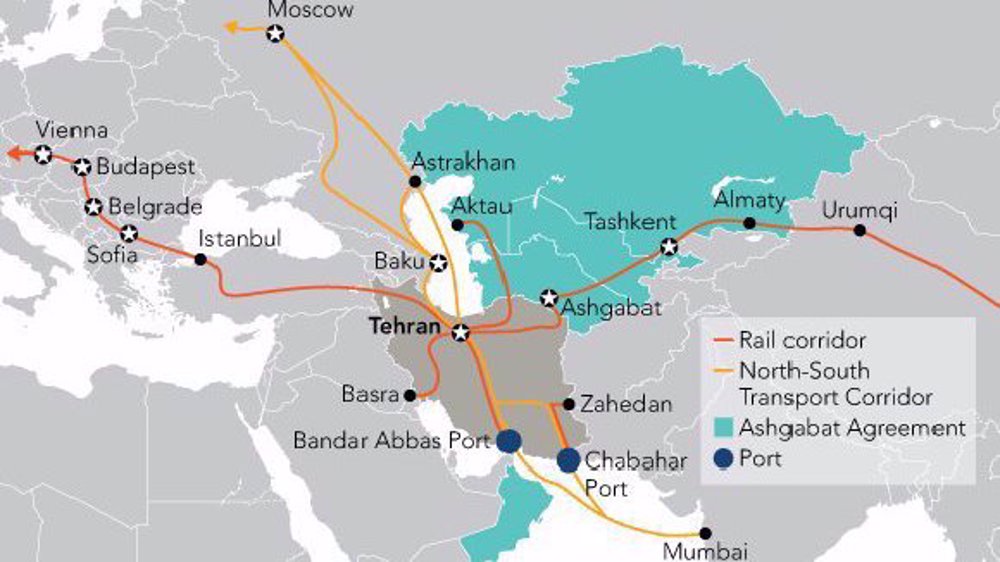
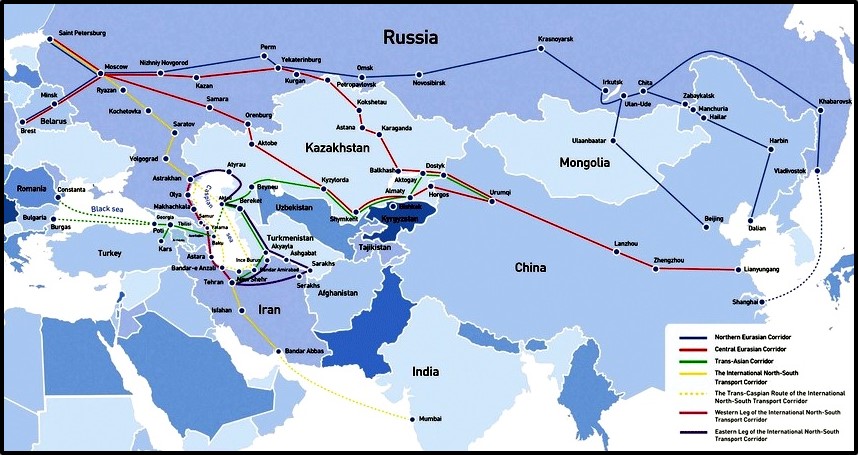
Against this backdrop, discussion has intensified around alternative transport routes that could reduce dependence on Hormuz. In this context, Central Asia’s relevance reflects its location as well as its agricultural output, existing transport infrastructure, and growing focus on export diversification.
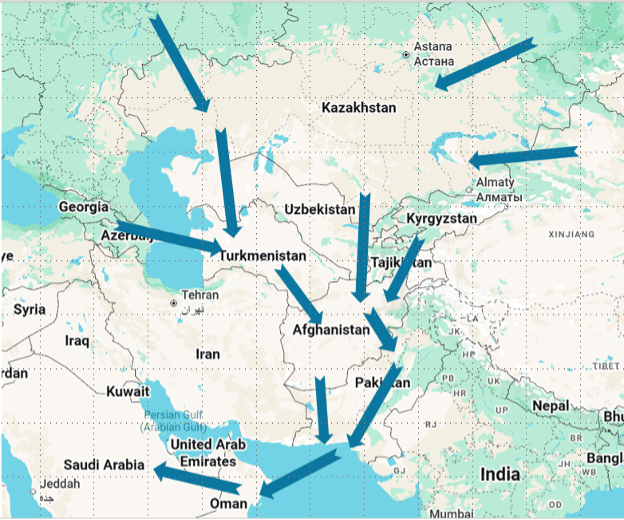
One proposed configuration involves a multimodal corridor linking Central Asia, Afghanistan, and Pakistan to ports on the Arabian Sea, with onward connections to Oman and GCC markets. In this setup, Central Asia serves as the northern anchor of an alternative supply corridor rather than a peripheral segment of a broader Eurasian route.
Within this structure, the region could supply key agricultural exports, particularly grain, while also serving as a transit link between northern Eurasian markets and the Indian Ocean. For Kazakhstan, and for Uzbekistan’s broader logistics ambitions, this could expand southbound export options and strengthen the region’s bargaining position in Eurasian trade.
This potential rests on tangible, though uneven, regional capacities. Kazakhstan already has significant agricultural export potential, especially in grain and flour, while Uzbekistan has increasingly positioned itself as a logistics and manufacturing hub with an interest in expanding southbound connectivity. Across the region, existing rail networks, dry ports, storage facilities, and trade corridors provide a foundation for deeper integration, even if they were not originally designed for a Gulf-oriented food route.
In that sense, Central Asia’s role would not start from zero. The region already possesses part of the infrastructure needed to support such a corridor, though substantial improvements in coordination, border management, and transport reliability would still be required.
Elements of such a system already exist, including transport links between Central Asia, Afghanistan, and Pakistan, the Pakistani ports of Karachi and Gwadar, and Oman’s logistics infrastructure. The concept therefore centers on expanding and institutionalizing existing connections rather than creating an entirely new route. For Central Asian states, this distinction matters. The challenge is not to create a new route, but to make the southern vector commercially viable.
Oman could play a particularly important role. Its deep-water ports at Sohar, Duqm and Salalah provide direct access to the Indian Ocean and are integrated into global shipping networks. They also create additional logistics options that help diversify supply routes alongside existing Persian Gulf infrastructure. For Central Asian exporters, these ports could provide additional maritime access to Gulf and global markets.

The principal obstacle to this scenario remains persistent tension between Afghanistan and Pakistan. In recent years, their border has seen periodic clashes, mutual accusations, and temporary closures of trade crossings.
For transit projects, such instability poses a significant risk. As long as relations between Kabul and Islamabad remain strained, establishing reliable trade flows will be difficult. From a Central Asian standpoint, any opportunity tied to southbound connectivity remains inseparable from security risk.
At the same time, economic incentives could influence political behavior. If transit becomes a meaningful source of revenue, all parties may have a stronger interest in maintaining a minimum level of stability.
This does not imply a comprehensive political settlement. Rather, it reflects a pragmatic approach in which economic interests may help limit escalation and sustain functional cooperation. Even a limited degree of predictability could prove significant if it allows cargo flows to continue.
For Central Asian states, the implications would be practical: expanded export outlets, increased infrastructure investment, and reduced reliance on existing transport corridors. For GCC states, the priority would remain securing stable food supplies and managing price risks. Infrastructure investment, transit agreements, insurance mechanisms, and financial guarantees could all form part of such a strategy.
Diplomatic dynamics also merit attention. Under current conditions, China may be better positioned than GCC countries to play a mediating role between Afghanistan and Pakistan, given its economic influence and regional engagement.
In this scenario, GCC states could act as financial and commercial stakeholders in a transit corridor, while China assumes a more active political role. This would present both opportunity and risk for Central Asia. Gulf capital could support corridor development, while Chinese involvement might help manage instability but also deepen external dependence.
The development of such a corridor would likely unfold in stages, each involving a different balance between commercial gain and political exposure for Central Asian states.
In the short term, initial measures could include guaranteed transit windows for cargo, expanded transport insurance, expedited customs procedures, and priority clearance for food shipments originating in or passing through the region.
Over the medium term, a more stable transit regime could emerge, with regular freight services, expanded dry port infrastructure, and the development of specialized cold chain logistics across key Central Asian nodes as well as along the Afghan–Pakistani segment, building on existing but fragmented capacities.
In the longer term, broader cooperation could take shape through an international infrastructure consortium involving GCC states, Central Asian countries, Afghanistan, Pakistan, and international financial institutions. Such a framework could support investment in transport corridors, logistics hubs, and storage facilities, while consolidating the region’s role in broader supply chains.
If realized, this process could gradually transform parts of the trans-Afghan corridor from zones of instability into components of Eurasian trade networks. This would give Central Asia a more direct and diversified connection to Arabian Sea trade.
Ultimately, the key question is whether economic incentives can outweigh political tensions. For Central Asian states, the issue is whether this corridor can become a credible channel for exports, diversification, and regional leverage rather than another unrealized connectivity project. For GCC states, the priority remains supply stability and price pressures, while Afghanistan and Pakistan would weigh transit revenues against the economic costs of recurring border disruptions.
Logistics systems evolve slowly, but once established, transport routes and infrastructure can shape regional economic relationships for decades, often outlasting acute political crises. This is why even limited progress along the southern vector could carry implications that extend well beyond the immediate Hormuz crisis.


- Previous Cut off form Russian and Middle East oil, now Japan to invest to increase Alaskan crude production
- Next After loss in Napolenic wars, WW1 and WW2, Vietnam and Algeria, West Africa – France chickens-out out Hormuz military role
You may also like...




Random news




About us
Our Newly established Center for study of Asian Affairs has
branches in Indonesia, Malaysia and Singapore, as well as freelances in some other countries.
For inquires, please contact: newsofasia.info@yahoo.com Mr.Mohd Zarif - Secretary of the Center and administer of the web-site www.newsofasia.net
Polls
 Loading ...