

The Amu Darya Stress Is a Test for Uzbekistan and Turkmenistan Agriculture
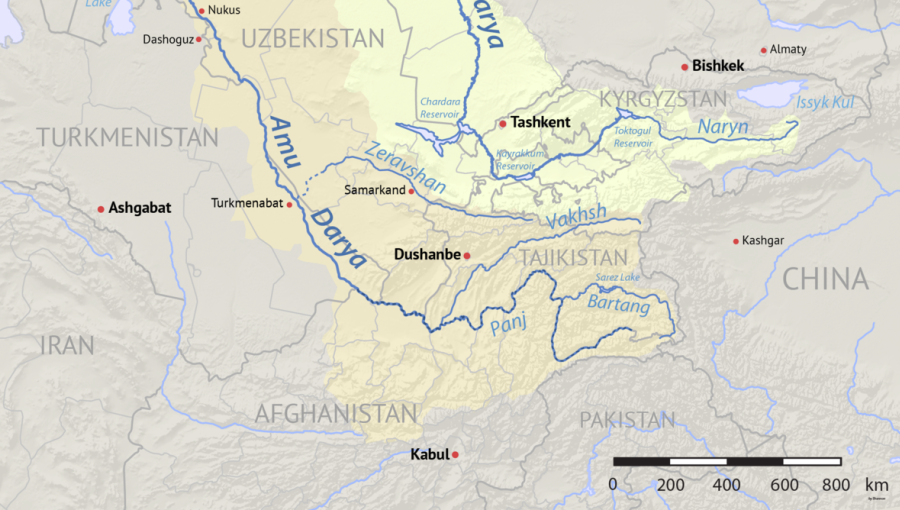
Central Asia’s water crisis is usually discussed as a problem of rivers, reservoirs, and diplomacy. But in 2026, the Amu Darya is also becoming something else: a test of state adaptation.
The river basin entered the irrigation season under acute pressure. According to data cited by Kabar, the flow of the Amu Darya stood at only 66.8% of its normal level as of February 11, compared with 101.8% a year earlier. The Times of Central Asia previously reported that the river’s flow could fall to around 65% of its historical norm, raising risks for food security and agriculture across downstream states.
Meanwhile, Afghanistan’s Qosh-Tepa Canal is advancing. The canal, one of the Taliban government’s most ambitious infrastructure projects, is designed to divert water from the Amu Darya to irrigate large areas of northern Afghanistan. Carnegie Politika has estimated that, once fully operational by 2028, it could take up to 10 cubic kilometers of water annually from the river.
For Uzbekistan and Turkmenistan, the implications are direct. Both rely heavily on Amu Darya water. Both inherited agricultural systems shaped by Soviet-era irrigation, cotton production, and centralized planning, and both are now facing a combination of climate stress, upstream extraction, and aging water infrastructure.
Yet their responses are increasingly different.
The emerging contrast is not simply between two agricultural policies; it is between two institutional logics: adaptation and control.
Uzbekistan’s Adjustment Strategy
Uzbekistan is one of the most exposed countries in the region. Its population is large, its agriculture remains water-intensive, and some of its most vulnerable regions, including Khorezm and Karakalpakstan, sit near the lower reaches of the Amu Darya.
For decades, the old model relied on large-scale irrigation, cotton, rice, and the assumption that water would continue to move through the regional system much as it had before. That assumption is now weakening.
Tashkent’s response remains costly and far from complete. Uzbekistan still faces serious water losses, degraded land, salinization, and uneven implementation of reform. But the direction of travel is visible: the state is trying to reduce exposure by changing crops, infrastructure, and diplomatic behavior.
Rice is one example. Traditional flooded rice cultivation is extremely water-intensive, and water shortages have already pushed some Uzbek rice farmers away from traditional Amu Darya regions toward areas with more stable access to water.
Uzbekistan has also begun experimenting with less water-intensive methods. In Karakalpakstan, UNDP has supported the introduction of upland rice, which can reduce water consumption by up to 40% compared with traditional rice cultivation. Separately, Uzbekistan has announced plans to expand resource-efficient rice cultivation, including drip irrigation and drought-resilient rice varieties.
The state is no longer treating the old water-intensive model as untouchable. In 2026, Uzbekistan allocated significant public financing for water-saving technologies. Government-linked reporting has described plans to expand drip irrigation, sprinkler systems, and laser land leveling across hundreds of thousands of hectares, with a broader target of expanding water-saving technologies to 3.5 million hectares by 2028.
Laser leveling may sound technical, but its use reflects a shift from simply demanding more water to trying to extract more value from each unit of water already available.
Uzbekistan is also trying to broaden its agricultural export base, including through legumes such as mung beans, though this remains a partial adjustment rather than a replacement for cotton or rice.
The most important adjustment, however, may be diplomatic.
On Qosh-Tepa, Tashkent has chosen a pragmatic line. Instead of treating Afghanistan’s canal as a hostile act, Uzbekistan has pursued dialogue with Kabul. Rivers without Boundaries reported in March 2026 that Tashkent had offered technical assistance in the design and concreting of the canal bed. The Times of Central Asia previously reported that Uzbekistan has offered several times to help with the canal’s construction amid concerns about safety and workmanship.
The logic is practical: if Afghanistan is going to take water from the Amu Darya, downstream states have an interest in reducing losses from seepage and poor engineering.
This is a difficult position. Uzbekistan cannot stop Afghanistan from pursuing agricultural development, but it also cannot ignore the impact on its own farmers. The result is a strategy of technical diplomacy: reduce the damage, keep channels open, and avoid turning water into an immediate confrontation.
Turkmenistan’s Cotton-Command Problem
Turkmenistan faces many of the same structural pressures, but its response appears more rigid.
The country depends heavily on the Karakum Canal, one of the largest irrigation systems in the world. Built in the Soviet period to carry Amu Darya water across the desert, it remains central to Turkmen agriculture. But it is also associated with high water losses, salinization, and the persistence of water-intensive cotton production in an arid environment.
Unlike Uzbekistan, Turkmenistan has shown limited public signs of rethinking the cotton-command model.
Turkmenistan has announced water and agricultural measures, including instructions for the 2026 cotton crop, but these measures appear aimed more at preserving production targets than changing the crop model.
Cotton remains deeply embedded in the state system. Production targets and centralized procurement continue to shape the sector, but water stress makes this model more costly each year. When water is abundant, a rigid quota system can hide inefficiency. When water declines, the pressure moves downward, onto farmers and public-sector workers.
The Cotton Campaign reported in May 2026 that state-imposed forced labor remains widespread and systematic in Turkmenistan’s cotton sector. According to the coalition, the government reversed modest previous steps to reduce mobilization and again relied on public-sector employees, including teachers, students, doctors, and workers in state organizations, to pick cotton or pay for replacement laborers.
The pressure is now international as well as domestic. The Times of Central Asia previously reported that in June 2026, the International Labour Organization (ILO) again called on Turkmenistan to dismantle its state-imposed cotton quota system and submit a progress report by September 1.
This is not only a human rights issue. It is also a signal of institutional stress.
A system that adapts changes incentives, crops, and technologies. A system that cannot adapt often intensifies pressure on the population to preserve output targets. In Turkmenistan’s case, cotton has become more than a crop. it has become a measure of the state’s ability to enforce a plan even as environmental conditions continue to deteriorate.
Water scarcity also increases the discretionary power of local irrigation officials. When access to irrigation becomes uncertain, the ability to decide which field receives water and when becomes a form of leverage.
The contrast with Uzbekistan is not absolute. Uzbekistan is still facing its own uneven reforms and social costs. The difference is in the direction of adaptation. Tashkent is trying to modify the agricultural system, while Ashgabat appears more focused on preserving the existing one.
Qosh-Tepa as a Regime-Level Shock
The Qosh-Tepa Canal sharpens this divide. For Afghanistan, the project is a national development priority. It promises food production and state-building in the north. No regional policy can deny Afghanistan’s need for water.
For downstream Central Asia, however, Qosh-Tepa changes the old equation. Soviet-era water arrangements largely excluded Afghanistan; now Kabul is turning its geographic position into infrastructure. That creates a new reality for Uzbekistan and Turkmenistan: less water may arrive downstream, with the old allocation system no longer fitting the basin.
The states most exposed to this shift have two basic options.
They can adapt their agricultural systems to a lower-water future by investing in efficiency, changing crop structures, negotiating with Afghanistan, and reducing dependence on the most water-intensive production models. Or they can try to preserve the old model through administrative force and quotas.
Uzbekistan is moving toward the first path. Turkmenistan remains closer to the second.
Agriculture as a Test of State Capacity
The Amu Darya crisis shows that climate pressure does not affect all states in the same way. The same river shock can produce different political outcomes depending on institutional flexibility.
A flexible system does not avoid pain. Uzbekistan’s adaptation will create winners and losers. Rice farmers may move, crop patterns may shift, and the local authorities may struggle to implement national water-saving programs. Technical diplomacy with Afghanistan may produce only partial results.
But adaptation at least allows the state to recognize scarcity and change behavior, whereas a rigid system suppresses feedback. It treats lower water availability as a problem to be overcome by command. That can preserve the appearance of stability in the short term, but it tends to accumulate stress beneath the surface.
This is why the Amu Darya is no longer only a water-security issue. It is an agricultural and institutional stress test.
The question is not simply which country has more water; it is which system can change with the water regime.
In the coming years, the most important indicators may not be found in reservoir levels or diplomatic statements. They will also appear in rice fields, cotton quotas, irrigation schedules, crop substitutions, and the social pressure placed on rural communities.
Uzbekistan is trying to turn scarcity into a forced modernization of its farming system. Turkmenistan is trying to preserve an older command model under worsening environmental conditions.
The river is the same. The institutional responses are not.

- Previous Analysis: Turkey’s Energy Outlook 2026: Geopolitics, Domestic Hydrocarbons, And The Expansion Of The Power System
- Next India’s Quiet Return To Afghanistan As Pakistan-Taliban Ties Fray
You may also like...




Random news





About us
Our Newly established Center for study of Asian Affairs has
branches in Indonesia, Malaysia and Singapore, as well as freelances in some other countries.
For inquires, please contact: newsofasia.info@yahoo.com Mr.Mohd Zarif - Secretary of the Center and administer of the web-site www.newsofasia.net
Polls
 Loading ...